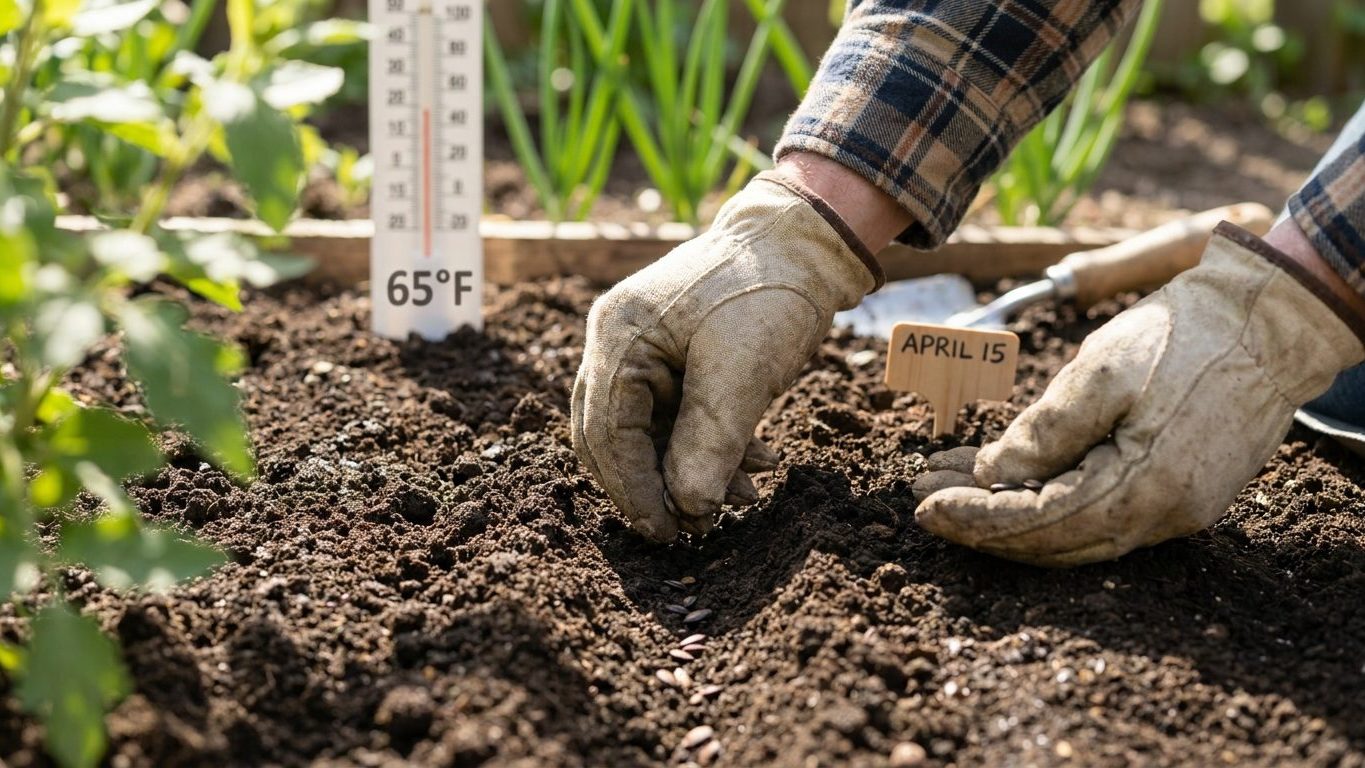

Sow melon seeds indoors around late April, four to five weeks before you plan to move them outside, and don’t transplant until after the average last frost date of May 18. Even then, treat that date as a coin flip, not a guarantee, because it’s a 30-year mean, and half of all years in Saskatoon see frost fall later than that.
The short answer for Saskatchewan
Environment and Climate Change Canada’s 1981-2010 normals for the Saskatoon SRC station put the average last spring frost at May 18 and the average first fall frost at September 18. Subtract one from the other and you get a mean frost-free window of about 123 days. That number looks workable for melons on paper. The catch is the word “mean.” An average frost date is the midpoint of a spread, not a safe line drawn in the calendar. In roughly one year out of two, frost arrives after May 18 in spring or before September 18 in fall, which means the real window some years is noticeably shorter than 123 days.
That’s why the practical answer for this province leans on transplants rather than direct seeding. Start seeds indoors in individual pots around the third or fourth week of April, so you’re moving four-to-six-week-old seedlings into the ground once the soil has warmed and the frost risk has genuinely passed, not just once the calendar says it should have. Direct-seeded melons in a short, cool-summer province like this one lose weeks of growing time waiting for cold soil to warm enough for germination, weeks a 123-day mean season can’t spare.
Why heat, not just frost, sets the real window
There’s a second number in the Saskatoon normals that matters as much as the frost dates: zero days a year average 90°F or higher. Melons are heat-loving fruit, and a season with essentially no hot days changes the math entirely. It’s not enough to count days between frosts. Those days also need to carry enough warmth to push a melon from flower to ripe fruit, and this province’s summers, most years, don’t generate much surplus heat above the minimum melons need to function. That’s the real constraint behind the date range above, and it’s the reason variety choice and season-extension tools matter more here than the raw frost-to-frost count suggests.
This page can give you the province-level starting point. It can’t tell you what’s happening in your own yard’s soil this particular spring, which is where the sections below come in.
What will not work here
Direct seeding melon seed straight into garden soil on May 18, the moment the average last frost has theoretically passed, is one of the more common ways this crop fails in Saskatchewan gardens. Melon seed wants warm soil to germinate quickly and evenly; cold spring soil in this province, even after the air itself is frost-free, holds germination back for a week or two beyond when a transplant could already be putting on true leaves. Every one of those lost days comes straight out of a 123-day mean window that has no slack to give.
Long-season melon varieties, the kind bred for hot southern growing regions and rated at 90 to 100-plus days to maturity, are a second common failure point. With zero average days at or above 90°F, this province simply doesn’t deliver the heat load those varieties expect. A 95-day variety planted as a transplant in late May, chasing a September 18 mean fall frost, is racing a clock that a cooler, shorter-season variety would clear with room to spare. The fruit may set, but it often doesn’t finish ripening before frost cuts the season short, leaving gardeners with a vine full of green melons in mid-September.
The watering trap that looks backward here
Because zero days cross 90°F, this isn’t a province where melons bake and gardeners need to fight constant evaporation. Summer rainfall averages about 6.6 inches across June, July and August, with August, the month when fruit is often sizing up and ripening, the driest of the three at 1.68 inches. The failure here isn’t overwatering from a nervous gardener who thinks the heat demands it. It’s assuming rainfall alone covers the crop through that driest stretch, then watching fruit stall or split when a dry August coincides with the exact weeks melons need steady moisture to finish. Skipping supplemental watering in late summer, on the assumption that a cooler climate means a wetter one, is a mistake specific to this province’s rainfall pattern.
Skipping soil-warming steps altogether, no black plastic mulch, no row cover, no cold frame at transplant time, is the last common failure. In a province averaging no real hot days, those tools aren’t optional extras. They’re what makes up the heat deficit the open air isn’t going to provide on its own.
What changes across Saskatchewan
The hardiness zone figure available for this province, 3a, is measured at the Saskatoon reference station under Natural Resources Canada’s Plant Hardiness Site, using the Canadian system’s seven climate variables rather than the single-variable USDA scale used elsewhere on this site. That figure describes Saskatoon. It doesn’t describe the whole province, and Saskatchewan is not one climate stretched over a map. A province this size, spanning open prairie in the south to boreal forest in the north, holds real differences in how early spring soil warms and how early fall frost arrives, even where the mean dates look similar on paper.
A gardener north of Saskatoon, or at higher elevation, should expect the practical frost-free window to run shorter than the 123-day mean calculated from the Saskatoon normals, not longer. That means shifting the whole melon calendar earlier indoors (starting seed sooner, hardening transplants off with extra care) and leaning harder on the fastest-maturing varieties available, rather than assuming the provincial mean applies evenly. A gardener further south, closer to the U.S. border, may see the window open slightly wider, but nothing in these figures pins down by how much, because the underlying data here comes from one reference station, not a province-wide network.
This is exactly the kind of gap a single province-level page can’t close responsibly. Rather than guess at a number for your specific location, use Natural Resources Canada’s Plant Hardiness Site (planthardiness.gc.ca) to look up the zone for your own municipality directly, the same way the Saskatoon figure above was sourced. That map exists precisely because one city’s normals can’t stand in for an entire province’s range of microclimates.
Where to check this for your own county
Everything above comes from one reference station and describes Saskatchewan in general terms. Real planting decisions belong at the local level, and Saskatchewan’s own agriculture ministry is the place to find that detail. The Saskatchewan government’s agribusiness, farmers and ranchers portal (saskatchewan.ca/business/agriculture-natural-resources-and-industry/agribusiness-farmers-and-ranchers) is the provincial starting point, and it’s worth checking directly rather than relying on this page’s province-wide averages.
Two things are worth looking for once there. First, any local or regional planting calendar that reflects frost data closer to your own municipality rather than the Saskatoon SRC station cited throughout this page, since a station reading even 50 or 100 miles away can shift both the mean last frost and the mean first fall frost by a week or more in either direction. Second, any variety trial results specific to melons grown in your district. Provincial and regional agriculture offices in short-season climates like this one often track which melon varieties have actually finished ripening locally before frost, information that matters far more than a seed packet’s generic days-to-maturity number, which is usually calculated for a warmer growing region.
A county or district-level recommendation will always beat a provincial average, for the simple reason that it’s built from conditions closer to your own soil and your own microclimate. This page works at the scale of the whole province because that’s what a province-wide reference station can responsibly support. It isn’t a substitute for the local data your provincial agriculture office can point you to, and it shouldn’t be treated as one.
Checking this against your own garden
Every date on this page describes an average measured at one weather station decades ago. Your own garden, this year, will tell you something more current, and three simple signs are worth watching before you trust any calendar over what’s actually happening in the soil.
Soil warmth by feel is the first and most direct check. Push a hand a few inches into the bed where melons are headed; if the soil still feels cool and slightly clammy rather than warm and dry to the touch, it’s telling you the ground hasn’t caught up to the air temperature yet, no matter what the calendar says about the last frost having passed. Melon roots stall in soil that still feels cold, even when the risk of frost itself is over.
The first flush of male flowers on a transplanted or direct-seeded vine is the second sign. Male flowers typically appear before female flowers, and their timing gives a rough read on how much heat the plant has actually banked so far this season, a more honest measure than counting days since transplant on a calendar.
The appearance of the first true leaves, the leaves that emerge after the initial seed leaves and actually resemble a mature melon leaf, marks the point where a young plant has moved from surviving on stored seed energy to actively growing on what your particular patch of soil and sun are providing it. Slow, delayed true leaves are the plant’s own report that your microclimate is running cooler than the provincial average, and that this year’s dates deserve adjusting from what any calendar suggests.