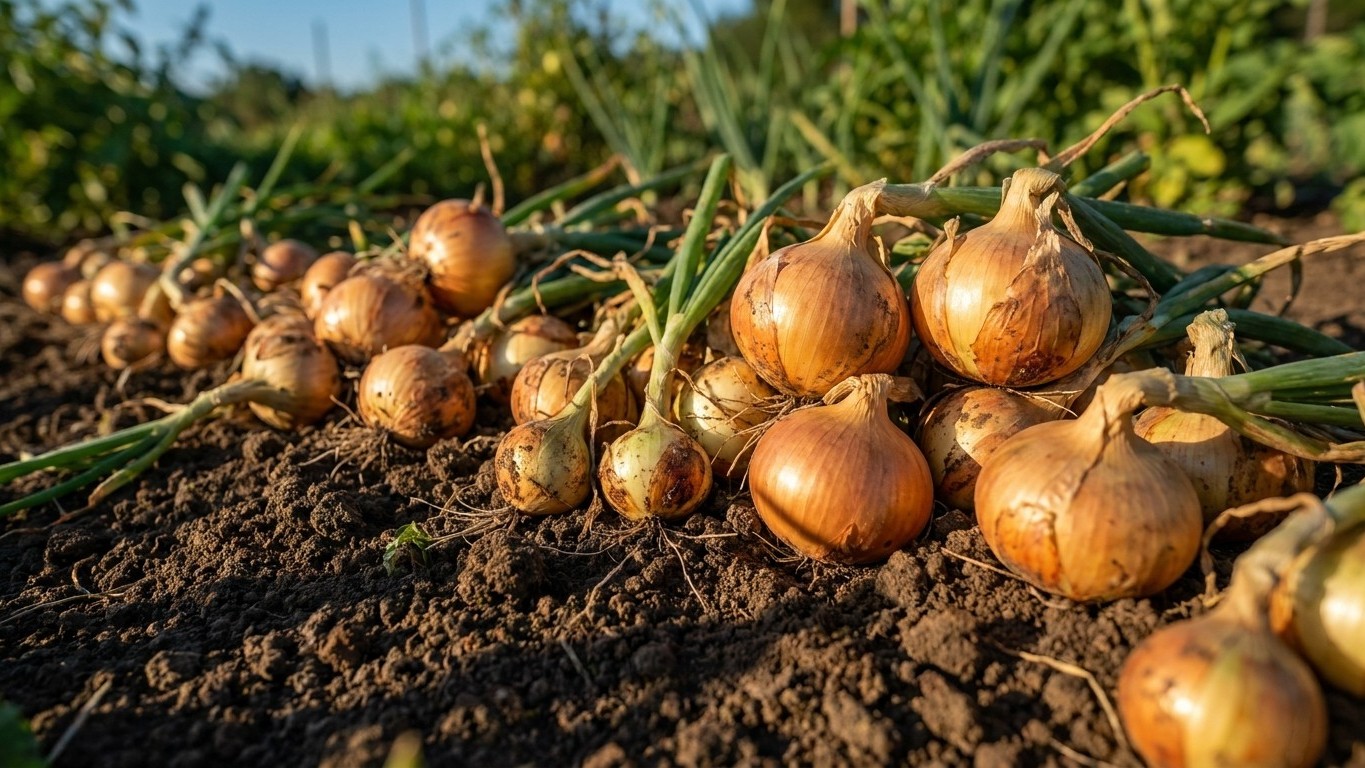

Two insects do most of the eating on onions here: thrips and grasshoppers. Thrips rasp the leaves and leave silvery scars. Grasshoppers chew them down. Both matter most while the tops are still growing, before the bulb starts to swell, and that is also when a gardener is least likely to be looking closely. Most of what else turns up in a Saskatchewan garden is a bystander.
Which pests attack onion in Saskatchewan
Montana State University Extension, Urban IPM and NDSU Extension, the services for the two states bordering Saskatchewan, document eleven pests for this territory: apple maggot, boxelder bug, brown marmorated stink bug, Colorado potato beetle, corn earworm, emerald ash borer, grasshoppers, miller moths, social wasps, thrips and yellowheaded spruce sawfly. Neither is a Saskatchewan service, so read the list as what the neighboring extension services document, not a survey of your own rows. It is also a short list for a whole prairie region, and I won’t pad it with species those services don’t name.
The two that eat onion
Of the eleven, thrips and grasshoppers are the ones that feed on onion foliage. Thrips are tiny and hide in the folds where leaves meet the neck. Grasshoppers are the opposite: big, obvious and indiscriminate, and they will chew almost any green tissue in reach.
The nine that belong elsewhere
The rest are on the list for good reasons, just not reasons that involve your onion bed.
- Apple maggot tunnels in apples and similar fruit, so it has no reason to visit an onion.
- Boxelder bug lives on boxelder and maple trees and mostly bothers people by crowding into houses.
- Emerald ash borer kills ash trees from the inside. Yellowheaded spruce sawfly strips spruce needles. Neither has any business at ground level in a vegetable bed.
- Colorado potato beetle feeds on potato and its relatives, which is a different plant family from onion.
- Corn earworm goes after corn ears and fruiting vegetables such as tomato.
- Brown marmorated stink bug feeds mainly on tree fruit and fruiting crops, not onion leaves or bulbs.
- Miller moths are adult moths that wander into houses and flutter around porch lights. The adults are not the ones eating your crop.
- Social wasps are a sting nuisance. If anything, they hunt other insects.
Seeing one of these on your onions doesn’t make it the culprit. It usually means the insect was passing through, and the real cause of the damage is somewhere else.
When each one shows up, and what it does first
The published facts for this page do not carry a frost-free window for Saskatchewan, so no calendar dates appear here. That suits the problem anyway, because planting dates shift from one garden to the next (the When to Plant Onions in Saskatchewan page covers that). What holds steady is the order of events: leaf growth first, bulbing after. Pests hit the crop in the same sequence, and the leaf stage is where they do their damage.
Day length sets the pace. At the Saskatoon reference station (52.17 degrees north), the longest day carries 16 h 31 of daylight. Short-day onions begin bulbing at about 12 hours, according to Clemson Cooperative Extension, so they bulb early and stay small this far north. Long-day varieties wait for 14 to 16 hours, which Saskatchewan reaches. The best onion varieties for Saskatchewan page goes deeper on that. The pest connection is that a long-day onion spends a long stretch building leaves, and every leaf lost during that stretch is less to feed the bulb later.
Thrips: silver first
Thrips can show up as soon as the transplants or sets have new leaves, and they keep feeding through the leaf-growing weeks. The first sign is not a bug. It is pale, silvery streaks or flecks along the leaves, often most obvious on the inner surfaces and near the base. Pull the leaves apart at the neck and you may see slender insects, small enough to mistake for dust. Heavy feeding leaves tips bleached and curled.
Grasshoppers: notches and stubs
Grasshoppers are a mid-to-late season problem, as they grow through the summer and their appetite grows with them. The first thing you see is ragged notching along leaf edges, then tops chewed down to stubs. Damage often starts at the garden’s edge next to grass or a ditch and works inward. Check the outer rows nearest uncut grass first, because that is where the chewing tends to begin.
The extension pages behind this list do not give emergence dates for Saskatchewan, and I won’t invent them. Treat the timing above as a sequence to watch for, not a schedule.
Telling the damage apart from everything else
Half the questions about onion pests turn out to be something else. Onion leaves are simple tubes, and they show stress in a few limited ways: yellowing, tip dieback, pale spots, flopping. Several causes produce the same look.
| What you see | Likely causes | What settles it |
|---|---|---|
| Silvery streaks or flecks on leaves | Thrips, or sun and wind scarring | Spread the inner leaves and look for tiny, slender insects at the base. Scarring from wind or hail has no insects and appears on the exposed side. |
| Ragged edges, chewed-down tops | Grasshoppers, or hail and wind tearing | Chewing leaves clean bite marks and frass. Tearing leaves frayed, split tissue, often after a storm. |
| Tips yellowing and browning | Dry soil, nutrient shortage, disease, or thrips | Dig down a few inches. Dry soil points to water. A uniform pale look across the bed points to feeding. Patchy spots or fuzzy growth point to disease. |
| Tops flopping over and yellowing late in the season | Normal maturing | Necks softening as the bulb finishes is expected, not a pest sign. |
| Tall, hard center stalk | Seed stalk formation | It comes from the plant’s own timing, not from insects. |
The single best habit is to find the insect before you blame it. Damage without a culprit is a weak diagnosis, and two problems often overlap (a thirsty onion attracts more trouble than a watered one). I can’t tell you what is in your own garden from a description. Take a photo of the leaf, plus a sample if you can, to the extension service in the last section and let them make the call.
What actually works here, and what is a waste of time
On a short northern season, timing beats treatment. An onion that loses leaves during its long leaf-building stretch can’t recover the lost growing time, and sprays applied after the scars appear do nothing for tissue that is already damaged. That flips the logic: act before damage, not after.
A physical barrier does the most for the least effort. Fine insect netting over the bed keeps grasshoppers off entirely, and a mesh fine enough can slow thrips too. Ask your extension office what mesh size suits the pest you’re dealing with. Put the barrier on at transplanting, not after the first damage, since netting placed on an infested bed just shuts the pests in. Keep the edges sealed, and lift a corner for weeding rather than leaving it open.
Other steps that help are smaller but real. Keep the bed’s borders mowed or cleared, since grasshoppers move in from tall grass. Water on schedule, because a stressed onion suffers more from every insect. Rotate the bed so onions don’t return to the same spot year after year. And check the leaf bases weekly during the leaf-growing weeks.
What doesn’t work is a long list. Spraying at the sight of a single insect wastes effort and product. Spraying after the damage is done saves nothing. Leaning on one home remedy, or relying only on companion planting, is a weak plan for a crop with such a short window. And treating boxelder bugs, wasps or moths as onion pests, because they happen to be nearby, sends effort in the wrong direction.
This site doesn’t name chemicals or doses. What is registered for use, and on which crop, is a question for your extension service, which knows current rules and labels.
Where to check this for your own county
The two services named in the facts are Montana State University Extension, Urban IPM and NDSU Extension. Their pest lists are documented for Montana and North Dakota, the states that border Saskatchewan. If you garden near the border, the county office of either service is a natural first call. Farther into the province, use those pages as a starting reference and take your questions to a local agricultural office in your own area.
Presence of a pest varies inside a territory. A list that holds for a whole state, or a whole region, says little about what is in one backyard. Grasshopper pressure can differ between neighboring townships, and a thrips problem might hit one garden hard and leave another alone. Latitude also changes things: the 52.17 degrees north figure belongs to Saskatoon, not to the whole province. A gardener in the far north or the far south of Saskatchewan should check their own latitude before applying day-length numbers, since the bulbing trigger shifts with it.
Bring a leaf sample and a photo to the county office before you buy anything. Note when the damage started, which part of the plant it hit first, and whether you found an insect. That short note usually saves a wasted trip and a wasted season. For the wider picture of the crop, start with Onions in Saskatchewan.
Common questions
Are thrips the main onion pest in Saskatchewan?
Thrips are one of two documented pests that feed on onion foliage, the other being grasshoppers. The neighboring extension services document them, and Saskatchewan itself has no service named in this page’s facts. Check with an office near you to see how much pressure your area gets.
Do boxelder bugs or stink bugs eat onions?
Not in any way that should worry you. Boxelder bugs live mostly on boxelder and maple trees, and brown marmorated stink bugs feed mainly on tree fruit and fruiting crops. Finding one on your onions doesn’t mean it is causing the damage.
Why are my onion tips turning yellow if I don’t see insects?
Yellow tips can come from dry soil, nutrient shortage, disease or normal maturing, as well as thrips. Check moisture a few inches down, then spread the inner leaves and look for tiny insects. If you still can’t tell, take a photo to your extension office.
Should I spray as soon as I see damage?
Spraying after damage appears won’t repair the leaf tissue already lost, and a wrong guess wastes both effort and money. Confirm what is feeding first, then ask your extension service what is registered where you live.