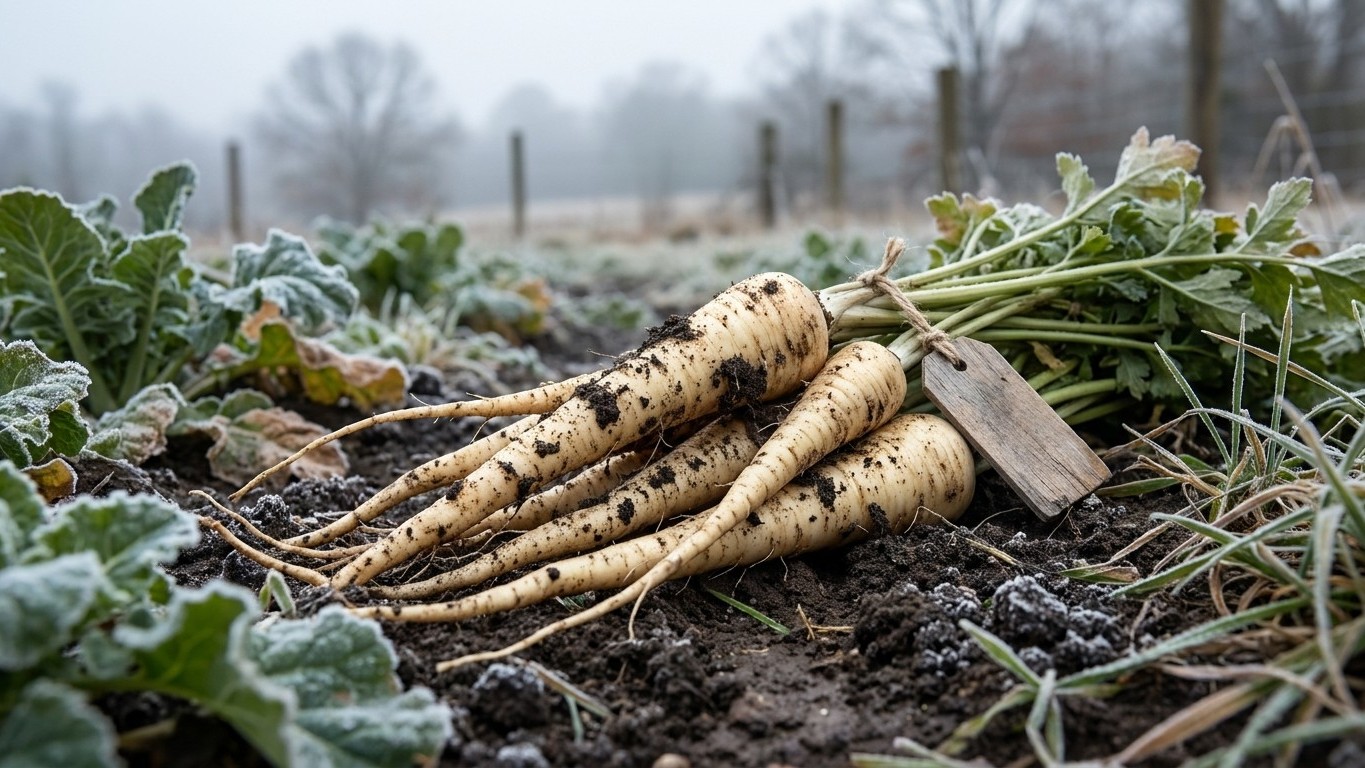

Yes, in an average year, parsnips left in the ground around Saskatoon get the sustained cold snap they need to turn sweet. The reference station’s coldest month runs well below freezing on average, which is exactly the kind of frost exposure that converts stored starch into sugar in the root. That’s a different question from whether the growing season is long enough to produce a full-size root worth waiting for.
The short answer
The number that actually decides this isn’t a hardiness zone rating. It’s the average minimum temperature during the coldest month of the year, because that figure tells you how much sustained cold the soil and the roots sitting in it are exposed to. At the Saskatoon reference station, the mean daily minimum for the coldest month comes in at -5.3°F, based on Environment and Climate Change Canada’s 1981-2010 climate normals. That’s not a record low or a one-night dip. It’s the average low across the coldest stretch of winter, which means cold snaps at or below that mark happen routinely, not as a rare event.
Parsnip sweetening depends on exactly that kind of repeated, sustained frost exposure, according to Utah State University Extension. Several weeks of cool, frosty weather trigger the conversion of starch stored in the root into sugar, which is what gives a well-timed parsnip harvest its distinctive sweet, nutty flavor instead of a flat, starchy one. A mild winter with only the occasional light frost won’t do it. A hardiness zone map won’t tell you whether that conversion happens either, because zone ratings are built around the coldest expected temperature a perennial plant needs to survive, not around how many frosty weeks accumulate in a typical winter.
With a coldest-month average minimum sitting more than 37 degrees below the freezing mark, the Saskatoon area is not a marginal case. Roots left in the ground into fall and early winter here are getting far more cold exposure than the bare minimum needed to sweeten. That said, this figure comes from one reference station, and Saskatchewan is not one climate. Northern districts and low-lying spots that trap cold air will run colder still, while sheltered gardens near a city center may see slightly milder winter nights. Anyone gardening well outside the Saskatoon area should treat -5.3°F as a useful benchmark, not a guarantee for their own backyard.
Does the season fit?
Frost exposure is only half the equation. A parsnip has to reach a usable size before the ground freezes solid, and that takes real time. Here’s how the arithmetic plays out using the Saskatoon reference dates.
- The average last spring frost at the Saskatoon reference station falls on May 18, according to Environment and Climate Change Canada’s 1981-2010 normals.
- Parsnip seed is sown directly in place, 2 to 3 weeks before that average last frost date, which puts a typical sowing window between roughly April 27 and May 4.
- Germination is slow and uneven for this crop. Utah State University Extension notes it takes 14 to 21 days, so seedlings shouldn’t be expected to break the surface until sometime between mid and late May. Digging up the row before then and re-sowing, thinking the seed failed, is a common and avoidable mistake.
- Root maturity takes 100 to 120 days counted from the seeding date, not from when the seedlings finally appear. Starting the count from late April or early May puts maturity somewhere between roughly August 5 and September 1.
- The average first fall frost at the same reference station lands on September 18.
- That leaves a cushion of roughly two to seven weeks between expected root maturity and the average first fall frost, depending on exactly when sowing happened.
On paper, that’s a comfortable fit, not a tight one. There’s real room built in before the ground typically starts freezing hard. The caution worth repeating: both frost dates are averages, not guarantees. In roughly half of all years on record, frost arrives later than these mean dates, and in the other half, it arrives earlier. A grower who sows late, or who hits a colder-than-average season, can still eat into that cushion faster than the numbers above suggest.
What goes wrong here
- Forked roots from heavy or stony ground. Parsnips send a single taproot straight down, and anything that blocks that path (rocks, clay clumps, compacted soil) sends the root splitting off in two or three directions instead. Utah State University Extension recommends deep, sandy soil for this crop, and where the bed is naturally heavier, double digging the row before sowing so the root has loose ground to push through.
- Forked roots from overwatering. This is a separate cause from soil texture, and it’s worth not lumping the two together. Waterlogged soil around the taproot can cause the same kind of splitting and branching as a rocky bed, even in otherwise good ground. Consistent, even moisture works better than heavy, irregular soaking.
- A season that runs out before the root sizes up. Sowing late, whether from a slow spring or simply waiting too long, eats directly into the cushion described above. Since 100 to 120 days is counted from seeding, not from germination, pushing the sowing date back by even two or three weeks can push maturity uncomfortably close to, or past, the average first frost.
- A winter too mild to sweeten. This isn’t the typical risk at the Saskatoon reference station itself, given how far below freezing its coldest-month average runs. But a sheltered urban garden, a warm microclimate, or simply an unusually mild winter can cut down on the sustained frost exposure the root needs. The safeguard is straightforward: leave mature roots in the ground through several hard freezes before pulling them, rather than harvesting at the first sign of cold weather.
Common questions
Does a specific parsnip variety sweeten faster in a cold climate like this one?
The source guidance behind these figures doesn’t name any particular variety, so no specific cultivar can be recommended here based on it.
Can parsnips be sown in fall instead of spring in this climate?
The figures above are built around a spring sowing timed 2 to 3 weeks before the average last frost, which is the standard approach described by Utah State University Extension. Fall sowing isn’t covered by the facts behind this guidance.
How do I know the roots have had enough frost exposure to be sweet?
There’s no published threshold number of frost weeks here, only the general guidance that several weeks of cool, frosty weather are needed. Leaving roots in the ground through multiple hard freezes, rather than pulling them at the first light frost, is the practical approach.
Does soil type matter more than the winter climate for a good crop?
Both matter, but for different reasons. Soil texture (deep and sandy versus heavy and stony) determines whether the root grows straight or forks. Winter cold determines whether a straight, well-grown root actually turns sweet. Good soil with a mild winter still produces a fine-looking parsnip that never develops the sugar.