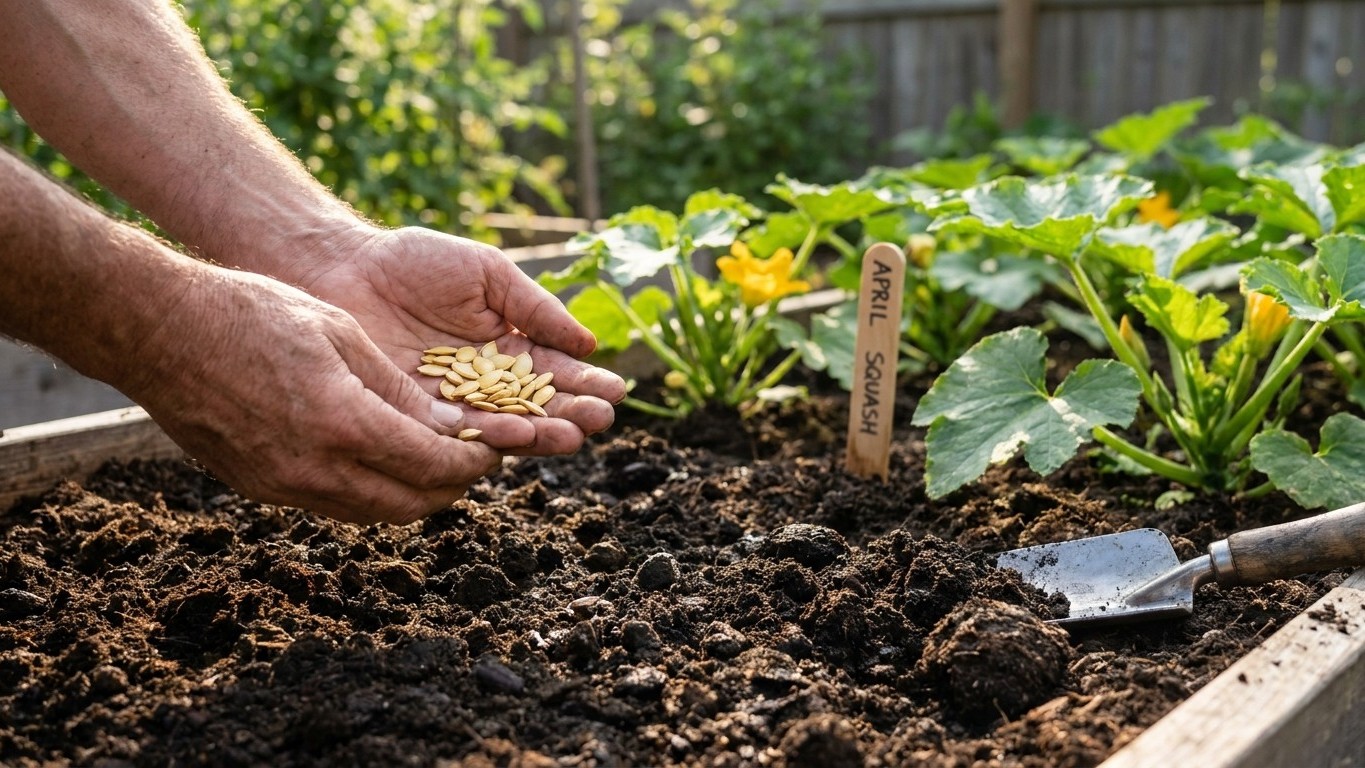

Sow summer squash directly outdoors once the soil has warmed past the mean last spring frost of May 18 at the Saskatoon SRC station, but treat that date as a coin flip, not a guarantee. Harvest needs to wrap up before the mean first fall frost of September 18. That gives a average window of about 123 days, comfortable for summer squash, but the two dates that bracket it are each only 50% probabilities.
The short answer for Saskatchewan
Environment and Climate Change Canada’s 1981-2010 normals put the mean last spring frost at Saskatoon SRC on May 18, and the mean first fall frost on September 18. Those numbers come from one station in one part of the province, and they are averages, not promises. In roughly half of all years on record, frost has shown up after May 18. So a gardener who sows summer squash the week of May 18 is betting on the better half of that coin flip, and losing that bet means replanting from seed after a frost has killed tender seedlings.
Summer squash is a warm-season crop with zero cold tolerance. It doesn’t just dislike frost, it dies at 32°F, and its growth stalls well before that if the soil hasn’t caught up with the air. A safer sowing target for direct seeding in this region is late May to early June, giving the mean frost date a buffer of a week to ten days rather than planting on it. Gardeners who want an earlier start commonly raise transplants indoors three to four weeks ahead and move them out once the risk has visibly passed, or they use row cover or cloches to buy a week of insurance on either end of the season.
The back end of the calendar matters just as much. September 18 is the average date the season closes, and again, it’s a midpoint: some years buy an extra two or three weeks, others end early. Summer squash typically needs somewhere in the range of 45 to 60 days from transplant to first harvest depending on the variety, which means a direct-seeded planting in late May should be producing well before the average frost risk returns in mid-September. That’s a comfortable margin on paper. In practice, a cool, slow spring can eat into it fast, which is exactly why the next section matters as much as this one.
This page has no fact for county-by-county frost dates inside Saskatchewan beyond the Saskatoon reference station, so it isn’t the place to guess at a date for Prince Albert or Estevan. What it can say, reliably, is that the frame is May 18 to September 18 at the reference point, and that every planting decision in the province should be measured against how far a given garden sits from that midpoint, not treated as fixed.
What will not work here
Late-maturing summer squash varieties are the first thing to cross off the list here. With zero days a year averaging 90°F or above at the reference station, this is a cool growing region by summer squash standards. Warmth-loving crops that lean on hot days to speed fruit set don’t get that push in Saskatchewan the way they would farther south. A variety bred for a long, hot season and a leisurely 65-plus days to first harvest is working against both a compressed frost-free window and a summer that never delivers the heat spike it was counting on.
A gardener who treats the mean frost dates as fixed calendar entries is setting up the same failure from the other direction. Sowing exactly on May 18 because “that’s the frost date” ignores that half of all years run later than that. The fix isn’t complicated: build in a buffer, watch the forecast in the two weeks around the mean date, and keep row cover on hand rather than assuming the average will hold.
Watering on autopilot fails here too
Summer rainfall across June, July and August averages about 6.6 inches, and August, the month when squash plants are typically sizing up and setting fruit hardest, is the driest of the three at just 1.68 inches. A watering routine built for a wetter region, or one that assumes rain will fill the gaps, runs into trouble exactly when the plants need water most. Because there’s no meaningful heat load pushing evaporation (recall, zero days above 90°F), the risk here isn’t scorched plants so much as steadily drying soil that nobody notices until leaves start to wilt in the afternoon. A weekly-watering habit copied from a hotter, wetter state doesn’t map cleanly onto a Saskatchewan August, and it shouldn’t be assumed to.
Dense spacing built for a humid climate is also worth reconsidering, though for a different reason than mildew pressure in a wet region. With modest summer rainfall and no extreme heat, airflow around the plants isn’t fighting the same battle it would in a muggy Southern garden, but tight spacing still slows soil warm-up in spring, which is already the tighter constraint here than disease.
What changes across Saskatchewan
The hardiness zone fact available for this page is 3a, in the Canadian system, for the reference city tied to these figures. That number alone tells a reader almost nothing about how far it stretches across the province. Saskatchewan runs from the U.S. border in the south to the boreal forest in the north, and a single zone rating anchored to one city can’t speak for that whole span. Northern and higher-elevation districts routinely run weeks behind the reference station on both ends of the frost-free season, meaning a later last spring frost and an earlier first fall frost, which squeezes the whole window a summer squash crop needs to mature.
It’s worth being direct about what this page can’t do: it can’t tell an individual reader which zone their own garden sits in, and it shouldn’t try. That’s a lookup, not a guess, and Natural Resources Canada maintains the tool built for exactly that job through its Plant Hardiness Zone site. A gardener in Saskatchewan who wants their own zone should check that map by municipality rather than assume the Saskatoon-area figures used here apply directly to their own yard.
What a reader farther north or at higher ground should shift, practically, is the whole calendar discussed above, pushed later on the spring end and earlier on the fall end. That means the late-May-to-early-June sowing window suggested for the reference area likely needs to move into June for colder districts, and the harvest push in September needs to start assuming frost risk returns sooner, not later. The same logic that applies to the mean dates for Saskatoon SRC, treat them as a midpoint with real variability on both sides, applies with even more force once a garden sits outside the reference area entirely.
None of this changes the underlying facts about summer heat and rainfall discussed above. Those numbers came from stations meant to represent typical growing-season conditions for the region, and a colder microclimate doesn’t usually mean a wetter or hotter one, it mainly compresses the calendar.
Where to check this for your own county
The Saskatchewan government maintains an agriculture and agribusiness resource hub at saskatchewan.ca, and that’s the right next stop for anyone whose garden isn’t near Saskatoon. This page has worked from a single reference station’s frost dates, rainfall normals and hardiness zone, all of which are stated plainly above as coming from that one location. A provincial resource built to serve every county can point toward locally trialled varieties and, where available, more localized planting guidance than a single-station reading can offer.
What’s worth looking for specifically once there: any regional or county-level planting calendar that reflects local frost data rather than the Saskatoon SRC figures used throughout this page, and any variety trial information showing which summer squash cultivars have actually performed well in Saskatchewan conditions, as opposed to varieties bred and tested for a warmer, longer season elsewhere. A provincial or county-level recommendation, grounded in local trial data and local frost records, will always beat a single reference-station estimate for a specific piece of ground.
That’s the honest limit of this page. It answers the provincial-level question using the best single-station data available, sourced and dated as such throughout. It doesn’t, and can’t, replace a resource built around a reader’s own county. Anyone gardening well outside the Saskatoon area, especially farther north where the hardiness zone discussion above already flagged real variability, should treat the numbers here as a starting frame to adjust, not a final answer.
Checking this against your own garden
Every date on this page is an average pulled from one station over a thirty-year record. A reader’s own garden will confirm or contradict it faster than any calendar can, and three simple checks do most of the work.
Soil warmth by feel is the first and most direct. Summer squash seed sitting in cold soil doesn’t just grow slowly, it can rot before it germinates at all. Pushing a bare hand into the top few inches of soil and feeling for a loss of that early-spring chill is a rough but reliable proxy for whether the mean frost date has actually translated into workable planting conditions on that specific patch of ground.
The first flush of male flowers is the second signal worth watching. Summer squash plants typically produce male blooms before female ones, and their appearance marks a shift into active reproductive growth. Their timing, earlier or later than expected for the calendar date, says something concrete about how that year’s spring actually ran compared with the 1981-2010 averages used throughout this page.
The emergence of first true leaves, the leaves that appear after the initial seed leaves and actually resemble mature squash foliage, marks the point where a seedling has moved past its most frost-vulnerable stage into sturdier growth. Watching for it gives a gardener a plant-based read on their own microclimate that outranks every average date discussed above.