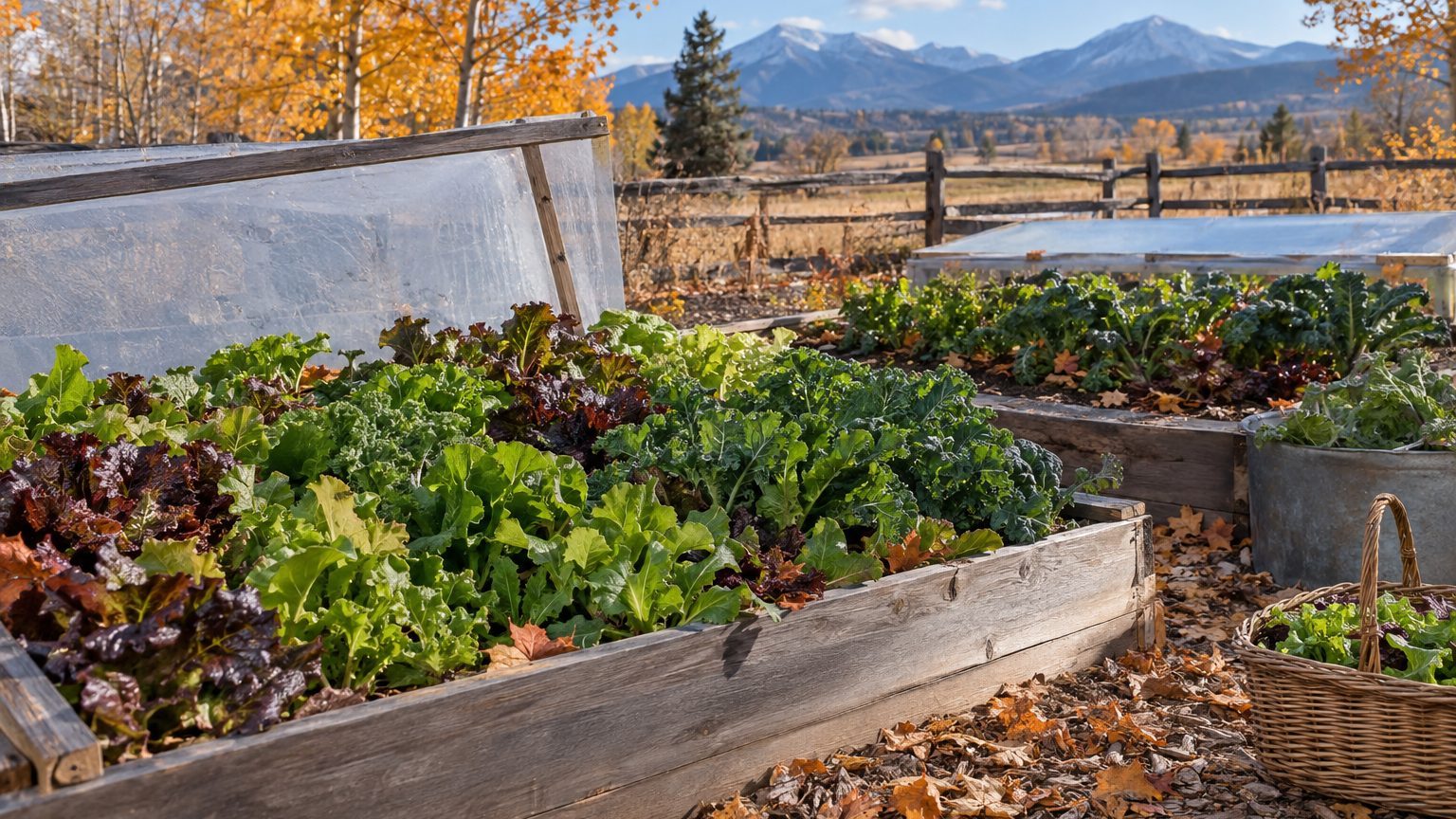

South Dakota winter salads are not sown in winter. You sow them in late summer while the soil is still warm, so the plants are near full size before the light fades and the hard freezes arrive. After that they mostly hold instead of grow, and you cut leaves as you need them. This week, find your first fall frost date and count backward from it to set your sowing dates.
When the soil is warm enough in South Dakota

The frost date and what it stands for
NOAA’s 1991-2020 climate normals put the last spring 32F freeze at the Sioux Falls reference station (NCEI station USW00014944) between April 29 and May 9. That band is a probability, not a promise, and a freeze after it turns up in some years. Gardens outside the city usually see the last spring frost later than the airport does, often by one to two weeks, and more at elevation. Check your own county before you commit to a calendar.
Treat the frost date as a proxy. Winter salads care about soil, and soil warms after the frost risk ends, not with it. A bed can be frost-free and still cold and sodden at seed depth. For the spring side of the year, that means hardy greens such as spinach and arugula can go in as soon as the ground is workable, well before the warm-season crops share the space.
The sowing that matters for winter eating happens at the other end of the year, and there the problem reverses. Late-summer soil is often too warm, not too cold. Lettuce-type seed in particular germinates poorly in hot ground, and a seedbed that dries out between waterings gives you a patchy stand. The crop as a whole is laid out in Winter Salads: What Grows When Lettuce Will Not, and the reasoning there holds here: you are timing the sowing to the cooling of the soil.
Reading the soil instead of the calendar
Push a soil thermometer to seed depth in the morning, when the reading is at its lowest, and take it over several days. In spring you want the trend rising and the soil crumbling in your hand instead of smearing. In late summer you want it falling, or at least cool enough that seed is not sitting in a baked bed.
You can pull a late-summer seedbed toward the right temperature. Water the row deeply the evening before you sow. Lay a board or a sheet of shade cloth over the row until the seedlings show, checking daily so they do not stretch under it. Sow in the evening, not at midday. Choose the bed that gets afternoon shade from a fence or a tall crop, and keep the top inch damp until the seed has come up.
In the following spring, the same soil logic runs in reverse. Plants that came through the winter restart as the ground thaws and warms. Lift covers gradually on mild days instead of stripping them in one go, because a warm afternoon followed by a hard night is how good plants are lost in March.
How long the season lasts here
The arithmetic
NOAA’s 1991-2020 normals for the same Sioux Falls station put the first fall 32F freeze between September 24 and October 4. Count from the end of the spring range (May 9) to the start of the fall range (September 24) and you get about 138 days. Count from the start of the spring range (April 29) to the end of the fall range (October 4) and you get about 158. So the frost-free window at this station runs roughly 138 to 158 days, or 20 to 22 weeks.
Those are reference-city figures. In a rural or suburban garden, the spring end typically moves later and the fall end earlier, by one to two weeks each. That can take a month off the window. Ask your county office what your own site runs, and treat any date as a starting point for your own arithmetic.
What that length allows
A window of this size is enough for one full summer crop in a bed and a fall sowing after it, but not for a relaxed schedule. Once the first fall frost arrives, growth slows sharply, and the light keeps shortening after that. Plants that are still seedlings when the hard freezes come will sit at that size through the winter. They will be alive in March and not much use in December.
This is why you should sow in several small batches rather than one big one. A batch that goes in too early can run to seed or be past its best before the cold arrives. A batch that goes in too late stalls small. Spacing sowings across the late-summer stretch gives you leaves at different sizes when the growth stops, and it hedges against a hot week or a dry one wrecking a single sowing. The succession sowing guide on this site walks through spacing the batches.
The short window also settles the question of transplants. Starting seedlings in a cool spot indoors or in shade, then setting them out, saves the weeks that a direct sowing spends germinating in hot ground. The cost is a root check. Taprooted and fussy types such as spinach, arugula and mâche are better sown where they will grow. Lettuce, kale and endive shrug off transplanting and gain the most from a head start.
Before you fix dates, check three things:
- Your own county’s frost dates, not the airport’s
- The days to maturity printed on each seed packet, which are counted under good growing conditions
- How much winter sun the bed actually gets once the neighbor’s shed or your own fence shades it
Heat and water in South Dakota

Summer is the smaller problem
Summers here can be hot, and hot spells in July and August will shape how you get the seed started. NOAA’s climate normals give both for the station nearest you, and rainfall varies from one part of the state to another, so look up your own. What matters for this crop is what the heat does at sowing: it warms the seedbed and dries the top inch.
When the summer runs cool and damp instead, the trouble shifts. Slow growth, damp foliage and crowded rows invite mildew, and a dense sowing of baby leaves holds wet air close to the plants. Water in the morning at the base of the plants, thin seedlings early, and leave enough space that air moves through the row. That advice holds in a hot dry summer too, because a well-spaced row loses less water and carries less disease either way.
The cold decides everything
Winter hardiness is where this territory sets its terms. NOAA’s 1991-2020 normals put the mean daily minimum of the coldest month at 8.5 F at Sioux Falls. That is an average of the nightly lows, so individual nights run colder. The USDA Plant Hardiness Zone Map (2023) places South Dakota across zones 3b to 5b, and other parts of the state differ from the reference city, colder in the north and at elevation.
Those numbers sort the crops into three groups:
- Stand uncovered for part of the winter: spinach, mâche, claytonia and kale, though leaf quality drops as the cold deepens
- Need a cover to stay in edible condition: arugula, mizuna, tatsoi, endive and loose-leaf lettuce, under a row cover or a low tunnel
- Cannot manage at all: heat-lovers such as basil, and heading lettuces left in an open bed
Even the first group gains from cover at these winter lows. A covered bed also reduces the swing between sunny afternoons and freezing nights, which is what tears leaves. Nothing in the second or third group will grow in midwinter without artificial heat, and the first group grows very little. What you cut in January is what you grew before the days got short.
The first fall frost then sets how late you can sow. Take the early edge of the NOAA range, September 24, and count backward by the days on the packet, then add a generous margin for slowing growth. If the sum lands in the past, that variety is too slow for this season and you want a faster type.
Which winter salads suit South Dakota
Choosing by type
Choose by cold tolerance first, speed second, and disease resistance third. This is a general ranking by type, since those depend on your county and on the packet in your hand.
| Type | Cold tolerance | Cover advised | Role in the bed |
|---|---|---|---|
| Spinach | Hardiest | Yes, for quality | Sown direct, holds through winter |
| Mâche | Hardiest | Helpful | Small rosettes, slow but steady |
| Claytonia | Hardy | Helpful | Low, tender leaves for the cold months |
| Kale | Hardy | Helpful | Sturdy, transplants well |
| Arugula, mizuna, tatsoi | Moderate | Yes | Fast, good for later sowings |
| Endive and escarole | Moderate | Yes | Bitter, robust heads or rosettes |
| Loose-leaf lettuce | Tender | Yes, and not through deep cold | Cut before the hard freezes |
A short season favors the faster types, the mustards and arugula, which reach a cuttable size soonest and let a late sowing still pay. Hot spells at sowing favor types with some heat tolerance at germination, and they favor sowing into shade with moist soil. Damp weather makes disease resistance the first thing to read on the packet, particularly mildew resistance in spinach and lettuce.
Why this page names no varieties
The only recommendation worth following is one trialled where you garden. Cultivars that thrive in one county can fail in another a few hours away. South Dakota State University Extension is the body to ask, and your county office can tell you what has performed in your soil and your frost pattern.
The same cold-first reasoning applies in other northern states, and the choices shift with the climate. Winter Salads for Idaho Gardens and Winter Salads for Maine Gardens show how the balance moves elsewhere. Grow all of these in beds or containers you have sown yourself. Nothing here involves gathering plants from the wild.
Common questions
Can I leave winter salad greens under snow?
Snow is a decent insulator, and hardy greens often come through beneath it in better shape than they would bare in a cold wind. It is not a substitute for cover on the tender types, and a heavy snow load can crush a low tunnel. Brush snow off hoops and keep a way to reach the plants.
Do containers work for winter salads here?
They work for the growing season and until the cold deepens, but a container freezes harder than the ground because it is exposed on all sides. Roots in a pot see colder temperatures than roots in a bed. Move pots against a south-facing wall or into an unheated garage on the coldest nights, and keep them just damp.
Is it safe to cut leaves that are frozen?
Wait until they thaw. Cutting or handling frozen leaves bruises them and leaves damaged tissue that rots quickly. Choose a mild, dry part of the day, cut just above the growing point, and leave the plant crown intact so it can put out more.
Should I look for special “winter” seed?
Seed packets sometimes carry hardiness or “overwintering” notes, and those are worth reading, but a label is not a local trial. Start with the types in the table and ask South Dakota State University Extension which cultivars have done well near you. Sow a small test of each before you commit a whole bed, because a variety that sulks in your soil will not show its faults until the cold arrives.