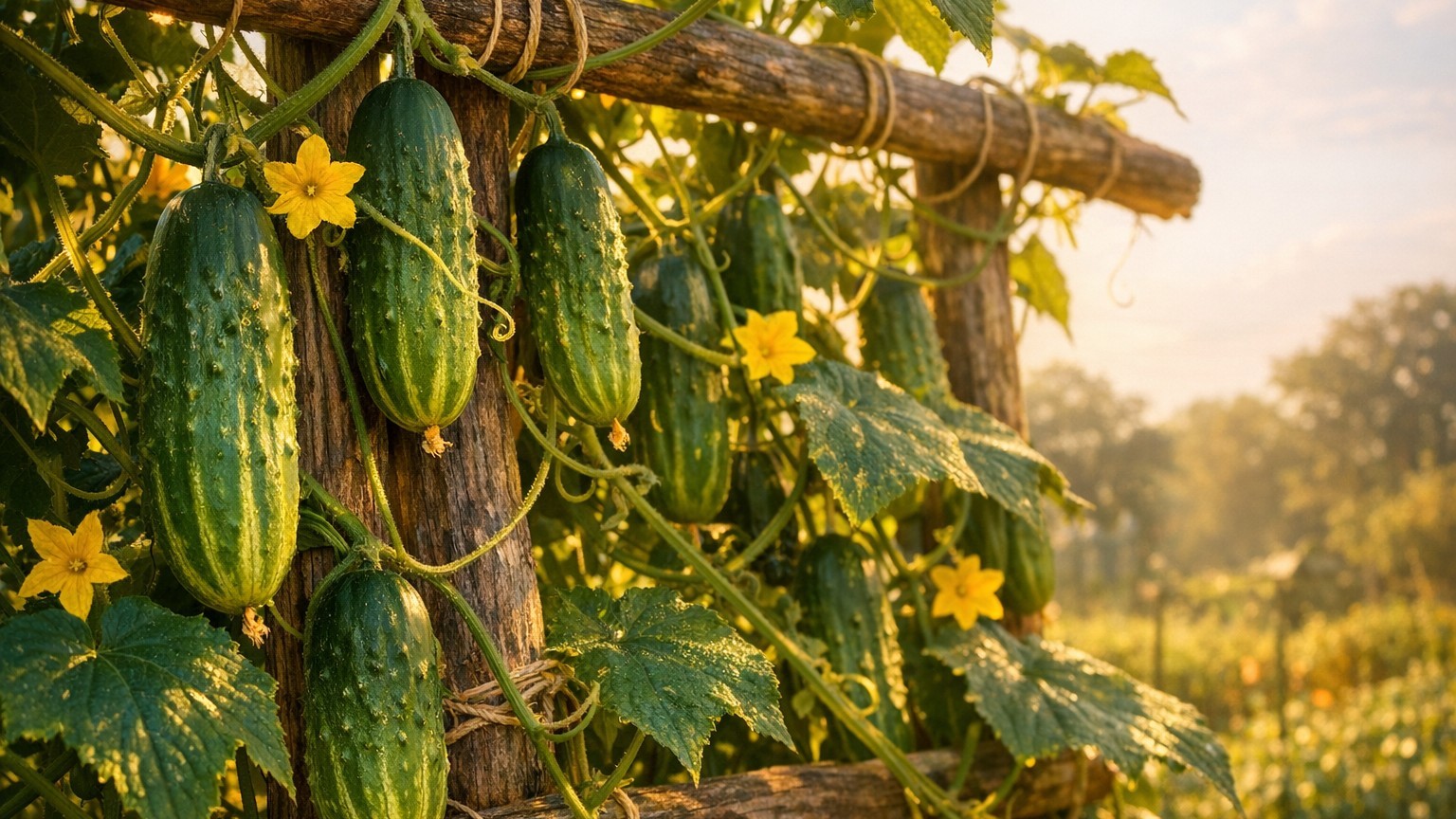

For most of Utah, the safest bet is a quick-maturing bush or pickling type, plus a burpless or parthenocarpic slicer if you want fewer bitter, misshapen fruit under dry summer heat. Long-season vining slicers are the riskier pick almost everywhere in the state except the warmest, lowest valleys. Your county extension office has the final word on what’s actually been trialled near you.
The short answer for Utah
Start with the two numbers that actually decide this: the frost-free window at the Salt Lake reference station runs from a last spring frost between April 12 and April 29 to a first fall frost between October 18 and October 29. Stack those dates against each other and the growing season at that reference point lands somewhere between about 172 and 200 days, depending on which end of each range you land on in a given year. That’s a workable window for cucumbers almost anywhere in the valley itself, but it’s a probability band, not a guarantee, and the caution attached to it matters: this is a mild valley station, and most of Utah sits higher and colder, while the southern corner of the state runs warmer still.
The second number that matters is heat load. The reference station averages 52.1 days a year at or above 90°F. That’s roughly seven and a half weeks where a cucumber plant is working hard just to keep its blossoms from aborting, let alone setting fruit cleanly. Combine that with a genuinely dry summer, about 2.0 inches of rain total across June, July and August, with July down at 0.49 inches, and you’ve got a crop that needs to size up fast, tolerate heat stress at bloom, and not depend on a long, cool stretch to finish.
That combination points toward types built for speed and heat tolerance over types built for size or novelty. Pickling types tend to mature faster and forgive a shorter effective season, which matters if you’re gardening above the valley floor where the frost-free window shrinks. Bush types take up less space and are easier to keep evenly watered, which counts for a lot when July delivers less than half an inch of rain. Burpless and parthenocarpic slicers set fruit without needing heavy pollinator traffic and tend to hold their shape better when heat stress interrupts the normal watering rhythm.
None of this tells you which named cultivar to plant. Utah State University Extension trials varieties by region and publishes what actually performs in local conditions, and that list changes as new cultivars come through trials. Treat the type, bush versus vining, pickling versus slicing, standard versus burpless, as the decision this page can make for you. Treat the specific variety name as a decision for your county extension office, because a name that thrives in the Dixie corridor is a poor bet for a mountain valley two hours north.
What will not work here
Long-season vining slicers are the first thing to cross off the list almost anywhere outside the warmest low-elevation valleys. When your frost-free window can run as short as roughly 172 days at a mild reference station, and shorter still at elevation, a cucumber that needs a long, unhurried stretch to fill out is racing a clock it may lose. A late-summer cold snap arriving on the early side of the October 18-29 fall frost range can end the season before a slow variety finishes its last flush.
Weekly watering is the second failure point
Cucumbers are shallow-rooted and thirsty, and Utah’s summer gives them almost nothing to work with: 0.49 inches of rain in July, the driest month of the growing season, and 52.1 days a year at or above 90°F pulling moisture out of the soil on top of that. A weekly watering schedule that might carry a crop through a wetter, cooler state leaves Utah cucumbers swinging between drought stress and a sudden soak, and that swing is exactly what produces bitter, hollow, or curled fruit. Consistent, more frequent watering, not a bigger single dose, is what this climate actually calls for.
Bare, unmulched soil compounds the same problem. Under nearly two months of 90-plus-degree days and next to no summer rain to replenish it, exposed soil around cucumber roots dries out fast enough to stress the plant between waterings even on a reasonable schedule. A mulched bed holds moisture longer and buffers the soil temperature swings that heat load creates.
Finally, jumping the gun on transplanting or direct seeding is a specifically Utah mistake given how wide the last-frost window runs. Setting cucumbers out in early April, ahead of even the earliest end of the April 12-29 range, risks cold soil that stalls germination or stunts transplants, and a late frost arriving at the far end of that range can wipe out an early planting entirely. Waiting until soil has genuinely warmed, rather than planting to a fixed calendar date, matters more here than in a state with a narrower, more predictable frost window.
What changes across Utah
Utah is not one garden, and the hardiness zone spread proves it: the state runs from USDA zone 4a up to zone 9a. That’s five full zones inside one set of state lines, which is a wider range than most states carry at all. A gardener in a 4a pocket and a gardener in a 9a pocket are not growing cucumbers under remotely similar conditions, even though both live in Utah.
In the coldest zones, the growing season is meaningfully shorter than the 172-to-200-day range calculated from the Salt Lake reference station, and the frost dates themselves shift later in spring and earlier in fall. That favors starting cucumbers indoors under cover rather than direct seeding, leaning harder toward the fastest-maturing bush and pickling types, and treating any vining slicer as a gamble unless it goes in under row cover or in a warm microclimate against a south-facing wall.
In the warmest zones, at the 9a end of the spread, the growing season stretches well beyond what the Salt Lake numbers suggest, and the limiting factor flips: instead of racing a short season, gardeners there are managing extended, intense heat that can push blossom drop and bitter fruit even in well-watered plants. Midday shade cloth during the hottest stretch and heat-tolerant slicer types matter more there than fast maturity does.
Because that spread exists inside a single state, there is no single answer to which zone description fits your garden, and this page isn’t going to guess. The USDA Plant Hardiness Zone Map lets you check your specific location rather than assuming the Salt Lake reference conditions apply to your county.
Where to check this for your own county
Utah State University Extension is the source built to close the gap this page can’t close: it works from the state level, and your growing conditions are decided at the county level. Their site is at extension.usu.edu, and it’s worth treating as the next stop rather than a footnote.
Two things are worth hunting down there specifically. First, a local planting calendar for your county or region, which will reflect the actual frost pattern where you garden rather than the Salt Lake reference station’s April 12-29 and October 18-29 windows. If you’re gardening at higher elevation or in one of Utah’s colder valleys, that local calendar will run noticeably tighter than the state-level numbers used on this page, and if you’re in the southern corridor, it may run noticeably looser.
Second, look for the cucumber varieties USU Extension has actually trialled and recommended for your area. Extension programs test cultivars under local soil, heat, and water conditions before recommending them, which is exactly the kind of ground-truthing a statewide page like this one can’t do. A variety that performs well in trials near St. George is not the same list you’d want for a garden near Logan or up in a mountain valley.
A county-level recommendation beats a state-level one every time, because it’s built from conditions closer to your own backyard. This page has given you the type of cucumber that fits Utah’s general season length and heat load. Your extension office can tell you the specific name that’s proven itself in your particular corner of a state that spans five hardiness zones.
Checking this against your own garden
Every date and average on this page is a regional probability, and your own garden will tell you something more precise than any of them. Three things are worth watching before you trust a calendar over your own soil.
Soil warmth by feel is the first check. Cucumbers germinate and transplant poorly into cold soil, and in a state with a frost window as wide as April 12 to April 29, a fixed calendar date can be badly wrong in either direction. If the soil in your bed still feels cool and damp rather than warm and slightly dry a few inches down, it’s telling you to wait regardless of what the date says.
The first flush of male flowers is the second signal. Cucumber plants typically produce male flowers before the female flowers that actually set fruit, and a strong early flush of males, followed shortly by females with a small swelling at the base, tells you the plant has moved past establishment and into fruiting mode. If male flowers show up but drop without any females following for an extended stretch, that’s often a heat stress signal worth watching, especially during a run of 90-plus-degree days.
The appearance of the first true leaves, the second set that emerges after the rounded seed leaves, is the third marker. Their timing and vigor tell you how your specific microclimate compares to the regional average: slow, pale true leaves point to cool soil or thin nutrition, while quick, dark green growth suggests your spot is running warmer or richer than the county norm. None of these checks require anything beyond your own hands and eyes, and together they’ll correct for whatever your particular yard does differently than the reference station this page is built on.