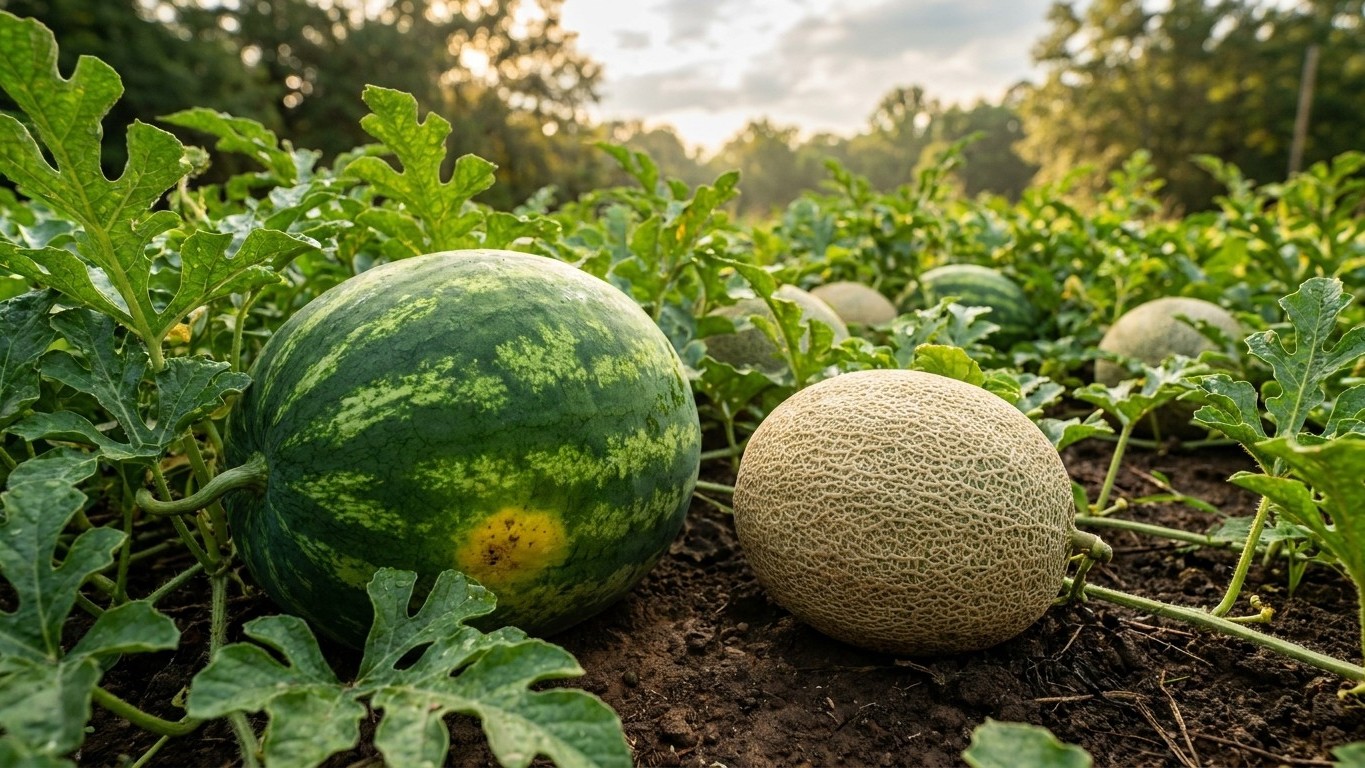

Vermont’s growing season runs long enough for melons on paper, but the state rarely delivers the sustained heat that ripens the big vines. The varieties that actually finish here are the fast, cool-tolerant ones: short-season cantaloupes and small icebox melons bred for northern gardens, not the sprawling watermelons and honeydews built for a Georgia summer.
The short answer for Vermont
Pick by type first, not by name. Vermont’s frost-free window runs from a last spring frost of April 30 to May 10 to a first fall frost of October 3 to October 13, at the Burlington reference station. Stretch those dates against each other and the frost-free season lands somewhere between 146 and 166 days, depending on which end of each range the year actually gives you. That sounds generous for a crop that mostly needs 65 to 90 days. The catch is heat, not calendar days.
Burlington averages only 5.4 days a year at 90F or hotter. Melons don’t ripen on day count alone; they ripen on accumulated heat, and Vermont’s summer nights stay cool even when the afternoons feel warm. A vine can sit in the ground for 80 days and still lag a variety in Kansas that hit the same calendar mark two weeks faster, simply because the Kansas nights never dropped below 70F.
That single fact decides the whole shopping list. Fast-maturing muskmelon and cantaloupe types bred for northern climates, the ones sold as 65-to-75-day varieties, are the safest bet because they ask for less cumulative warmth before they set fruit and start sugaring up. Small “icebox” watermelons, the personal-size types bred to finish in 70 to 80 days rather than 90-plus, are the next best option. Charentais-style melons, prized for tolerating cooler nights without losing sweetness, round out the short list.
| Melon type | Typical days to maturity | Heat demand | Fit for Vermont |
|---|---|---|---|
| Northern-bred cantaloupe/muskmelon | 65-75 | Moderate | Good |
| Icebox watermelon | 70-80 | Moderate-high | Workable |
| Charentais-type melon | 75-85 | Moderate | Workable with row cover |
| Standard large watermelon | 85-100+ | High, sustained | Poor |
| Honeydew | 80-100 | High, sustained | Poor |
Anything in that last two rows is asking Vermont’s climate for something it doesn’t reliably have: a long run of hot nights, not just a long run of frost-free ones.
What will not work here
Large watermelons are the clearest failure. A 90-to-100-day variety needs both the frost-free window and a steady heat load to fill out that fruit and convert starch to sugar near the end. Vermont’s 5.4 average days above 90F simply doesn’t supply that. The vine can grow, flower, and set fruit that never finishes sweetening, which is the most common complaint from gardeners who try a standard slicing watermelon here: plenty of green rind, disappointing flesh.
Honeydew runs into the same wall from a different angle. Honeydew sugars up almost entirely in the final stretch before harvest, and that stretch wants heat, not just sun. A cool August in the Champlain Valley, or a normal one in the Green Mountains, leaves honeydew stalled at a pale, watery stage no amount of extra time on the vine will fix.
The rainfall numbers point to a second, less obvious failure: disease from crowding. Vermont averages about 11.9 inches of rain across June, July, and August, with June the wettest month at 4.26 inches and August the driest at 3.54. That’s not a drought pattern, and it’s not a desert-dry summer either. It’s a humid one, and melon vines planted at tight, warm-climate spacing lose airflow fast once the leaves close in. Powdery mildew and downy mildew both move quickly through a humid canopy with poor circulation, and a wet June combined with a still-cool root zone is exactly the setup that favors fungal spread over vine growth.
A third failure mode is timing pressure at the front end. With a last frost that can run as late as May 10, gardeners who direct-seed melons outdoors on a calendar date rather than a soil check are gambling with a young seedling against a real frost risk. Cold, wet soil in early May also rots slow-germinating seed before it ever gets a chance to fail from heat later in the season.
What changes across Vermont
Vermont’s USDA hardiness zone spans 3b to 5b, a wide spread built from average annual extreme minimum temperature, not from season length directly. But the two track together closely enough to matter: the Champlain Valley around Burlington, the mildest corner of the state, sits at the warmer end of that range, while the Green Mountains and the Northeast Kingdom sit at the colder end, with meaningfully shorter frost-free stretches than the numbers cited above.
That means the frost dates and the 146-to-166-day window given earlier describe Burlington, not the whole state. A gardener at higher elevation or further north should expect a shorter effective season than that range implies, and should shift decisions accordingly: lean toward the fastest end of the maturity range for any type chosen, start transplants indoors rather than direct-seeding, and treat black plastic mulch or row cover as a real requirement rather than an optional boost.
There is no single answer for “Vermont” here, and a page that gave one would be misleading a third of the state. The spread from 3b to 5b is large enough that a variety comfortable in the Champlain Valley can be marginal sixty miles away at higher ground. Rather than guess which end applies to a given garden, check the current USDA Plant Hardiness Zone Map for the exact location, then treat the Burlington figures in this article as the mild-end case, not the statewide average.
Where to check this for your own county
This page describes the state as a whole, anchored to one reference station on Lake Champlain. A county recommendation will beat it every time, because it accounts for local elevation, local frost pockets, and local soil that this page cannot see.
The University of Vermont Extension, at uvm.edu/extension, is the source built for that finer level of detail. Two things are worth pulling from it before planting anything:
- The local planting calendar for the region, which will adjust the frost-date window used here to the specific county rather than the Burlington airport station
- Any list of melon or cucurbit varieties actually trialled by extension staff or local growers in that county, which reflects what has performed in real Vermont soil rather than what a seed catalog promises
Extension offices also track disease pressure by region, which matters given the humidity risk described above. A county with a wetter local microclimate than the state average may need earlier fungicide scheduling or wider spacing than a general guide would suggest, and that kind of detail only shows up at the county level, not the state one.
Treat this page as the starting filter: it narrows the decision to melon type, given Vermont’s season length and heat load. The extension office narrows it the rest of the way, down to which named varieties have actually produced ripe fruit in that specific county in recent years.
Checking this against your own garden
Every date and average on this page describes a weather station, not a backyard. The final call belongs to direct observation, and three signs matter more than any calendar.
Soil warmth by feel is the first. Push a hand a few inches into the bed where melons will go; if it still feels cold and damp rather than warm and dry even on a sunny afternoon, the ground isn’t ready regardless of what the date says. Melon roots stall in cold soil even when the air temperature looks fine.
The first flush of male flowers is the second signal. Melon vines typically produce a run of male blossoms before the female flowers, the ones with a small swelling at the base that will become fruit, appear. Seeing male flowers only means the vine is getting close, not that it’s already producing; waiting for female flowers to show is the more useful marker for how far along the season actually is on that particular vine.
The first true leaves, the ones that emerge after the initial seed leaves and actually look like melon foliage, are the third. Slow, pale true leaves on a seedling that’s had two or three warm weeks point to a microclimate running cooler than the state averages suggest, which is a signal to shift toward the fastest-maturing type available rather than hold out for a slower one that matched the calendar better.