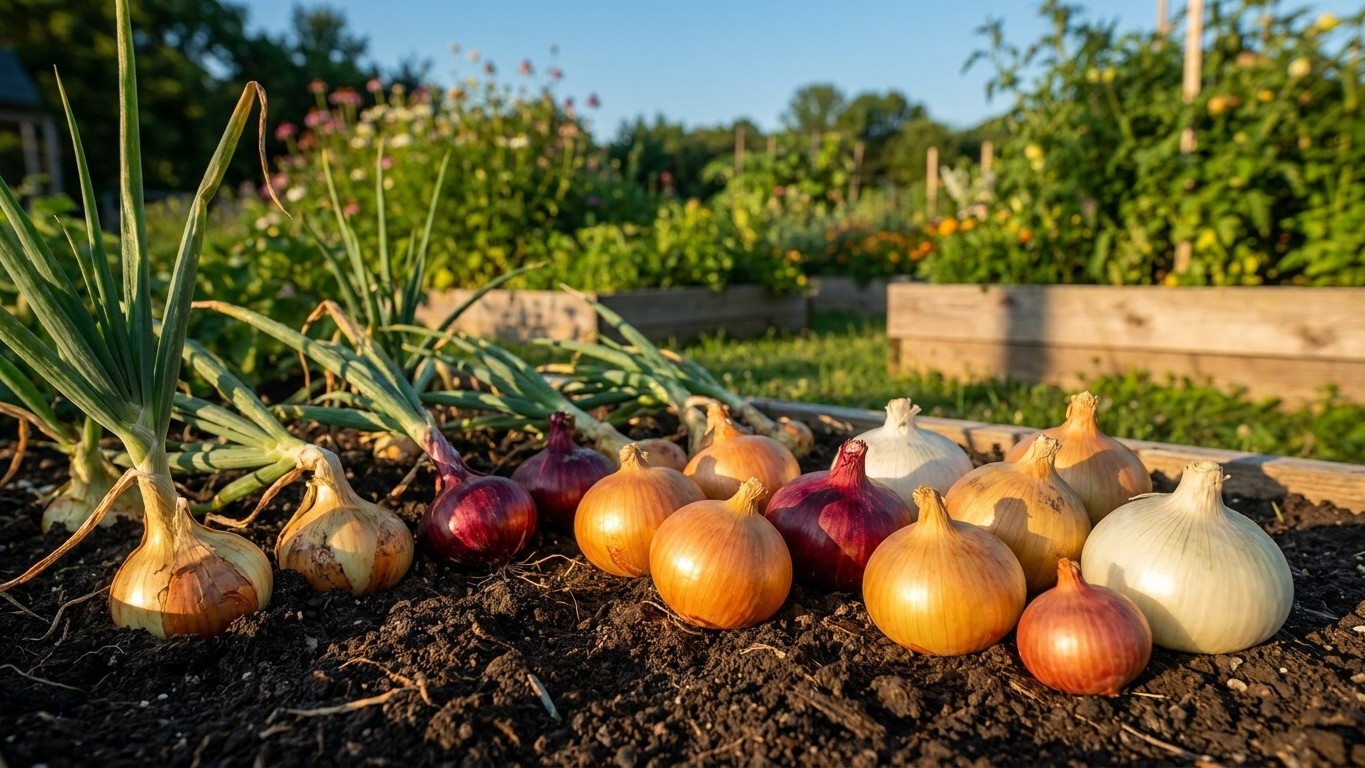

Three things do most of the eating in a Virginia onion bed: thrips rasping the leaves, maggots tunneling the roots and bulbs in cool spring soil, and rot organisms that take over the bulb, often after harvest. All three work on a calendar set by something most gardeners never track, which is how long the plants stay leafy and unfinished. Day length sets that clock. An onion that gets its bulbing signal on time leaves the danger zone early. One that never gets it stays exposed.
The short answer for Virginia
The figures on this page come from NOAA NCEI station USW00013769, at 36.82 degrees north. There, the longest day of the year delivers 14 h 32 of daylight, counted to the geometric horizon (atmospheric refraction adds roughly seven minutes that this number leaves out). Onions do not bulb because the soil warmed up. They bulb because the day got long enough, and every variety has its own threshold. Clemson Cooperative Extension puts the trigger for short-day onions at about 12 hours.
That threshold is why pest timing and variety choice are the same conversation. A short-day onion in Virginia starts swelling early, finishes while the soil is still workable, and comes out of the ground before the hottest, stickiest weeks. A plant that stays in leaf mode all through June and July is a long, slow buffet. For a wider look at the crop, start with Onions in Virginia.
Who shows up, and in what order
Specific emergence dates for Virginia are not published here, and they shift by county and by year. The general sequence is well known, though:
- Onion maggots: fly larvae that burrow into roots and the base of young plants, favoring cool, damp spring ground. Seedlings and sets are the usual victims.
- Onion thrips: slivers of insect, barely visible, that scrape the leaves and leave silvery streaks. Populations tend to build as weather warms and dries, which overlaps with the stage when bulbs are sizing up.
- Rot organisms: neck rot and bacterial soft rot. They start in the field after wet weather, then finish the job in a pantry or cellar if bulbs were cured poorly.
Notice the pattern. The maggot hits early, the thrips hit mid-season, and the rots hit last. An onion that bulbs on time dodges some of the middle stretch. One that gets delayed meets all three in full force.
Plant timing matters here too, and it differs by region of the state. The full breakdown is in When to Plant Onions in Virginia.
What will not work here
Late planting does not delay the harvest. It shrinks it. Whatever size the plant has reached on the day the lengthening light triggers bulbing is the size the bulb will be. An onion set in the ground too late has only a few leaves when the signal arrives, and each leaf becomes a ring of the bulb. Few leaves, small bulb. No amount of summer fertilizer rescues that.
Varieties with the wrong day-length requirement fail in a different way, and it is worse for the pest picture. Long-day onions wait for 14 to 16 hours of daylight. At the reference station, the day reaches 14 h 32 only around the solstice, at the very end of the season, with the soil hot and the tops worn out. The plant spends months making leaves, produces a thin or absent bulb, and then rots. Every week of that leafy waiting is a week of feeding for thrips and a week of humid weather for the fungi.
Here is what to keep out of a Virginia bed planted for bulbs:
- True long-day types (14 to 16 hours needed): the signal comes too late in the season, so expect leaves all summer, no real bulb, then rot.
- Long-day sets planted in spring: the same day-length problem, plus a late start that leaves them small even if they do bulb.
- Any onion planted late because “it will catch up”: it will not. Bulbing is triggered by light, so the plant stops growing leaves on schedule whether it is ready or not.
- Short-day types planted in spring for a storage crop: they bulb early and small, and their sweetness means they will not hold through winter (more on that below).
Intermediate-day types sit between the two groups and are the usual compromise for a state with this much variation. The sorting is covered in The Best Onion Varieties for Virginia.
What changes across Virginia
Virginia runs from roughly 36.5 degrees north at the southern border to about 39.5 degrees in the northern part of the state, a spread of around three degrees. That is enough to matter. The 36.82 figure belongs to one station, not to the whole state, and a gardener in the far north or the far southwest should not borrow it.
| Location | Latitude | Longest day | What it changes |
|---|---|---|---|
| Reference station (USW00013769) | 36.82 degrees north | 14 h 32 | Baseline for this page. Short-day types bulb early; long-day types get their trigger too late. |
| Far southern edge | About 36.5 degrees north | Nearly identical to the reference (figure not published here) | Advice above applies almost unchanged. |
| Far northern Virginia | About 39.5 degrees north | Longer than 14 h 32 (figure not published here) | Slightly more summer light and colder winters. Planting dates shift later, and intermediate types have more room to work. |
Elevation adds a second variable. The western mountains are cooler than their latitude suggests, which pushes planting dates later and can stretch both the maggot season and the spring soil chill. Day length does not change with altitude, but the calendar around it does.
The practical takeaway: a reader in the north of the state may plant a couple of weeks apart from the reference station, and may find that intermediate types do better than the short-day onions that suit the southeast. A reader in the south should lean toward short-day types and early planting.
Sweet now, or onions that last
The bite of an onion comes from volatile sulfur compounds. Those same compounds protect the bulb while it sits in storage, and a sweet variety carries fewer of them. University of Missouri Extension states the rule plainly in its onion guide (G6355): “As a rule, ‘sweet’ onions do not store as well as the more pungent types.” This is chemistry, not bad luck and not a flaw in a given variety.
Short-day types run sweeter, and they are what southern gardens grow, Virginia’s southeast included. Long-day types keep longer, which is why northern gardens can feed a household into March. Virginia sits in between, and most growers end up choosing one side of the trade or splitting the planting.
The March pantry tells the story. A bed of short-day sweet onions is mostly gone by then. Whatever is left is soft, sprouting, or smelling wrong, and what you ate, you ate in summer and fall. A bed of pungent, intermediate-leaning types is still firm in a dry cool spot, with a few sprouting but most usable. Nobody gets a sweet onion that stores. Plan for the trade rather than hoping around it.
Storage only works if the bulbs are cured first. Necks should be tight and skins papery before anything goes into storage, never straight from the ground. After curing, Clemson Cooperative Extension gives the target: “Ideal conditions are between 45 °F and 55 °F, and 50 to 60 percent humidity” (Clemson Home & Garden Information Center). Onions want it dry, the opposite of carrots and other roots, so one damp cellar cannot hold both well. A bulb stored damp is a bulb handed to the rot organisms from earlier.
Checking this against your own garden
Nothing here should be read as a figure for your exact address. The reference station is one point in a state that spans about three degrees of latitude, and pest dates in particular vary by county and by year. Your county office of Virginia Cooperative Extension is the place to get local numbers. A few checks you can finish this week:
- Find your own latitude. If you are far from 36.82 degrees north, particularly in the northern part of the state, your longest day is longer than 14 h 32 and your planting window differs.
- Get your local frost dates. This page does not publish them, so ask your county extension office for the dates that apply to your town rather than the state.
- Ask when maggots and thrips are active locally. Extension agents track regional pest activity, and the answer changes from one valley to the next.
- Read the label on any set or plant for its day-length group. If it says long-day, expect the failure pattern described above.
- Test your storage spot. Check that it holds 45 °F to 55 °F and stays dry, at 50 to 60 percent humidity. A cheap hygrometer will tell you in a day.
Common questions
What is the most common pest of onions in Virginia?
Onion thrips and onion maggots are the two insects most growers end up dealing with, thrips on the leaves as the weather warms and maggots at the roots in cool spring soil. Exact emergence dates are not published here and vary by county, so your county extension office is the right source for the local calendar.
Can I plant long-day onions in Virginia?
You can put them in the ground, but they will not do what you want. Long-day varieties need 14 to 16 hours of daylight to bulb, and the reference station reaches 14 h 32 only on the longest day of the year. Expect leaves all season, little or no bulb, and then rot.
Does planting later avoid the pests?
Late planting does not delay bulbing, because day length triggers it, not planting date. It only shrinks the plant that has to bulb, so you get a smaller harvest. It may shift which pest arrives first, but it does not remove them.
How long will homegrown onions keep?
It depends on the type. Sweet onions do not store as well as pungent ones, and this page does not publish a specific number of weeks. Cure the bulbs first, then store them at 45 °F to 55 °F and 50 to 60 percent humidity.