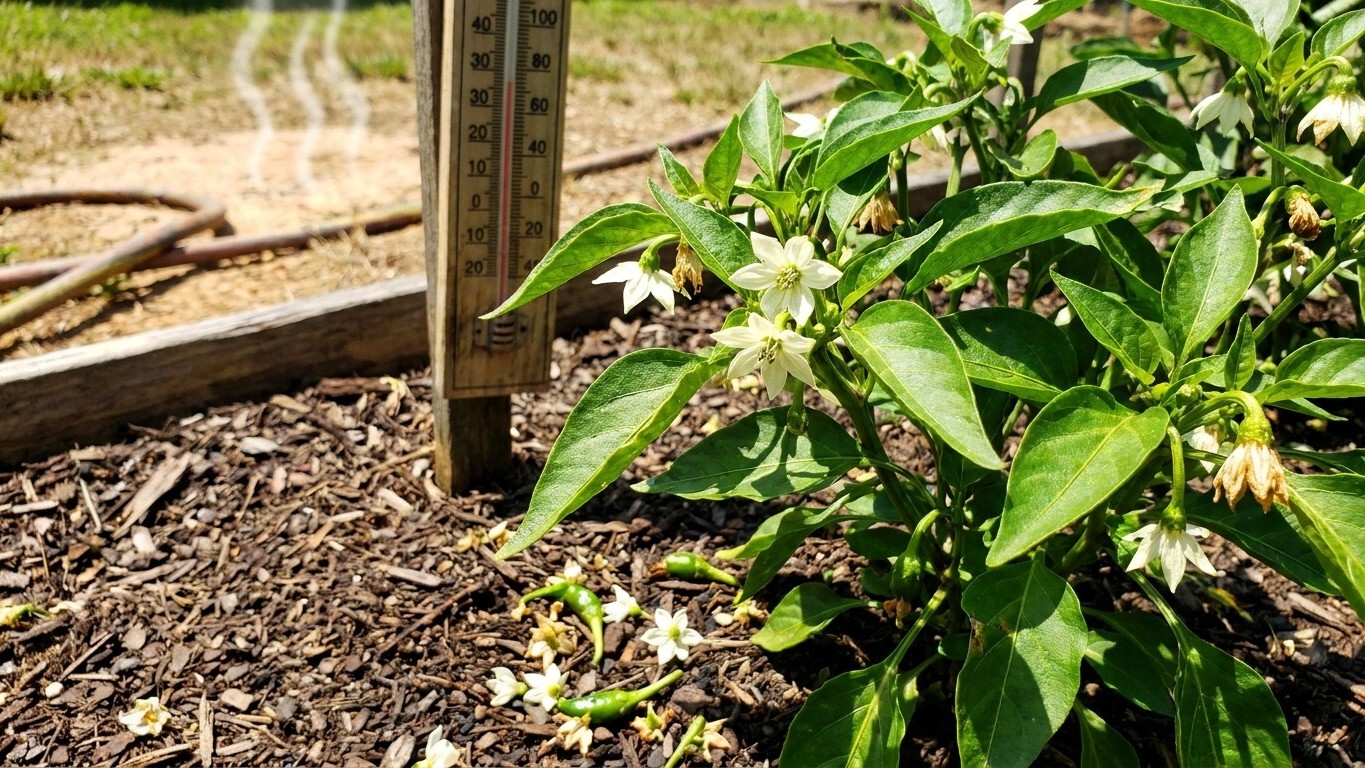

Peppers in Virginia most often Fail to Set Fruit because temperatures push past the crop’s narrow comfort zone in one direction or the other. Nights that stay above 55 F work fine, but once they drop below that mark, or once daytime highs climb past 90 F too often, flowers drop before they ever become peppers. Timing the transplant around the local frost date matters just as much.
The short answer
Virginia Beach, used here as the reference station, averages 26.0 days a year at or above 90 F. That number comes from NOAA’s 1991-2020 Climate Normals, and it’s the figure that matters for pepper growers, not the average summer temperature. A pepper plant can shrug off a single hot afternoon. What it can’t shrug off is a run of days where highs sit in the 90s for a week or more, because that kind of stretch causes the plant to abort its own flowers. The blossoms open, look fine, and drop off within a day or two without ever swelling into fruit. Twenty-six days spread across a Virginia summer usually means several short heat spells rather than one long one, which is actually the more forgiving pattern, but any grower inland from the coast, especially in the Piedmont or Southside, should expect more 90-degree days than the coastal reference station logs.
The other failure point sits at the opposite end of the thermometer, and it gets ignored far more often. Pepper flowers also stop setting fruit when nighttime lows fall below 55 F. Cool nights slow pollen viability and can cause the same blossom drop that heat does, just for a different physiological reason. This is where Virginia’s geography complicates things. The state runs from the Atlantic to the Appalachians, and summer night temperatures vary by more than latitude alone would suggest, since elevation and local terrain shift things by several degrees within short distances.
This site does not carry summer night minimum data for Virginia locations. That’s not an oversight to gloss over. It means a grower in Fairfax County, Roanoke, or Virginia Beach needs to track their own overnight lows through the growing season rather than assume a number based on where they sit on a map. A backyard thermometer or a basic weather station log for June through August will tell you far more than any regional guess, and it’s the only way to know whether cool nights are the reason your plants are dropping flowers while the calendar says it should be warm enough.
When to start seed here
Working backward from the garden calendar is the most reliable way to land pepper transplants in the ground at the right moment. Here’s how the arithmetic runs for most of Virginia:
- Start with the last spring frost date. For coastal Virginia, based on NOAA NCEI’s 1991-2020 Climate Normals and 32 F freeze probability data from station USW00013769 at NAS Oceana, that date falls between March 20 and April 3. That’s the mild end of the state. The Blue Ridge and southwest Virginia run weeks later, so anyone in those regions needs to check local frost records rather than borrow the coastal figure.
- Add the requirement that soil temperature reach 60 F before transplanting, per Utah State University Extension guidance on peppers. Air temperature can feel warm enough while soil several inches down is still cold from winter, so a simple soil thermometer check beats guessing from the calendar.
- Once you know your transplant window, count back 8 to 10 weeks to find your indoor seed-starting date. If your last frost falls around March 27, the midpoint of the coastal range, 8 to 10 weeks earlier lands seed-starting somewhere between mid-January and the very start of February.
- Adjust for your own county. If your local frost date runs two or three weeks later than the coastal figure, as it does through much of the Piedmont and points west, shift your seed-starting date later by the same span so the transplants aren’t sitting indoors, rootbound, waiting for warm soil.
That backward count is worth redoing every year rather than repeating from memory, since soil warms at different rates depending on how wet or dry the spring turns out. A raised bed or a south-facing plot can hit 60 F soil a week or two ahead of an open, low-lying garden, which is reason enough to check with a thermometer rather than trust the date alone.
What goes wrong here
- Blossom drop from a hot spell. When daytime highs push into the 90s for several days running, flowers open and fall without setting fruit. Provide afternoon shade with row cover or a shade cloth rated for 30 to 40 percent light reduction during the hottest stretch of a heat wave, and keep soil moisture steady, since drought stress on top of heat stress makes drop worse.
- Blossom drop from a cool night. Nights below 55 F cause the same symptom for the opposite reason. Since this site doesn’t track nightly lows for Virginia, watch your own thermometer through late spring and again in early fall, and if a cold snap is forecast, consider row cover overnight to hold in a few extra degrees around the plants.
- Sunscald on developing fruit. Virginia summer sun is strong enough to scald pepper skin on fruit that loses leaf cover, leaving pale, papery patches that often rot. Avoid heavy pruning during peak summer heat, and stake plants so foliage stays full enough to shade the fruit it’s growing.
- Blossom-end rot. This shows up as a dark, sunken patch on the bottom of the fruit and traces back to uneven calcium uptake, usually caused by inconsistent watering rather than a true calcium shortage in the soil. Water deeply and on a steady schedule instead of letting the soil swing between soaked and bone dry, and mulch to even out moisture between waterings.
Common questions
How many 90-degree days does Virginia average in a typical summer?
The Virginia Beach reference station averages 26.0 days a year at or above 90 F, based on NOAA’s 1991-2020 Climate Normals. Inland locations in the Piedmont and Southside typically see more such days than this coastal reference point.
What temperature at night stops peppers from setting fruit?
Utah State University Extension identifies 55 F as the low threshold: nights that drop below that mark interfere with fruit set, just as days above 90 F do. This site doesn’t publish night minimum data for Virginia, so track your own overnight temperatures through the season.
When is the safest time to transplant peppers in Virginia?
Transplant after your local last frost date and once soil temperature reaches 60 F. Coastal Virginia’s frost date typically falls between March 20 and April 3, per NOAA NCEI records for station USW00013769, but the Blue Ridge and southwest Virginia run weeks later, so check local data before setting a date.
Why do pepper flowers fall off without producing fruit?
Flower drop without fruit set almost always traces back to temperature stress at one extreme or the other, either a hot spell pushing days above 90 F or a cool stretch dropping nights below 55 F. Inconsistent watering during a heat spell tends to make the drop worse.