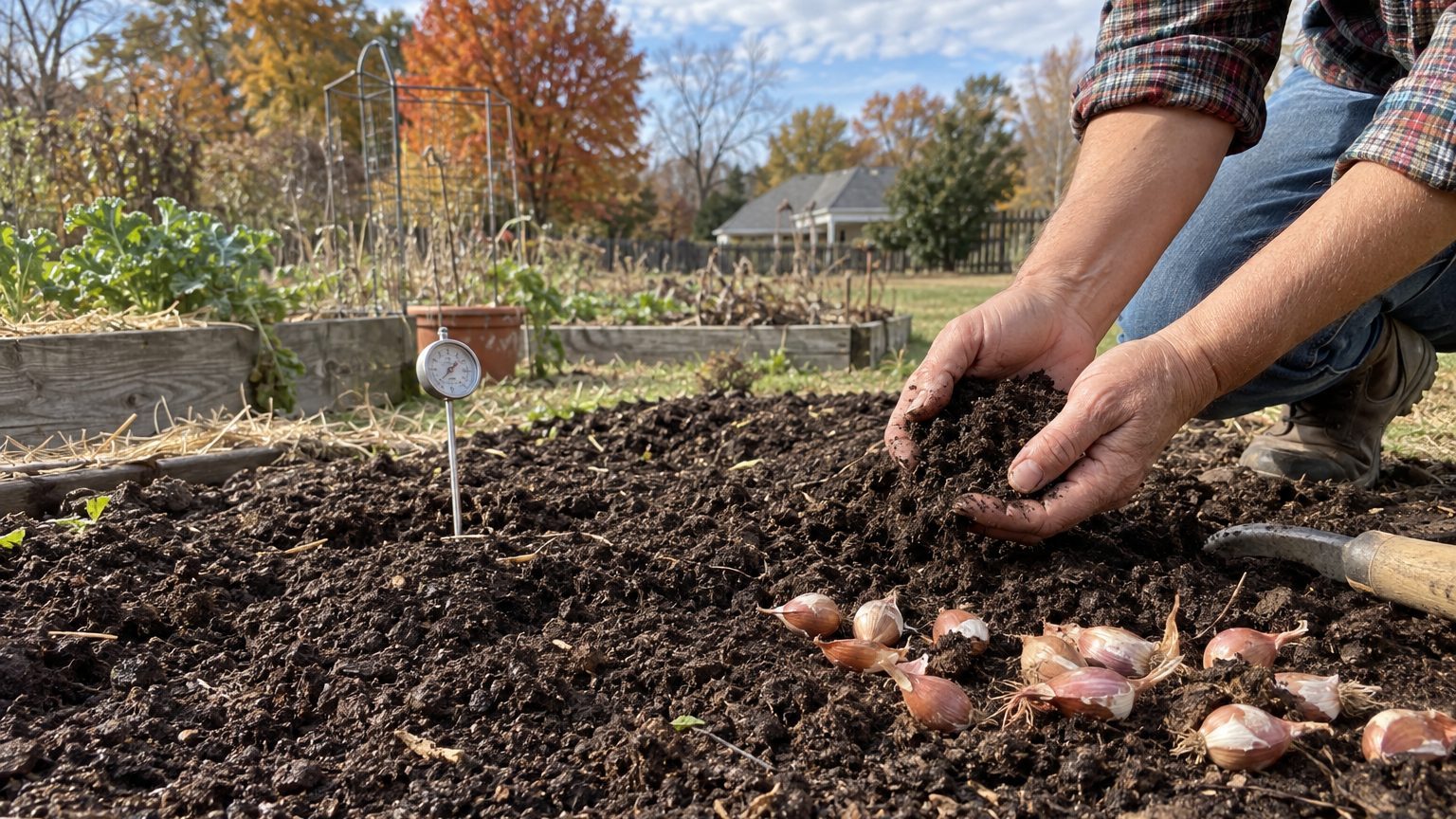

Shallots go into Virginia ground when the soil is workable and warming, not on a fixed date. On the coast, that means roughly late March into early April for spring planting. Autumn planting is a real option in the milder parts of the state. The Blue Ridge and southwest Virginia run weeks behind. The numbers below come from a coastal station, so treat them as the mild end of the range. For the crop in general, start with Growing Shallots: One Bulb In, a Handful Out.
When the soil is warm enough in Virginia
The last spring frost at NAS Oceana, in Virginia Beach, falls between March 20 and April 3. That range comes from the NOAA NCEI 1991-2020 Climate Normals and marks the band where the chance of a 32 F freeze sits between 30 and 70 percent (station USW00013769). A frost date is a probability, not a promise, so a late freeze after the band is always possible.
Reading the soil, not the calendar
Frost is a proxy. Shallots care about soil, and soil warms after the frost risk ends, not alongside it. Air can climb above freezing by mid-March while the top few inches of a clay bed stay cold and soggy. Sets pushed into that mud sit idle or rot.
The practical test is cheap. Grab a handful of soil and squeeze it. If it crumbles when poked, it is workable. If it stays in a slick ball, wait. A soil thermometer in the top few inches tells you whether the bed is trending up or still stuck. Most gardeners on the coast find the beds ready in the back half of that frost window. Inland, add weeks. The Blue Ridge and southwest Virginia run later in spring and earlier in fall than the coast does.
Autumn or spring, and what to check at harvest
Autumn planting works on the same logic in reverse. At the coast, the first fall frost lands between November 10 and November 24, so sets planted in autumn have time to root before the ground chills. Shallots handle the autumn-to-spring route much as garlic does, and the garlic section of this site covers the planting mechanics, mulch and rotation in depth. What differs for shallots is that each set multiplies into a cluster, so spacing has to leave room for a handful of bulbs rather than one.
Curing and storage are where food safety enters. Pull the tops, cure the bulbs somewhere dry with moving air, and inspect each one before it goes in storage. Look at:
- The neck, which should be dry and tight, never soft or damp
- The base, where any mold ends the question
- The skin and the flesh beneath it, which should feel firm all the way through
A bulb that looks fine is not proof it is sound. If the neck is soft or the base is moldy, discard it. No keeping time is guaranteed, because it depends on how well each batch cured.
How long the season lasts here
Set the two NAS Oceana frost ranges side by side. The last spring frost falls March 20 to April 3 and the first fall frost November 10 to November 24. Counting from the earliest spring date to the earliest fall date gives 235 days. The latest to the latest also gives 235. Stretch it from the earliest spring date to the latest fall date and it is 249 days. Squeeze it the other way and it is 221. So the frost-free window at the coast runs roughly 221 to 249 days, a bit over seven months at the short end.
That number matters less than what it allows. A window that long leaves room for a second sowing, which is the whole point of succession planting. A first batch of sets goes in as the soil warms, and a later batch or a different type follows weeks after, so the harvest does not land on one weekend. The succession sowing guide in our garden section walks through spacing those rounds. On the coast, it also leaves room for an autumn planting after a spring harvest, if you are building an overlapping rotation.
Transplanting also pays off in a long window. Starting shallots from seed or in trays indoors, then moving them out, buys a head start, but each move risks root damage. Where the season is generous, the check is worth doing, because a transplant that loses a few roots still has months to recover.
Move inland and the arithmetic tightens. The Blue Ridge and southwest Virginia start later and end earlier. What the shorter calendar changes is clear enough, though. With a short window, the first sowing is the only one, and transplanting stops being worth the root check. Direct-set the bulbs, and do it as soon as the soil allows. Growing Shallots in Minnesota shows what that one-shot approach looks like in a place with a far shorter season.
Heat and water in Virginia
The winter side is the number that decides autumn against spring.
At Virginia Beach, the mean daily minimum of the coldest month is 31.6 F. That is the average overnight low in the depth of winter, not a record low. It sits just under freezing, which means nights dip below 32 F but the ground rarely locks up hard. A set planted in autumn can root in that kind of ground, and the payoff is a larger, earlier bulb than a spring planting delivers. The USDA Plant Hardiness Zone Map 2023 puts the state across zones 5a to 8b. That system rests on one variable, the average annual extreme minimum temperature, and the spread is wide. The coast is the mild end, and the mountains are the cold end.
Where the ground freezes hard and stays wet, autumn-planted sets rot or heave out of the soil as it freezes and thaws. In the Blue Ridge and the colder interior, spring planting is the safer call. If you are deciding where your own garden falls, check the local winter before you check the calendar. Growing Shallots in Tennessee works through the same autumn-or-spring choice for a neighboring state with a similar mix of mild and cold ground.
Summer is the other half of the problem, and the honest view is qualitative. Virginia summers are humid, and warm, damp weather favors foliar disease, mildew and slow ripening of the tops. Shallots tolerate warmth if they get airflow, but a crowded bed with wet leaves is where trouble starts. Space the bulbs generously, keep the bed well drained (a raised bed helps on clay), water at the soil rather than overhead, and rotate alliums so the same bed does not host them year after year. Garlic and shallots share the same pests, so the garlic section’s rotation advice applies directly.
Which shallots suit Virginia
Choose by type, and let conditions rank the criteria. The varieties that perform in Virginia are the ones trialled in Virginia soil.
For the humid summers, disease resistance and tolerance come first. A type that stays clean through a wet June outranks one that sizes up slightly bigger on paper. For hot spells, favor types that cope with airflow and shade at the root, and plan on spacing and mulch to supply both. In the mountains, where the window shrinks, the earliest-maturing types make sense, because the first sowing is the only one.
Shallots grown from sets and shallots grown from seed also behave differently. Sets are the simpler route for most home growers, with divisions that multiply underground. Seed-grown types can suit larger plantings, but they need the longer, steadier window the coast offers and the root check that comes with transplanting. If you are not sure which fits your bed, start with sets.
The place to get a variety name is Virginia Cooperative Extension. Its agents and Master Gardener programs know which types have held up across the state’s very different zones, and they can tell you what is working in your county rather than at a reference station on the coast.
Common questions
Can I plant shallots in autumn in Virginia?
In milder areas, yes. At the coast, the first fall frost falls between November 10 and November 24, and winter nights average just below freezing. In the colder interior and mountains, hard freezes and wet ground can rot or heave sets, so spring is safer.
Is the last frost date the same as my planting date?
No. At NAS Oceana, the last spring frost falls between March 20 and April 3, but soil warms after the frost risk ends. Plant when the bed is workable and trending warmer, not when the calendar says so.
How do I know if a stored shallot is still safe to eat?
Inspect it. A firm, dry neck and a clean base are what you want. A soft neck or a moldy base ends the question, and the bulb goes in the trash. Looking sound is not proof of being sound.
Which shallot variety should I buy?
Ask Virginia Cooperative Extension for the varieties trialled near you. Choose a disease-tolerant type for humid summers, and in the mountains, the earliest types. Soil conditions in the Blue Ridge differ from the coast by weeks, so a variety that works at Virginia Beach may not suit a mountain bed.