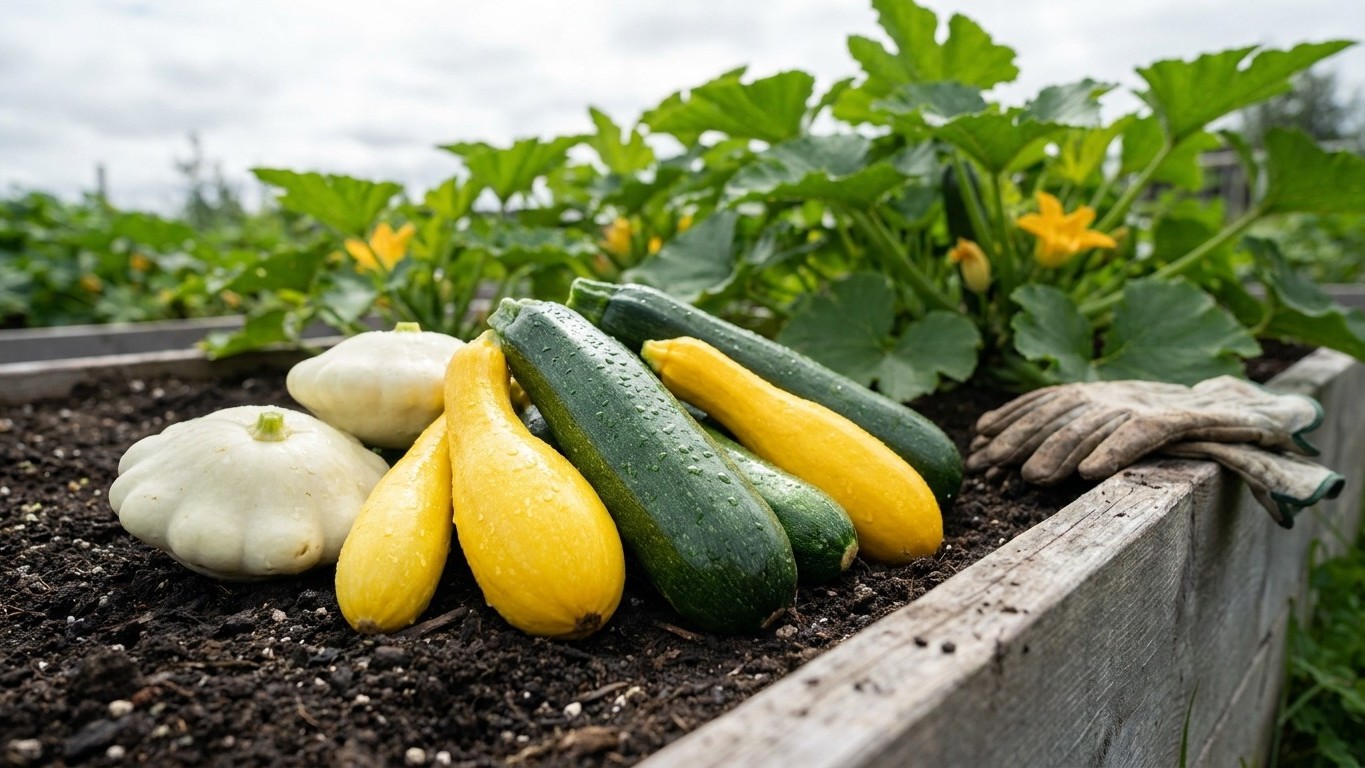

Western Washington’s cool, dry-summer climate favors fast-maturing, disease-resistant zucchini and yellow squash over the large-fruited, heat-hungry varieties bred for hotter regions. With only a handful of truly hot days each year, the varieties that mature quickly and set fruit without a long heat streak are the ones that actually fill a basket here.
The short answer for Washington
Start with the number that decides everything else: the reference station near Seattle averages just 3.0 days a year at or above 90°F. That is not a typo, and it is not close to what a gardener in Ohio or Georgia deals with. Summer squash is a heat-loving crop by nature, but it does not need scorching days to produce, it needs consistent warmth over a long stretch. Western Washington offers exactly that: a mild, extended window rather than a hot, short one.
That distinction should drive variety choice. Fast, compact producers that set fruit reliably in the 65-80°F range outperform varieties bred for desert or Deep South heat. Standard green zucchini, yellow crookneck, and scallop-type patty pan squash all do this well, and they are the varieties most commonly recommended for maritime Pacific Northwest gardens because they finish their fruiting cycle before cool, wet weather returns in fall.
Frost dates support a long growing window on paper. The last spring frost at the reference station falls between February 27 and March 18, and the first fall frost doesn’t arrive until November 13 to November 30. That’s close to eight months frost-free. But squash doesn’t care about frost dates alone, it cares about soil temperature, and cold, wet spring soil in western Washington routinely delays direct-seeding weeks past the last frost date. The type decision that matters most for this territory, then, isn’t which variety survives cold. It’s which variety matures fast enough to make full use of a mild but not blazing season, and which one tolerates the cool, damp air that settles in even during the growing months.
Choose compact bush-type zucchini and yellow squash over vining or trailing types, which take longer to establish and are slower to set their first fruit. Choose varieties marketed as early or short-season, generally maturing in the 45- to 55-day range from transplant, over the 60-plus-day varieties that need sustained heat to finish. That single shift, favoring speed over size, is the practical answer for most of this territory.
What will not work here
The clearest failure mode in this climate isn’t frost. It’s disease pressure that builds quietly across a cool, humid growing season. Powdery mildew is the single biggest threat to Summer Squash in western Washington gardens, and it thrives precisely because the region rarely gets hot and dry enough to knock it back. Varieties bred without mildew resistance, especially older heirloom types, often look fine in July and collapse by late August, just as they should be hitting peak production.
Rainfall numbers explain part of this. Summer rain across June, July, and August totals only about 3.0 inches, with July, the driest month, averaging just 0.6 inches. That sounds dry, and by irrigation standards it is: squash planted in July without supplemental water will stress and drop blossoms. But low rainfall totals don’t mean low humidity. The marine air that keeps this region mild also keeps foliage damp longer into the morning than a gardener from a drier interior climate would expect, and that dampness is exactly what fungal disease needs. Spacing plants for airflow, not just for root room, matters more here than the rainfall figures alone suggest.
Large, slow-maturing squash varieties bred for long, hot summers are the other clear mismatch. With only three days a year reaching 90°F, there simply isn’t the heat accumulation to push a 70- or 80-day variety to full size before fall weather and shortening daylight slow growth. Gardeners who plant these varieties often end up with a handful of undersized fruit and a lot of unproductive vine.
Weekly watering schedules, common advice in hotter, drier states, also underperform here. It isn’t that squash needs more water in western Washington, it’s that the water needs to be timed around the dry stretch of July specifically, rather than spread evenly across a summer that includes wetter June and August bookends. A schedule built for a uniformly dry summer doesn’t match this region’s lopsided rainfall pattern.
What changes across Washington
Washington’s hardiness zones span an enormous range, from 4a to 9a on the USDA Plant Hardiness Zone Map, and that spread alone should be a warning against treating this as a single-climate state. The frost dates and heat figures cited above come from a maritime reference station near Seattle. They describe a mild, marine-influenced climate typical of the Puget Sound lowlands, not the state as a whole.
East of the Cascades, Washington shifts into high desert conditions with a much shorter, hotter, and drier growing season, and this page does not have verified frost-date or heat-day figures for that region. Applying the western Washington windows to a garden in the Columbia Basin or the Okanogan would be a mistake in both directions: the frost-free season is likely shorter there, and the summer heat load almost certainly far higher than the 3.0 days above 90°F recorded near Seattle.
Elevation adds another layer inside the western side of the state as well. Gardens in the foothills of the Cascades or the Olympics sit at higher elevation and cooler nighttime temperatures than the lowland reference station, even at similar latitude. A zone 9a rating near Puget Sound tells you almost nothing about a garden a few thousand feet up a mountain valley, where a zone in the 6a to 7a range is far more likely.
None of this means guessing. It means checking where a specific garden actually falls before trusting any single frost date or zone number on this page. The USDA hardiness map is built for exactly this kind of lookup, and a gardener in the north Cascades foothills or east of the mountains should treat the Seattle-area figures here as a baseline for comparison, not a direct answer.
Where to check this for your own county
The Washington State University Extension service is the right next stop. This page has described the state-level picture: maritime frost dates, low heat-day counts, and rainfall patterns tied to one reference station. A county extension office works from local trial data and local weather records, and that beats a statewide figure every time.
Two things are worth looking for specifically. First, the local planting calendar for the county in question, since a coastal county, a Puget Sound lowland county, and an eastern Washington county will each publish different windows for direct-seeding or transplanting summer squash, reflecting real differences in soil warm-up and frost risk that a single state figure can’t capture. Second, the list of varieties actually trialled in that county’s demonstration gardens or master gardener programs. Extension offices often maintain performance notes on which zucchini, yellow squash, or patty pan varieties held up against local disease pressure and local growing conditions over multiple seasons, information no state-level page can offer with the same precision.
This page has given the state’s baseline: a long, mild, cool-summer growing season where fast-maturing, mildew-resistant varieties outperform heat-hungry ones, with a clear caveat that eastern Washington runs on different numbers entirely. A county recommendation from WSU Extension will sharpen that baseline into something specific to the soil and microclimate of the reader’s own address, and that’s a step this page simply cannot take on its own.
Checking this against your own garden
Every date and figure on this page is a regional average, and a reader’s own garden will always outrank it. Three simple checks, needing no equipment beyond a hand and a pair of eyes, tell more about a specific plot than any calendar.
Soil warmth by feel comes first. Squash seed sits and rots in cold soil no matter what the calendar says, so before direct-seeding, press a bare hand into the top few inches of soil in the planting bed. If it feels only slightly cool, similar to room temperature, that’s a far better signal than the frost-free date, especially in a region where cold, wet spring soil is common well past the last freeze.
The first flush of male flowers is the second signal worth watching. Squash plants typically produce male flowers before female ones, and a garden that’s slow to show any flowers at all, well past the point neighboring gardens are flowering, is telling the gardener something about a cooler-than-average microclimate, whether from shade, elevation, or exposure to cool marine air.
The first true leaves, the second set that appears after the initial rounded seed leaves, mark the point where a seedling has moved from surviving to actually growing. A slow gap between seed leaves and true leaves usually points to insufficient warmth or light, both common limiting factors in a maritime climate with a modest heat budget, and a signal to hold off on transplanting a second round rather than force the schedule.