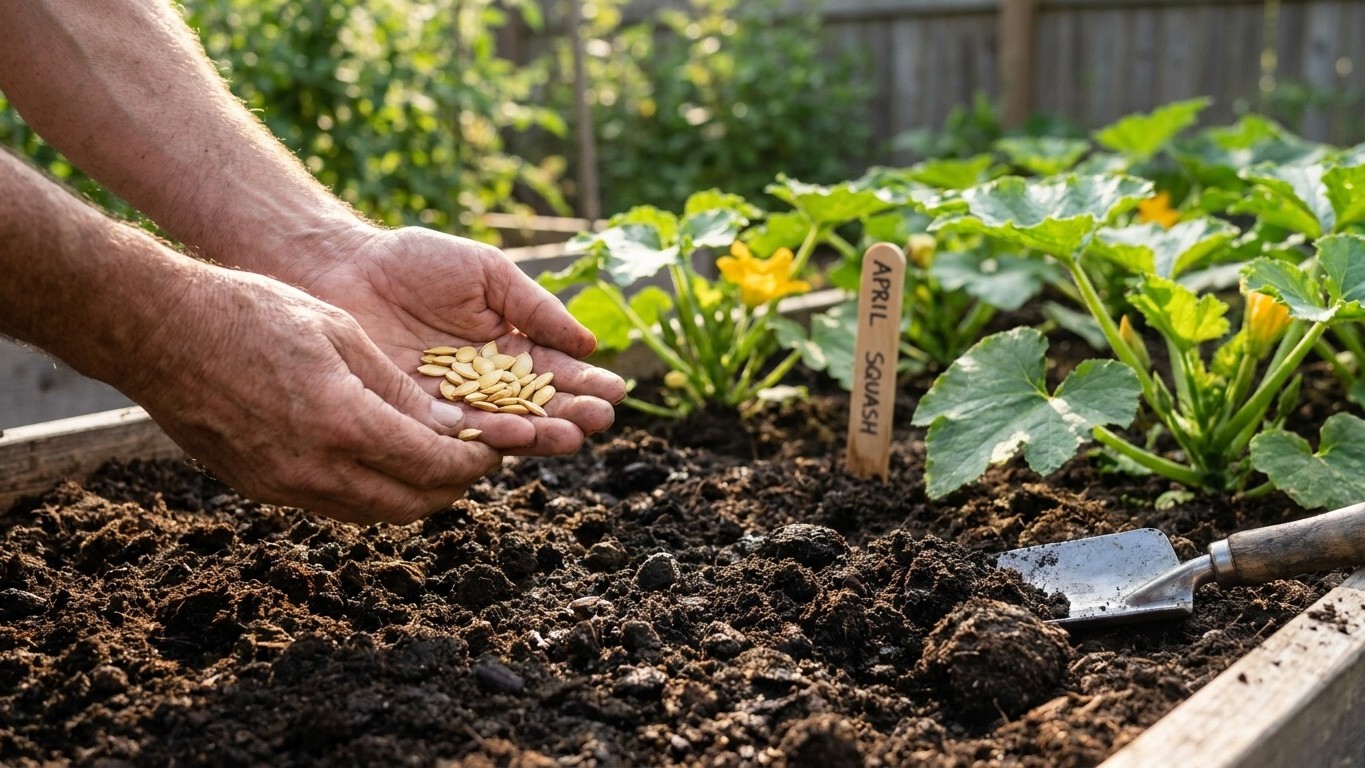

Summer squash goes into West Virginia soil after the last spring frost clears, roughly April 9 to April 23 depending on where you garden, and stops producing when the first fall frost hits, somewhere between October 18 and November 1. That gives most of the state a solid five-to-six-month window, but the exact dates you pick depend on more than a calendar page.
The short answer for West Virginia
West Virginia’s last spring frost falls between April 9 and April 23, based on NOAA’s 1991-2020 climate normals for the Charleston reference station (USW00013866). Those two dates aren’t a guess and they aren’t a single “safe day.” They mark a 30-to-70% probability band for a 32F freeze. Plant on April 9 and you’re accepting up to a 70% chance a freeze still happens after that date. Wait until April 23 and the odds drop to roughly 30% or lower. Summer squash has zero frost tolerance, so the practical move for most gardeners is to sow at or after the later end of that window, unless you’re prepared to cover seedlings or replant.
Soil temperature matters as much as the calendar date. Squash seed wants soil in the 60s F to germinate reliably; cold, wet soil in early April just sits there and rots. Since the frost-probability band already pushes sowing toward mid-to-late April, soil warmth and frost risk tend to line up in West Virginia’s favor rather than fighting each other.
On the back end, the first fall frost arrives between October 18 and November 1, again per the same NOAA normals. Summer squash typically matures in 50 to 65 days from seed, so even a late-April planting finishes well before that window closes. That leaves room most years for a second, mid-season sowing in late June or early July if the first planting gets hit by squash bugs or vine borers, a common reason to replant rather than nurse a failing patch.
What this page does not have is a county-level date. The frost dates above come from one reference station in the Kanawha Valley. If you garden at higher elevation or farther from that valley, treat April 23 as a floor, not a target, and lean toward the later side of the window.
What will not work here
Season length isn’t the obstacle in West Virginia. The gap between the later spring frost date (April 23) and the earlier fall frost date (October 18) is close to six months, far more than any summer squash variety needs. So the “my squash never had time to finish” failure that shows up in short-season states doesn’t really apply here. What actually trips people up is watering rhythm and disease pressure, not the clock.
The reference station averages about 13.8 inches of rain across June, July, and August, but that total isn’t spread evenly. June brings 4.72 inches, July 5.38 inches, and August drops to just 3.75 inches, the driest of the three summer months. A gardener who waters once a week on a fixed schedule is fine in a wet June and dangerously behind by mid-August, right when squash plants are sizing fruit and pulling the most water from the soil. Add in 16 days a year averaging 90F or hotter, enough to spike evaporation without qualifying as extreme heat, and a once-a-week habit built in spring quietly starves the plants by late summer.
The rainfall numbers hide another problem: distribution within each storm. Summer rain in this region tends to arrive as thunderstorms rather than steady soaking rain. A two-inch downpour that falls in forty minutes runs off far more than it infiltrates, especially on compacted or clay-heavy soil common in West Virginia’s hillside gardens. Counting that storm as “watering done for the week” is a common and avoidable mistake.
Close spacing is the other failure point. West Virginia’s river valleys and wooded hollows trap humidity, and summer squash planted at the tight spacing recommended for drier climates invites powdery mildew and bacterial wilt before August even starts. Give plants more air movement than the seed packet suggests if your garden sits in a valley or near tree cover, and expect to lose some spacing efficiency in exchange for keeping the foliage dry longer after rain or dew.
What changes across West Virginia
West Virginia spans USDA Hardiness Zones 5a through 7a, a range built entirely on average annual extreme minimum winter temperature, per the USDA Plant Hardiness Zone Map (2023 edition, based on 1991-2020 normals). That’s a wide spread for one state, and it’s driven almost entirely by elevation and river valley effects rather than latitude. A garden in a sheltered valley can sit a full zone or two warmer than a ridge-top garden twenty miles away.
There is no single planting date that works for all of it. The frost dates cited above come from the Charleston station, sitting in a river valley, and NOAA’s own caution applies directly here: valley stations report later fall frosts and earlier spring frosts than the mountains around them. Higher elevations across the state freeze noticeably earlier in autumn, sometimes by two to three weeks compared to the valley floor.
What that means in practice: a reader gardening at higher elevation should treat the October 18 fall frost date as optimistic, not as a working assumption, and should plan a slightly earlier harvest window or accept a shorter fruiting season. A reader in a warmer, lower-elevation valley might push a succession planting a bit later into early July and still finish before frost. Neither of those numbers appears in the state-wide facts above, because they depend on exactly where inside West Virginia the garden sits.
Rather than guess which zone applies to your yard, check it against the interactive USDA Plant Hardiness Zone Map, which lets you enter a ZIP code and get the specific zone for that location rather than the state-wide 5a-7a range. That single lookup does more to sharpen your planting date than any rule of thumb based on county name or general region.
Where to check this for your own county
This page gives the state-wide picture, built from one reference station’s frost data and one statewide hardiness range. A county recommendation will always beat a state one, because it accounts for the elevation, valley effects, and local soil conditions this page can’t see. West Virginia University Extension is the place to get that county-specific version, at extension.wvu.edu.
Two things are worth hunting down there specifically. First, a local or regional planting calendar, if the county office publishes one, will adjust the frost-date window to actual local conditions rather than the Kanawha Valley numbers used here. Second, look for any variety trial results or extension bulletins naming summer squash varieties tested in West Virginia conditions. Extension offices often run or reference regional variety trials that flag which types held up against squash vine borer, powdery mildew, or the wet-then-dry summer pattern typical of the state, information no state-wide calendar can capture.
Extension staff and county agents also field direct questions by phone or email, and they’re generally used to fielding exactly this kind of question from home gardeners rather than commercial growers. If your garden sits at elevation, in a narrow hollow, or in an unusually exposed spot, a five-minute call to your county office is likely to produce a more useful answer than any statewide date range, including this one.
Checking this against your own garden
Every date on this page is a regional average built from thirty years of weather records at one station. Your own garden will confirm or contradict those numbers faster than any calendar, and three simple checks tell you which way it’s leaning.
Start with soil warmth by feel. Push a finger a couple of inches into the planting bed in mid-morning. Cold and clammy soil means germination will be slow and uneven no matter what the calendar says; soil that feels closer to room temperature is ready for seed. This is a more honest test than counting days from the frost date, since a shaded or north-facing bed warms noticeably slower than an open, south-facing one even a few yards away.
Second, watch for the first flush of male flowers. Summer squash produces male blossoms before female ones, sometimes by a week or two, and an early wave of males with no fruit-set yet is completely normal, not a failure. It’s a signal the plant has shifted into reproductive mode and female flowers, the ones with a tiny swollen squash shape behind the bloom, are close behind.
Third, track how fast true leaves appear after the seedling’s first pair of round cotyledon leaves. Quick true-leaf growth points to warm enough soil and adequate moisture; a stalled seedling sitting at the cotyledon stage for a week or more usually means the soil is still too cold or too wet, regardless of what the frost-date window suggests for your area.