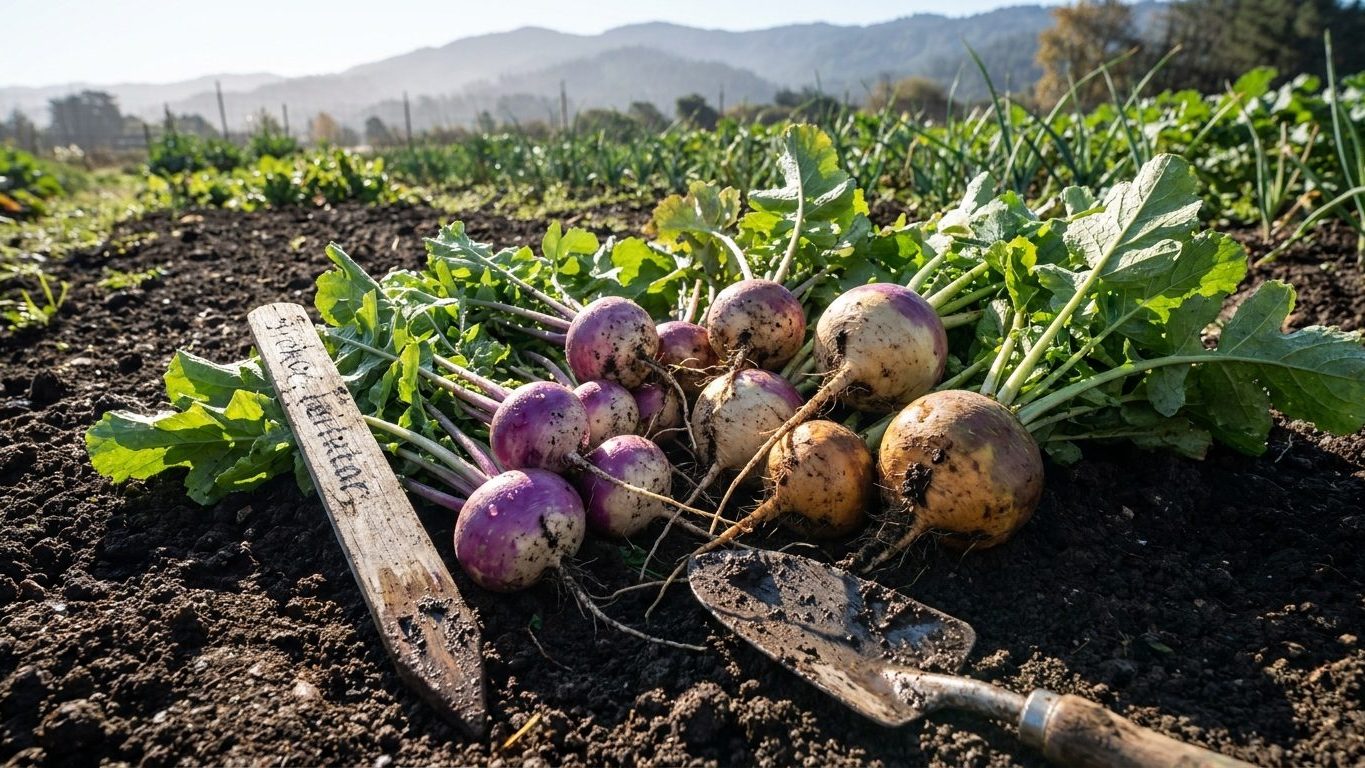

For most West Virginia gardens, the best turnips are quick, smooth-rooted types such as Purple Top White Globe and Hakurei, grown mainly as a fall crop. Rutabaga earns a place too, as long as it is sown early enough to finish before the first hard freeze. Greens-type turnips, Seven Top for example, cover the spring. Slow, heavy-rooted varieties are where the state says no.
The short answer for West Virginia
The numbers behind that answer come from the Charleston station. In NOAA’s 1991-2020 Climate Normals, the last spring freeze (32°F) falls between April 9 and April 23. The first fall freeze falls between October 18 and November 1. Both ranges are the 30-70% probability band: inside them, the chance of a 32°F night sits between 30 and 70 percent. They are odds, not promises, and a late cold snap in the middle of the April window is ordinary. Charleston is also a river valley, so the rest of the state differs, and higher ground freezes noticeably earlier in fall.
From the April window to the October window is about six months at that station. That is enough for a spring crop of fast turnips and a longer fall crop, though not enough to be careless. This page does not carry a summer temperature figure for the state, so the call on heat rests on the crop’s nature. Turnips and rutabaga are cool-season roots, and they size up best when the nights are cool. Fall is therefore the stronger season, and spring is the shorter, riskier one.
Turnips by type
Quick white salad types like Hakurei are the safest bet for a first try. They mature fast, they can be pulled small, and they fit in either the spring or the fall gap. Purple-top globe turnips are the all-purpose choice, with a sturdy root for storage-minded cooks and edible tops. Greens turnips grown for leaves alone are the most forgiving of all, because you harvest long before the roots matter.
Rutabaga
Rutabaga takes noticeably longer than any turnip, so it belongs in the fall plan. Sow it in late summer so the roots finish in cool weather. Established open-pollinated types such as Laurentian and American Purple Top are the ones to look for. For the sowing dates, the When to Sow Turnips in West Virginia page works them out from the frost windows above. The wider picture of the crop is in Growing Turnips and Rutabaga in West Virginia.
| Type | Best season here | Fit for West Virginia |
|---|---|---|
| Quick white turnips (Hakurei) | Early spring or fall | Very good; fast enough to beat both frost windows |
| Purple-top globe turnips | Fall, with a spring sowing possible | Good all-rounder for roots and tops |
| Greens turnips (Seven Top) | Spring and fall | Very forgiving; harvest leaves young |
| Rutabaga (Laurentian, American Purple Top) | Fall only | Good if sown on time; poor if started late |
What will not work here
The most common failure is sowing rutabaga in spring. It is slow, and in West Virginia the spring window is short. The ground thaws, the April freeze odds fade, and the weather turns warm before a rutabaga has built a decent root. Warm weather pushes roots toward woody, bitter and split. A spring rutabaga is mostly a lesson. Sow it in late summer and let the cool autumn do the work.
Late fall sowing fails for the opposite reason. At Charleston the first freeze lands between October 18 and November 1, and that is the valley, the mild end of the state. A turnip sown in mid-September on a ridge may meet a hard freeze long before its root is a useful size. Greens will survive a frost, even sweeten after one, but a half-formed root will not rescue the crop.
Overwintering is a poor plan too. The mean daily minimum of the coldest month at Charleston is 26.1°F. That is the average night, not the record low, which means hard freezes are routine in winter even in the valley. Turnip tops that sailed through October will not stand all winter unprotected, and the roots are not dependable in the open ground at that figure. Treat both crops as harvest-by-December plants, or pull them and store them.
Humidity is the quieter problem. This page does not have a humidity or rainfall figure for the state, so the point rests on what hollows and river valleys are known for: still, damp air. Seedlings planted shoulder to shoulder in that air stay wet longer, and leaf diseases and rot get a head start. Thin turnips to the spacing on the seed packet, and give rutabaga more room than you think it needs. Crowding does as much harm here as a cold snap.
One more failure is trusting a single date. A planting date copied from a seed packet written for a flatter, drier region will not account for a hollow where cold air pools or a south slope that warms early. Use dates as a starting point and then let the garden correct them.
What changes across West Virginia
West Virginia does not have one growing climate. The USDA Plant Hardiness Zone Map (2023, built on 1991-2020 normals) places the state in zones 5a to 7a. That span is wide, and it is why there is no single answer here. Zone is built on one variable, the average annual extreme minimum temperature, so it says little about when the first fall freeze arrives or how long a crop has to size up. It still tells you which end of the spread you are on.
Charleston is the reference here, and it is a river valley. Gardeners in the northern part of the state, and anyone at altitude in the mountains, should expect colder winters and earlier fall freezes than the Charleston figures. For them the practical shifts are simple. Sow fall crops earlier than the valley schedule suggests. Favor the fast types: Hakurei, greens turnips, and purple-top globes sown on time. Treat rutabaga as a late-summer sowing with no slack in it, or skip it if the elevation is high and the season short.
Gardeners in the milder valleys and the southern lowlands have more room. The fall window stays open longer, a rutabaga sown on time has a fair run at a full-size root, and a spring crop of turnips is safer. Even there, the Charleston dates are probabilities for one station, not a guarantee for your lot.
Nobody can tell you which zone your yard sits in from a web page. Check the USDA Plant Hardiness Zone Map and enter your ZIP code. Then adjust the Charleston dates in the direction your zone points: earlier fall and later spring as you move colder, the reverse as you move warmer.
Where to check this for your own county
This page is the state view, and a county recommendation beats it. West Virginia’s land-grant extension service is West Virginia University Extension, and its county offices see the same frost pockets, soils and failures that you do. Go there with two things in mind.
- The local planting calendar. Look for sowing dates for your county or your part of the state, and compare them to the Charleston windows on this page. If they say earlier for fall, believe them.
- Varieties trialled nearby. A variety that performed in a trial at your elevation is better evidence than a catalog description. Note which turnips and rutabagas were grown, and how they handled the weather.
This page does not contain a county-level calendar or a list of trial results, and it makes no claim about either. Nor should you take a calendar from another state’s extension service. Neighboring states sit in different climates, and a fall date that suits one can be a month off for you. Every state publishes its own materials, and the one that covers your county is the one to follow.
If you cannot find a vegetable calendar online, call or email your county extension office and ask what they recommend for turnips and rutabaga in your area. Local staff often know things that never reach a PDF, such as which hollow freezes first and which soils bake dry in August.
Checking this against your own garden
Your own observation outranks every date above. Three signs are worth watching, and none needs equipment beyond your hands and eyes.
First, feel the soil. Push your hand a few inches into the bed in early spring. If it is cold and clammy and clumps in a wet ball, the seed will sit and the crop will lag. If it crumbles and feels neutral on your skin, you are in the window. A bed that warms a week or two ahead of a neighbor’s tells you your site runs early, so shift your sowing accordingly.
Second, watch for the first flush of male flowers on squash or zucchini. They open before the females and signal steady warmth. For a spring turnip crop, that is a sign the window is closing. For a fall plan, it is a reminder that the late-summer sowing for rutabaga is near, and that the warmth still in the soil will help seeds sprout.
Third, watch the first true leaves. After the rounded seed leaves come the rough, lobed true leaves. If your seedlings reach that stage within a week or so of sowing, your timing is good. If they stall, or lean and stretch, the weather or spacing is working against you. Thin as soon as those leaves appear. Then note where the first frost bites your garden, whether on the low corner or the open slope, and write it down. Next year that note will be worth more than any chart.
Common questions
Can I grow rutabaga in West Virginia?
Yes, as a fall crop. Sow it in late summer so the roots finish in cool weather before the first freeze, which at Charleston arrives between October 18 and November 1. At higher elevations the freeze comes earlier, so the margin is thinner.
Which turnip is best for beginners?
A quick white type like Hakurei is the safest first choice, because it matures fast and can be harvested small. A greens turnip such as Seven Top is even more forgiving, since you are growing leaves rather than roots.
Should I plant turnips in spring or fall in West Virginia?
Fall is the stronger season, because turnips size up best in cool weather. A spring sowing can work with fast types, but the window is short: the last spring freeze at Charleston falls between April 9 and April 23, and warm weather follows soon after.
Will turnips and rutabaga survive the winter in the garden?
Do not count on it. The mean daily minimum of the coldest month at Charleston is 26.1°F, so hard freezes are routine. Harvest before deep winter, or protect the bed and expect mixed results.