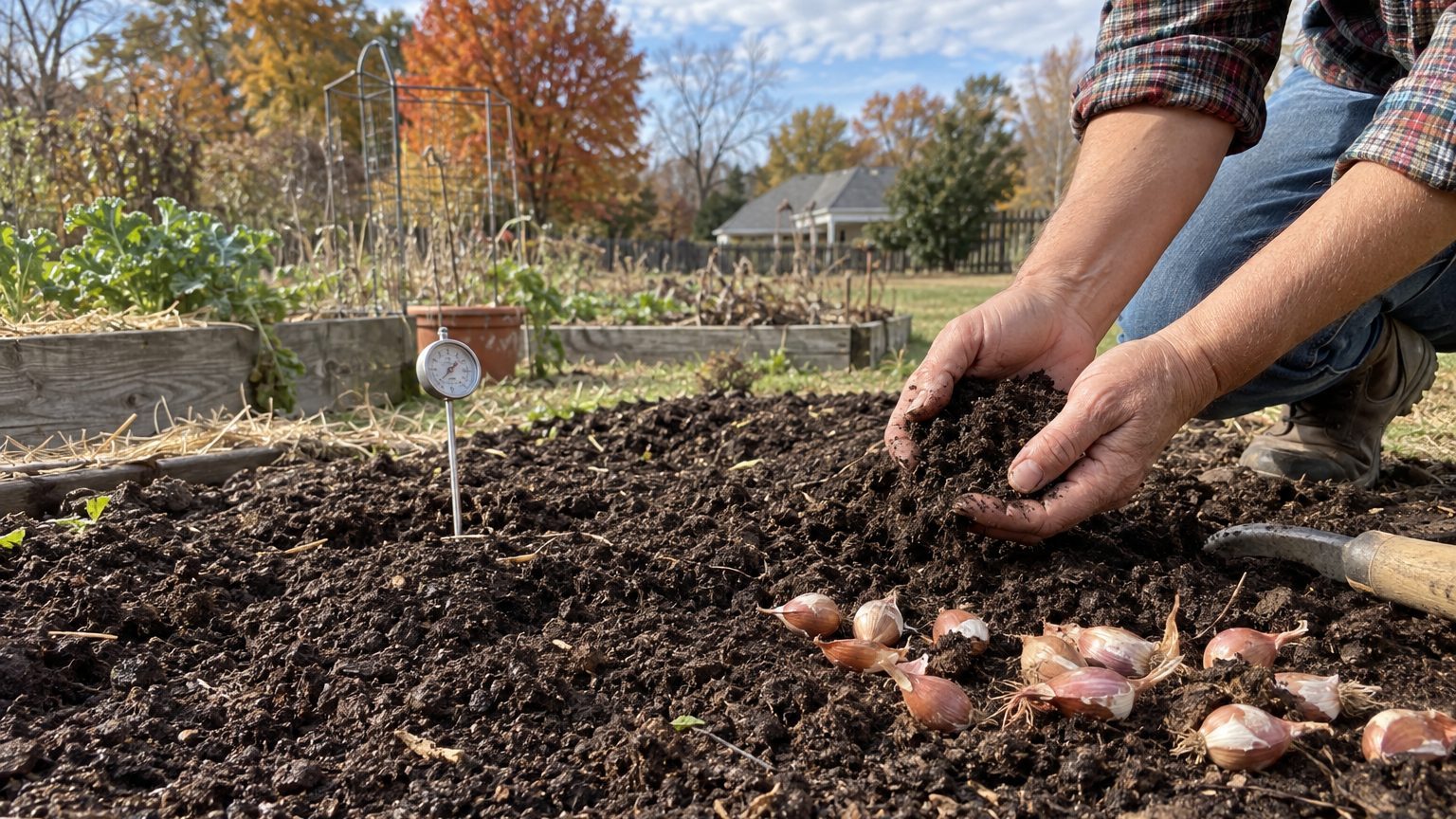

In Wisconsin, plant shallots in spring as soon as the ground can be worked, which means April in the south and later in the north. Autumn planting works only where winters are gentler and the bed is mulched. The NOAA normals put the last spring freeze between April 16 and April 29, but the soil, not the calendar, gives the real go-ahead. For most of the state, spring is the safer default.
When the soil is warm enough in Wisconsin
The last spring freeze, according to the NOAA NCEI 1991-2020 Climate Normals (32 F freeze probabilities, 30-70% band, station USW00014839), falls between April 16 and April 29. That span is the stretch when the odds of another 32 F freeze sit between 30 and 70 percent. It is a probability, not a promise, and a late freeze in early May is always possible.
Frost is also a proxy. Shallots do not care what the thermometer said on a given night. They care about the soil: whether it has thawed, drained, and stopped feeling like cold oatmeal. Soil warms after the frost risk fades, not alongside it, so a bed can be frost-free on paper and still be too wet and cold to plant. Grab a handful, squeeze it, and tap it. If it forms a sodden ball that won’t crumble, wait. Working wet clay compacts it, and compacted soil is hard on shallow-rooted alliums.
Why the date moves across the state
The station behind those dates sits in the southeast, close to Lake Michigan, which moderates temperatures. Inland southern Wisconsin and the north run colder, and the north also thaws later. Wisconsin also spans USDA hardiness zones 3b to 6a (USDA Plant Hardiness Zone Map 2023, built on the average annual extreme minimum), so a planting date that suits a lakeshore bed in the south will be early for a garden near the northern border. Use the April 16 to April 29 span as a starting reference for the southeast, then adjust to what your own soil is doing.
Established shallot sets generally shrug off a cool snap once they are rooted. A spring set pushed into mud, though, may sit and rot instead of growing. Patience in April usually costs less than a replant in May.
What carries over from garlic
Shallots share several habits with garlic: autumn planting, curing, storage, and keeping alliums out of beds where onions or garlic grew recently. Shallots differ in a few ways. They multiply into clusters from a single set, so they need more elbow room than a single clove. They are often planted in spring where garlic is planted in fall. And the harvested bulbs are smaller and thinner-skinned, which makes the curing inspection matter more.
When curing, look at the neck and the base. A neck that is still soft or moist, or a base showing mold, ends the question for that bulb. Looking sound is not the same as being sound, so don’t pass a bulb on appearance alone. For the general picture of how a shallot grows, the main guide, Growing Shallots: One Bulb In, a Handful Out, is the place to start.
How long the season lasts here
Count from the early end of the spring range to the early end of the fall range: April 16 to October 17 is 184 days. Count from the late ends: April 29 to October 29 is 183 days. Both come from the same NOAA station, so the window is about 183 to 184 days between the last spring freeze and the first fall freeze (first fall frost span: October 17 to October 29).
That number comes with a caveat the data itself spells out. Lake Michigan delays the first fall freeze at the lakeshore, while inland southern Wisconsin typically freezes in early October and the north far earlier. A garden in the north or well inland should count on a shorter window than the station figures suggest. Those 183 to 184 days are the lakeshore best case, not the statewide average.
What a window of this length allows
A window that long leaves room to be flexible. Shallots mature on a summer schedule, so the planting that goes in earliest gives the best bulbs, and a planting made weeks later will produce smaller ones. A second planting still has uses: staggered harvests of green tops through the summer, or a late batch of bulbs where size doesn’t matter. Treat the first planting as the main crop and anything after it as a bonus. The Growing Shallots in New Hampshire page shows how another cold-winter state handles the same trade-off, and the succession sowing guide on this site lays out how to space repeat plantings.
Transplanting is the other question the window answers. For seed-grown shallots started indoors, the transplant route buys time, but only if the roots are worth the effort. Check the root ball before setting out: white roots reaching the edge of the cell and holding the soil together are what you want. Where the window is shorter, inland or in the north, that head start can decide whether a seed-grown crop sizes up at all. Near the lake, with the full 183 to 184 days, sets planted directly are simpler and need no root check.
Heat and water in Wisconsin
What they do show is a northern state, where heat is the smaller worry. Hot spells do occur, but the more common summer problem for a shallot bed is a cool, damp spell. That brings downy mildew, other leaf and neck diseases, slow ripening, and tops that refuse to fall over on schedule. Bulbs that ripen slowly in wet weather cure poorly, and curing is where food safety comes in.
That makes water management a matter of drainage and airflow. A raised bed or ridged row sheds water, and spacing the plants leaves room for air to move. Keep irrigation off the foliage, and pull mulch back from the necks when leaves start yellowing. In a damp season, those habits matter more than any extra watering.
Autumn against spring: the winter decides
The deciding figure is the winter low. At the Milwaukee reference station, the mean daily minimum of the coldest month is 17.2 F (NOAA NCEI Climate Normals 1991-2020). That is a monthly mean of the nightly lows, not a record, so colder nights are common, especially inland and north. Where the ground freezes hard and stays wet, autumn-planted sets rot or heave out of the soil during freeze-thaw cycles. Where winters are milder, and especially with a loose mulch applied after the ground freezes, autumn planting gives larger bulbs that start growing earlier in spring.
| Criterion | Autumn planting | Spring planting |
|---|---|---|
| Winter risk | Rot or heaving in wet, hard-freezing ground | Avoids the winter entirely |
| Where it fits | Milder, well-drained sites near the lake, with mulch | Inland, northern, and poorly drained gardens |
| Payoff | Larger, earlier bulbs when it works | Reliable stand, smaller margin for size |
| Main risk | Losing the planting | Wet, cold April soil delaying the start |
My advice for most Wisconsin gardeners: plant in spring, and try a small autumn block on your best-drained bed as a test. Timing and mulching for autumn follow the same rules as garlic, so the garlic pages on this site cover the how. Montana faces a similar winter question, and Growing Shallots in Montana works through it for a drier climate.
Which shallots suit Wisconsin
The only recommendation worth trusting is one based on trials in your own conditions. A cultivar that thrived in a milder state can sulk in a Wisconsin bed. The University of Wisconsin–Madison Extension is the right source for what has been trialled locally, and its county offices can tell you what grows near you.
What can be said is how to choose by type, reasoning from the territory’s facts. The window is about 183 to 184 days at the lakeshore and shorter inland and north, so the earliest-maturing types are the safer pick, because they have the best chance of sizing up and curing before fall closes in. If a cool, wet summer is the likelier threat, disease resistance should be the first criterion on the seed or set listing. Look for notes on leaf disease tolerance and neck rot, because those are what damp seasons bring.
The choice between multiplier types grown from sets and seed-grown types depends on your window. Sets are quicker and need no transplant check, so they are the practical option for most gardens. Seed-grown types can work near the lake with a good indoor start, and they offer more variety, but a shorter inland season leaves less room for error. Whichever you choose, give them airflow, good drainage, and a bed that has not held onions, garlic, or leeks recently. Rotating alliums breaks the disease cycle, and in a damp climate that matters.
When the crop comes out, cure it in a dry, airy place and inspect each bulb. A soft neck or a moldy base means that bulb goes in the trash, not in storage.
Common questions
Can I plant shallots in Wisconsin in the fall?
Yes, with conditions. With a coldest-month mean daily minimum of 17.2 F at Milwaukee and hardiness zones running from 3b to 6a, autumn planting works best on well-drained ground in the milder south, with mulch after the soil freezes. In northern or wet sites, sets often rot or heave, and spring planting is safer.
What is the last frost date for shallots in Wisconsin?
According to NOAA NCEI 1991-2020 Climate Normals for station USW00014839, the last spring freeze falls between April 16 and April 29. It is a probability band, and the station sits near Lake Michigan, so the north and inland run later. Wait for workable soil, not just the date.
How many days do shallots have to grow here?
From the same NOAA normals, the span between the last spring freeze and the first fall freeze is about 183 to 184 days (April 16 to October 17, or April 29 to October 29). Inland and northern gardens get less, since the first freeze arrives earlier there.
Which variety should I grow?
Ask the University of Wisconsin–Madison Extension for the varieties trialled in your county. Local trial data beats any list from outside the state, and a county extension office can usually tell you which garden clubs or growers in your area keep records of what has worked.