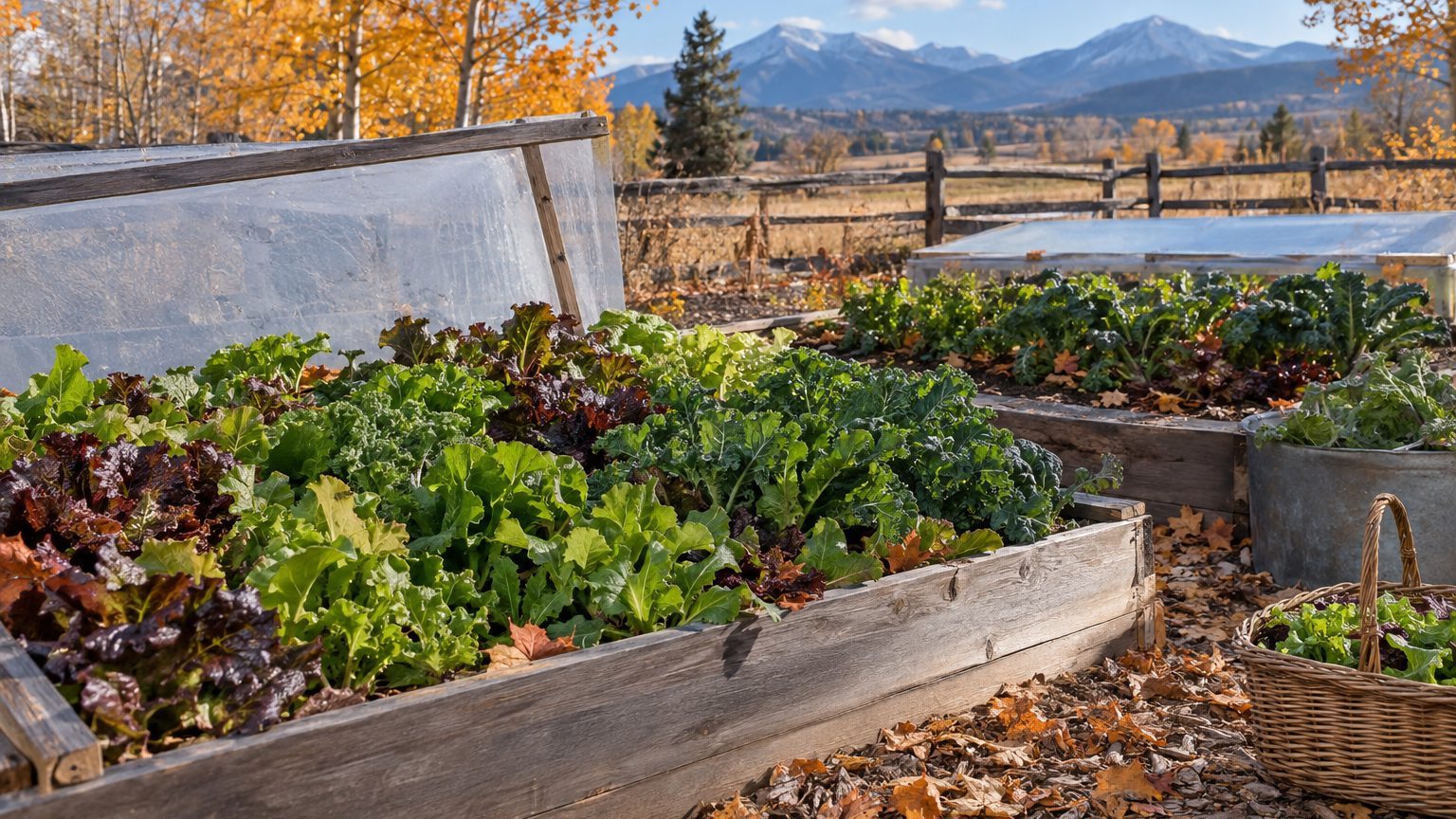

Wisconsin winter salads are decided by plant size on the day the light gives out, not by how tough the leaf is. Once late fall days shorten enough, growth nearly stops, and from then on you are only cutting what the plants already built. Find your own first fall freeze, count back from it using the days on the seed packet, and add a generous margin, because growth slows well before the frost arrives.
When the soil is warm enough in Wisconsin

The date most gardeners ask for is the last spring frost. NOAA’s 1991-2020 climate normals for the Milwaukee station (USW00014839) put the last spring freeze at April 16 to April 29, using the 30 to 70 percent probability band for a 32 F freeze. That is a probability, not a promise, so a late freeze can still land after the window closes. Other parts of Wisconsin differ, and the north runs well behind Milwaukee.
Frost is a stand-in for soil, and a poor one
Frost tells you about air on a clear night. Seeds care about the soil, and the soil warms after the frost risk ends, not at the same moment. For a spring sowing of hardy greens that gap is harmless. For winter salads it matters in a different way, because the sowing that feeds a winter harvest happens in the back half of summer, when the problem reverses. The spring frost date is useful mainly for knowing when to take covers off and reclaim the frame. It says nothing useful about when to sow for winter.
In late summer the trouble is soil that is too warm. Lettuce and spinach seed can refuse to germinate in hot soil, and what does sprout may come up patchy. Sow in the evening, water the row before and after, and lay a board or a strip of shade cloth over the row until the first seedlings show. Pull it off promptly once they do, or they stretch and fall over.
Reading the soil instead of the calendar
A cheap soil thermometer settles the argument. Push it to seed depth and read it in the morning, when the bed is at its coolest. Then check the rest:
- Soil at seed depth is cool to the touch, not warm like a car seat.
- The surface stays damp for the days it takes seed to sprout.
- The bed crumbles in your hand instead of forming a hard crust.
- Any earlier crop is out and the ground is loosened.
If you are still deciding which crops count as winter salads at all, Winter Salads: What Grows When Lettuce Will Not sets out the crop list. For the specific varieties that have been trialled in your part of the state, University of Wisconsin Extension is the source to ask.
How long the season lasts here
NOAA’s 1991-2020 normals for the same Milwaukee station put the first fall freeze at October 17 to October 29. Set that against the spring range of April 16 to April 29 and the arithmetic gives a window between the two extremes. The shortest case, April 29 to October 17, is about 171 days. The longest, April 16 to October 29, is about 196 days. Call it roughly 24 to 28 weeks, and treat it as a spread, not a target.
The lake changes the picture. Lake Michigan delays the first fall freeze at the shoreline, so a lakeshore bed can run past the Milwaukee range. Inland southern Wisconsin typically freezes in early October, and the north freezes far earlier. If you garden away from the lake, your window is shorter than the one above, and you should shorten every plan that follows from it.
What a window of that length allows
A season of nearly six months leaves room for two crops in one bed. The first is whatever you plant in spring. The second goes in after you clear it, and that second sowing is the one that becomes your winter salad. Time it from the fall end of the calendar, not the spring end. Count back from your first fall freeze by the packet’s days to maturity, then keep going for the weeks when growth slows.
That counting decides whether to transplant. Sturdy, slow types such as endive, escarole, radicchio and kale gain real weeks if you start them in trays in a shaded corner while the bed is still occupied, then set them out as the old crop comes out. Spinach and mâche resent root disturbance, and direct sowing suits them better. Catalogue days to maturity are usually counted from transplant and shift by a week or two with the season, so add slack for a direct sowing.
When the window is short
Move toward the inland or northern end and there may be room for only one sowing. With one shot, direct sowing usually beats transplanting, because a check at the roots costs days you do not have. Put your effort into the timing of that single sowing and into a low tunnel or cold frame set up before the first hard freeze, not after it. Our succession sowing guide covers how to stagger several small sowings when the calendar allows more than one.
If your garden runs colder still, Winter Salads for Montana Gardens shows how a shorter, harsher season changes the plan, and Winter Salads for New Hampshire Gardens is worth a look for another cold-winter state where covers do much of the work.
Heat and water in Wisconsin

NOAA publishes both in its climate normals, and the station nearest you is the one to check. What can be said honestly is that in a northern state like this one, heat is not the main pressure on a winter salad. Cold is. It decides which crops stand uncovered, which need a cover to stay edible, and which cannot manage at all.
What the winter low decides
NOAA’s 1991-2020 normals for Milwaukee give a mean daily minimum of 17.2 F in the coldest month. That is about 15 degrees below freezing on an average night, and an average hides colder ones. The USDA Plant Hardiness Zone Map 2023 runs the state from zone 3b to 6a, built on the average annual extreme minimum, so the north sits far colder than Milwaukee. Read the table as a rough sorting, and move every row one step colder if you garden in the north.
| Group | Examples of type | Through a Wisconsin winter |
|---|---|---|
| Hardiest | Spinach, mâche, claytonia, kale | Can survive uncovered, but leaves are battered. Cover keeps them cleaner and easier to cut. |
| Middle | Mizuna, tatsoi, endive, escarole, radicchio | Need a cover to stay in edible condition. |
| Tender | Most head and leaf lettuces, arugula in hard cold | Struggle even under cover in the coldest weeks. Count on them for fall, not midwinter. |
Light, damp and the last useful sowing
The first frost sets how late a sowing can still reach useful size. With the Milwaukee first freeze at October 17 to October 29, and inland gardens earlier, a sowing that is only a seedling on that date will sit small all winter. It will not size up until light returns in spring. Use the fall freeze as the deadline for plants that are nearly at full size, not for seeds that have just come up.
Where summers run cool and damp instead of hot, the trouble is disease and slowness. Leaves that stay wet in cool fall weather invite downy mildew on spinach and gray mold on almost everything. Growth slows in low light and cool soil, and slugs work through beds that never dry out. Water in the morning, not the evening, so foliage dries before cold nights. Give plants room for airflow, and vent covers on mild, sunny days, because trapped humidity does more harm under plastic than the cold does.
Which winter salads suit Wisconsin
Choosing by type
Reason from the facts above. A window of roughly 24 to 28 weeks at Milwaukee, and less inland or north, favors the fastest types when you have one sowing to make. Baby-leaf mizuna, tatsoi and arugula size up quickly and can be cut young, while endive, radicchio and heading kale need the long end of the window or an early tray start.
The cold pushes you toward the top of the table. Spinach, mâche, claytonia and kale are the backbone of a Wisconsin winter bed, and the middle group earns its place only if you commit to a cover. The tender group is worth growing for autumn and then letting go.
Because damp autumns are the norm at the reference station’s latitude, disease resistance should be the first thing you read on a packet. Look for stated resistance to downy mildew on spinach and for varieties bred to hold in cold. Then give every planting airflow and shade at the root during the hot germination window.
Why no varieties
A variety that shines in one Wisconsin county can sulk in another. The cultivars worth buying are the ones trialled where you garden, and the only recommendation that means anything comes from people who grew them there. Ask University of Wisconsin Extension for the greens and cover methods tested in your county, and bring your reference city, your soil and whether you sit on the lakeshore or inland. Check whether a packet’s days to maturity are counted from sowing or from transplant, since the two differ by weeks.
Common questions
Can I Sow Winter Salads in spring instead?
You can sow hardy greens in spring, but they will not become winter salads. Spring sowings mature in warming weather and often bolt in summer heat. The plants that supply winter cuttings come from a late-summer sowing that reaches near full size before fall. Spring is the time to eat the crop you overwintered, and to take the covers off.
Do I need a heated greenhouse?
No. An unheated cold frame or low tunnel is enough for the hardier types, because the point is to hold the plants in edible condition, not to keep them growing. Growth largely stops in the darkest weeks regardless of heat. A heated greenhouse changes what you can grow, but it also adds cost and a new set of disease problems from humidity.
Does living on the lake give me extra weeks?
Only at the fall end. Lake Michigan delays the first fall freeze at the shoreline, so a lakeshore bed can run a little past the Milwaukee range. It does not make the coldest month any milder, so plan covers as if the deep-winter cold is coming.
Should I brush snow off a low tunnel?
Leave a light layer, because snow insulates the plants underneath. Clear it when hoops start to bow, since heavy wet snow can flatten a tunnel, and brush it from the south side first so light reaches the leaves. On a bright day after a snowfall, lift one end of the cover for an hour. Heat builds under plastic faster than most people expect.