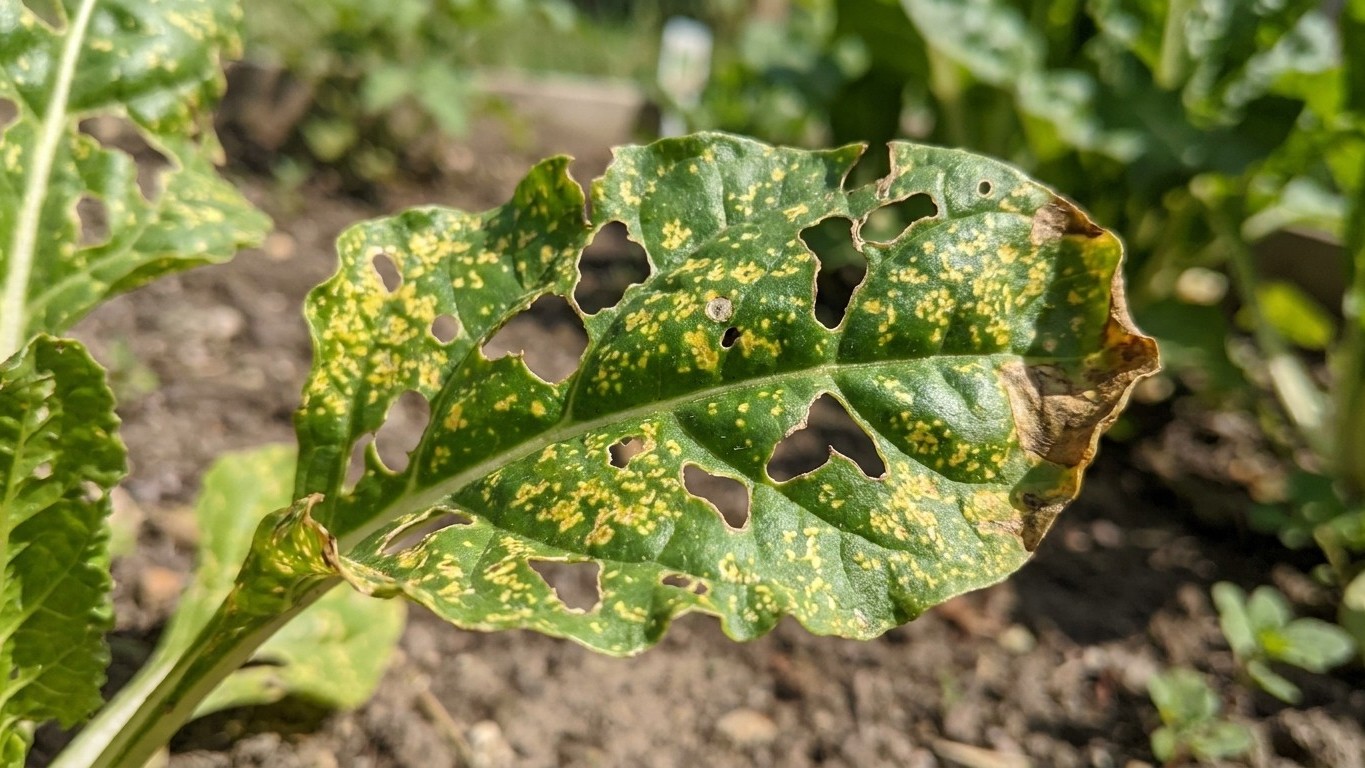

Summer squash in Wyoming faces a short list of pests, and most of them are generalists that show up on lettuce, beans and potatoes too. Aphids, cutworms, flea beetles, grasshoppers and garden slugs are the ones with a documented reason to bother zucchini or yellow squash here. None of them wait long once the frost-free window opens.
Which pests attack summer squash in Wyoming

University of Wyoming Extension documents thirteen pests for the state’s vegetable gardens, but only five of them have any real business on a squash plant. Aphids, cutworms, flea beetles, grasshoppers and the garden slug are generalist feeders that hit cucurbits along with everything else in a mixed garden bed. Each one either sucks sap from leaves, chews seedling stems at ground level, or rasps holes in foliage and fruit skin once plants are established.
The other eight names on the University of Wyoming Extension list have no real reason to touch a squash plant, and that matters because a gardener who sprays for the wrong insect wastes a short season. Cabbage worms feed almost exclusively on cole crops, cabbage, broccoli, kale, and squash leaves don’t interest them. Colorado potato beetle and potato psyllid are nightshade specialists tied to potatoes, tomatoes and related plants; squash sits in a different plant family entirely. Mexican bean beetle needs bean foliage to complete its life cycle and largely ignores cucurbits. Tomato hornworm, despite the name recognition, targets tomatoes, peppers and other nightshades, not squash vines. Sugarbeet root aphid is named for its host, table beets, and stays underground on beet roots rather than moving to squash. Root maggots in Wyoming gardens are a cabbage-family and onion problem, laying eggs at the base of those specific plants rather than at squash stems. Blister beetles show a strong preference for beans, tomatoes and potato foliage, and while they can wander onto nearby plants, they aren’t documented here as a squash pest.
That leaves a short, workable list. If a Wyoming gardener finds chewed squash leaves and starts searching for the culprit, the search narrows fast: it’s one of five insects, or it’s something else entirely, which the next section sorts out.
When each one shows up, and what it does first
Everything on this list is timed to the frost-free window, not to a calendar month, because that window itself moves. Wyoming’s last spring frost typically falls between May 7 and May 18, and the first fall frost arrives between September 24 and October 5, based on 1991-2020 climate normals for the reference station. At elevations near 6,000 feet the frost-free season runs roughly 130 days, and frost is possible in any month at higher elevations, so squash planted early risks a setback before any insect even arrives.
Cutworms are usually the first problem a gardener notices, and it happens fast. Within days of transplanting or direct-seeding, a stand can show seedlings clipped clean at the soil line overnight, with no leaf damage above that point, just a stem severed and a plant lying on the ground. This is a seedling-stage pest; once squash stems thicken past the first few weeks, cutworms stop being a threat.
Flea beetles tend to appear next, feeding on young leaves as soon as the plants push out their first true leaves. The signature sign is a scatter of small, round shot holes across the leaf surface, as if someone had used a hole punch. Damage on young plants can slow growth noticeably, though established squash usually outgrows it.
Aphids build up more gradually, clustering on the undersides of leaves and along new growth, often not obvious until colonies are already dense. Leaves may curl or yellow, and a sticky residue (honeydew) sometimes coats the foliage below an infested spot.
Grasshoppers become a bigger concern as the season dries out, since populations build through summer and peak feeding pressure often lines up with the driest stretch. Wyoming’s summer rainfall averages about 5.8 inches across June, July and August, with August the driest month at 1.52 inches, and that dry stretch is when grasshoppers move from field edges into gardens looking for green leaves. Damage shows up as large, ragged chunks torn from leaf edges rather than the small holes flea beetles leave.
Garden slugs show up whenever conditions turn damp or shaded, feeding at night and leaving irregular holes in leaves and sometimes in fruit, along with a telltale slime trail visible in early morning.
Telling the damage apart from everything else
Squash plants get blamed for insect damage that’s actually something else entirely, and Wyoming’s climate makes a few of those mix-ups common. The single detail that settles most of these cases is whether there’s a slime trail, a chewed stem, or neither, since insect feeding almost always leaves a physical trace and environmental stress rarely does.
| Symptom | Likely cause | What distinguishes it |
|---|---|---|
| Yellowing between leaf veins | Nutrient deficiency | No holes, no chewing marks, pattern spreads evenly across older leaves first |
| Wilting despite moist soil | Disease (vine borer, bacterial wilt, root rot) | Stems may show discoloration or ooze when cut; insects leave visible feeding marks instead |
| Wilting with dry soil | Drought stress | Leaves recover within hours of watering; pest damage does not reverse |
| Torn or bent stems | Mechanical damage (wind, hail, foot traffic) | Damage is localized to one plant or row, not spread across the bed |
| Small round holes across leaves | Flea beetles | Uniform shot-hole pattern, concentrated on young leaves |
| Slime trails and ragged leaf edges | Garden slug | Visible slime, damage worse near soil contact or mulch |
Wyoming’s dry air and intense summer heat load add another wrinkle. With an average of 10.4 days a year reaching 90°F or higher at the reference station, squash leaves can scorch or droop at midday from heat stress alone, then recover by evening, a pattern that has nothing to do with insects. A gardener who isn’t sure which of these is happening shouldn’t guess. The signs above narrow the possibilities, but a county extension agent looking at an actual plant, or a sample brought in, settles it faster than any general description can.
What actually works here, and what is a waste of time
On a season this short, timing does more work than any single control method. Getting a physical barrier over young squash plants before the last frost date passes, rather than after damage appears, is the single decision that prevents the most loss. Floating row covers placed at transplanting keep cutworms and flea beetles off seedlings during the vulnerable first weeks, and they can come off once plants flower and need pollinator access.
Cutworm collars, a simple cardboard or paper tube pushed into the soil around each stem, stop the classic overnight stem-clipping without any spray at all. For slugs, reducing mulch thickness right against the stem and watering in the morning rather than the evening cuts down on the damp, cool conditions slugs need to move and feed at night.
Handpicking works for grasshoppers and slugs on a small planting, though it’s labor that scales poorly once a garden gets past a few rows. Grasshopper populations swell during Wyoming’s dry August stretch, and by the time damage is obvious in late summer, the insects have often already moved on from the plant they hit hardest.
What tends to waste time is spraying broadly and late, after damage is already visible and the responsible pest has moved on or finished feeding. Aphid colonies, in particular, often draw in natural predators, lady beetles and lacewings included, and a broad treatment can wipe those out along with the aphids, leaving the plant worse off for the rest of the season. Because pesticide products, active ingredients and what’s legally labeled for use change and vary by state, that decision belongs with University of Wyoming Extension, not a general gardening guide.
Where to check this for your own county
Everything above describes what’s documented at the state level, and a state-level list is not the same thing as what’s actually in one garden. Pest pressure in Wyoming shifts with elevation, local moisture and what’s growing nearby, so a garden at 6,000 feet with a late, hard frost season can see a completely different mix of pressure than one in a warmer valley.
University of Wyoming Extension maintains the pest information referenced throughout this page, and its county offices are the right next stop for anything specific, whether that’s confirming an insect ID, asking about current recommendations, or finding out what’s showing up locally this season. The extension’s main portal is uwyo.edu/uwe, and from there a county office contact is usually one or two clicks away.
Bringing a photo, or better, an actual sample in a sealed bag, to a county office visit gets a faster and more accurate answer than a written description alone. That’s the next useful step for anyone looking at damaged squash leaves and still unsure what caused it.