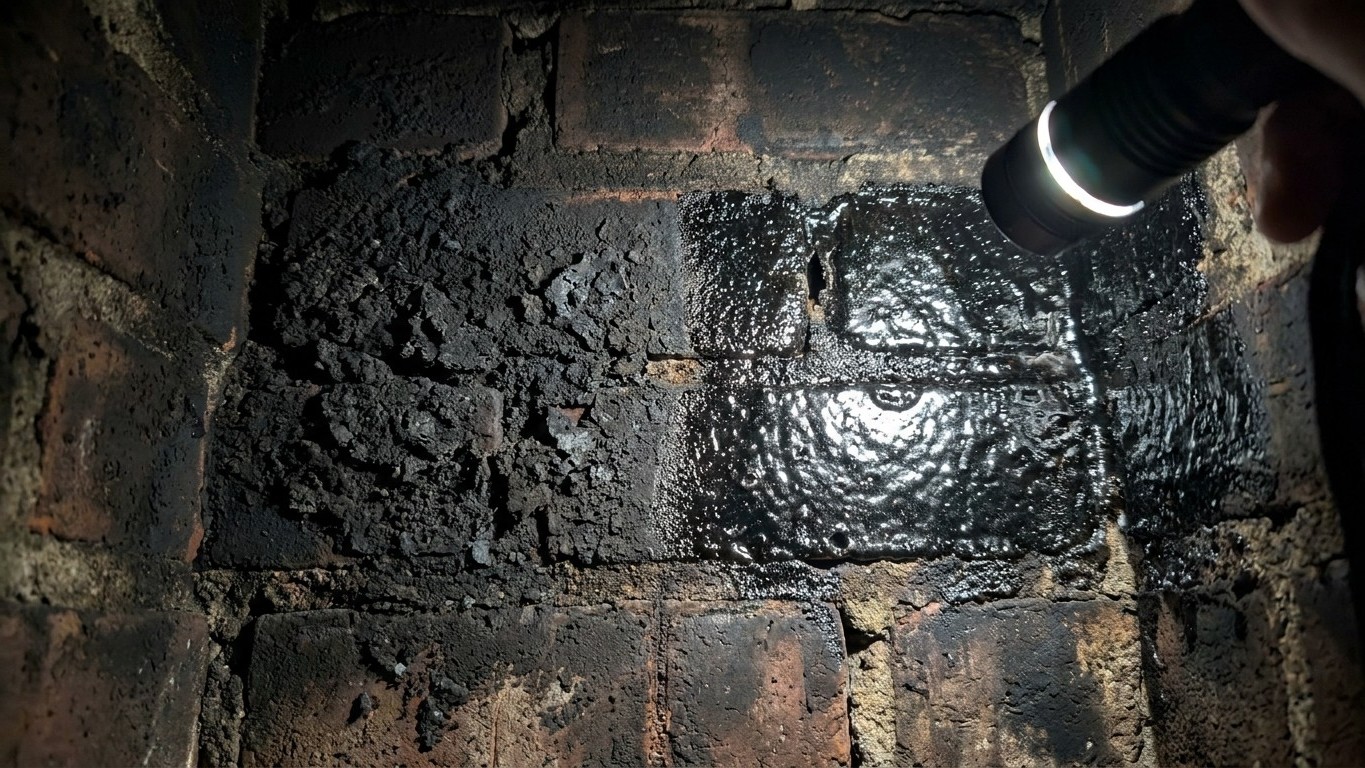

That shiny, tar-like black coating inside your flue is creosote, and it’s flammable. If it’s flaky and dull, you have time to deal with it properly. If it’s glossy and hard, you’re looking at the advanced stage, and it needs a professional before you burn another fire.
What you are seeing

Open the cleanout door or look up the flue with a flashlight, and you’ll find one of two things. The first is a dry, flaky, dark coating that brushes or flakes off fairly easily. It looks a little like dark ash that clumped together. This stage is annoying, not an emergency, though it still means your system needs attention before the next fire.
The second is different. It’s shiny, almost glass-like, sometimes bubbled or rippled, and it does not come off with a brush. This is glazed creosote, and it’s the dangerous version. It builds in layers, each one sealing in the last, and it can be a quarter inch thick or more before anyone notices. A shiny black glaze is the advanced stage and does not brush off, which is exactly why it matters: normal maintenance tools can’t touch it.
Either way, the material you’re looking at is not soot in the way most people picture soot. Creosote is unburnt wood gas that condensed on a cool flue wall, and it is fuel. That’s the part that catches people off guard. It’s not just dirty, it’s stored energy sitting inside your chimney, waiting for enough heat to ignite it.
So the urgency depends on which version you found. Flaky, dull creosote is a maintenance item, something to schedule this week. Glossy, glazed creosote is a stop-and-call-someone situation. Don’t run another fire through that flue until it’s been inspected. A chimney fire starting in a glazed flue can reach temperatures that damage the flue liner, crack masonry, or worse, and it often happens quietly at first, a low roar overhead that homeowners mistake for wind.
Either way, what you’re seeing didn’t happen from one fire. It built over weeks or a whole season, which matters for the next part.
Why it happens
The two most common causes are also the two habits people adopt specifically to save wood, and that’s the part that trips most homeowners up. Burning green, unseasoned wood is the biggest contributor. Wet wood has to boil off its own moisture before it can burn cleanly, and that process eats heat that would otherwise push smoke and gases fully out of the flue. Instead, those unburned gases drift upward, hit the cooler flue walls, and condense into liquid tar. Cool down further and it hardens into the black coating you found.
The second habit is damping the fire down overnight to stretch the wood supply and keep coals alive until morning. It feels efficient. It’s the opposite. A choked-down fire smolders instead of burning, and smoldering produces more unburned gas than a hot, active flame does. That gas has nowhere to go but up a flue that’s now running cooler because the fire itself is weaker. More gas, less heat to carry it out, more condensation. It’s a direct trade: the fire lasts longer, but the flue pays for it.
Here’s where the obvious explanation usually misses the mark. Most people assume creosote means something is wrong with the chimney itself, bad design, wrong height, a leaky cap. Chimney geometry does matter, but in the large majority of cases the flue is doing exactly what it’s built to do. The fuel and the fire management are what changed the outcome.
That’s also why creosote never builds evenly. It accumulates fastest where the flue is coldest: the top few feet, and any section that runs through an unheated attic, crawlspace, or exterior wall. Those cold spots are where wood gas hits the dew point first and turns solid. A flue that runs straight up through a heated living space stays warmer its whole length and collects less. One that snakes through an unconditioned attic before reaching the roofline will almost always show heavier buildup up top, even though the fire below burned exactly the same wood.
Put those two pieces together, wet fuel plus a cool flue path, and you get the glaze stage. It doesn’t happen from one bad night. It’s the result of repeated smoldering fires, each one adding a thin film that the next fire seals over instead of burning away.
What to do about it
Tonight, the honest move is to stop burning through that flue until you know which stage you’re dealing with. If what you found is dry and flaky, and you can see it clearly with a flashlight from the cleanout or firebox, you’re likely fine to schedule a cleaning in the next week or two rather than tonight. Don’t burn a fire in the meantime if you can avoid it, since every fire adds another layer on top of what’s already there.
If what you found is glossy, hard, or thick enough that you can’t see bare metal or masonry underneath it, that’s the line where this stops being a DIY project. There is no burning it off safely: a chimney fire IS that, uncontrolled. Some people hear that creosote burns off in a hot fire and treat that as a cleaning method. It’s not a method, it’s the exact failure this whole situation is warning you about. A fire hot enough to ignite glazed creosote inside a flue is a chimney fire by definition, not a controlled burn-off.
The professional limit here is clear: glazed or thick creosote, any buildup you can’t identify with certainty, or any flue you haven’t had inspected in the current heating season needs a certified chimney sweep with the right tools, not a wire brush from the hardware store. They can also check for cracked liners, damaged caps, or draft issues that a flashlight inspection from the ground won’t reveal.
For the flaky stage, once it’s been cleaned, the useful thing you can do this evening is look at what you’re about to burn. Check the wood you’re planning to put in the stove tonight. Does it look freshly split, feel heavy for its size, or hiss and bubble at the ends when it heats up? Those are signs it’s too wet to burn cleanly, and burning it tonight adds straight back to the problem you just found. Set it aside and burn from a drier batch if you have one, even if that means a smaller fire than planned.
How to keep it from coming back
The upstream fix isn’t a chimney habit, it’s a woodpile habit. Properly seasoned firewood, split and stacked with airflow around it for enough time to drop its internal moisture, burns hotter and cleaner from the first match. A hotter fire pushes gases out of the flue fast enough that they don’t have time to condense before they clear the top. That single change, fuel moisture, does more to prevent creosote than any chimney modification.
Piece size matters too, though it’s the quieter factor. Oversized splits take longer to reach full combustion temperature, which means more time producing partial-burn gases before the fire’s hot enough to consume them cleanly. Smaller, well-matched splits for your firebox size catch faster and reach clean-burning heat sooner.
Air control is the third piece, and it’s where the overnight habit comes back in. Rather than choking the air all the way down to stretch a fire until morning, running a smaller fire with more air, or simply letting it burn out and restarting in the morning, produces far less creosote over a season than one big fire smothered for eight hours. It feels less efficient in the moment. It isn’t, once you count the cost of a chimney cleaning or a sweep call.
If your woodpile is the part you’re not sure about, that’s worth working through directly. The sibling page in this series, Your Woodpile Isn’t Actually Seasoned Yet, walks through how to actually tell if your wood is dry enough to burn and how long different species really need to season, which is usually the root of this whole problem in the first place.