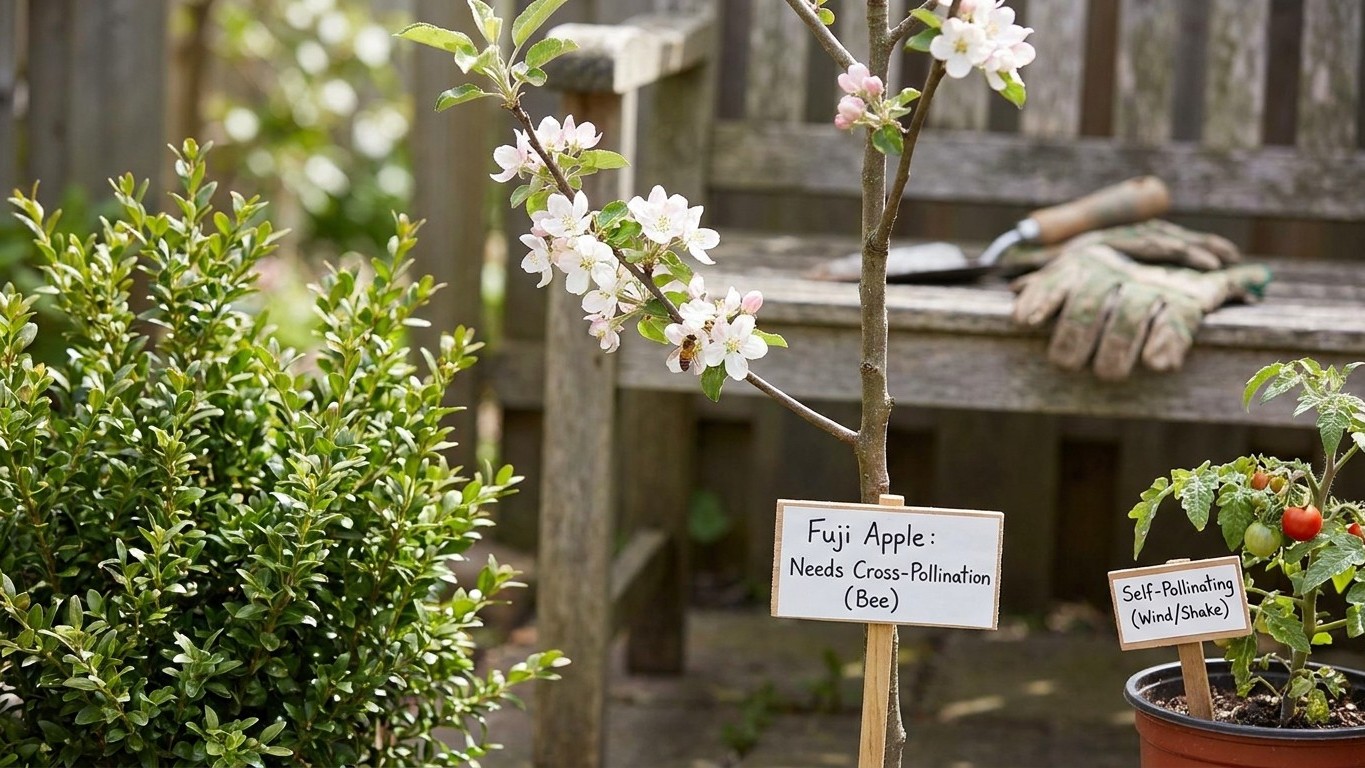

Your Fuji tree needs pollen from a different apple variety blooming at the same time, or you’ll get flowers every spring and little to no fruit. Gala, Ginger Gold, Granny Smith, Jerseymac, Mollie’s Delicious, Red Delicious, and Yates all work, since they open their blossoms in that same window and carry pollen Fuji can actually use. One tree from that list, planted where bees can move between the two, is usually all it takes. Walk out and check what’s already blooming near your Fuji before you spend money on anything new.
The short answer
Fuji is pollinated by Gala, Ginger Gold, Granny Smith, Jerseymac, Mollie’s Delicious, Red Delicious and Yates, according to Clemson Cooperative Extension’s HGIC 1350. Any one of those seven varieties, planted where bees travel between the two trees, supplies the pollen Fuji needs to set a full crop instead of a thin one.
Two trees are enough in the ordinary case. Plant your Fuji next to any single variety from that list and you have a working pair, because each of the seven carries fertile pollen that can fertilize Fuji’s flowers. One tree gives pollen, the other receives it, and both usually benefit since the pollen-giving variety generally needs a partner of its own too. This is the normal pattern behind most named apple pairings, covered in more general terms on our Apple Pollination page.
The exception is a variety with sterile pollen. Fuji’s own compatibility list does not include one, but growers sometimes plant Mutsu alongside Fuji because the two flower together. Mutsu’s pollen cannot fertilize anything, Fuji included, so a garden holding only those two trees blooms well and sets fruit on neither. In that situation you need a third tree, one carrying fertile pollen, to pollinate both of them.
For most home gardens the fix is simpler than that. Choose one name off the list above, plant it within the same yard as Fuji, and let the bees do the rest.
Why these varieties and not others

Every apple variety carries a bloom group, a relative order of flowering time within a given season and climate. Clemson Cooperative Extension’s HGIC 1350 places Fuji in bloom group B, alongside Gala, Ginger Gold, Granny Smith, Jerseymac, Mollie’s Delicious, Red Delicious and Yates. USU Extension separately describes Fuji’s bloom season as mid to late, which reflects the same relative position from a different reference point rather than a conflicting one.
A relative order, not a calendar date
The group letter is not a date on anyone’s calendar. In a warm spring in one region, Fuji and Gala might open their flowers in the same week of March. In a cooler spring, or a different hardiness zone, both might open weeks later on the calendar. What stays fixed is the order between them: whatever week Fuji opens, a group B partner opens within roughly the same short window, wherever the two trees are actually growing. That fixed order is the entire point of the bloom group system, and it is why the list of names above holds from a warm valley to a cold hillside even though the actual dates shift.
Sharing a bloom group only means the flowers are open at the same time. It says nothing about whether the pollen inside those flowers is fertile, and it says nothing about ancestry. Two varieties can flower together and still fail as a pair, either because one carries sterile pollen or because one was bred directly from the other. A parent tree’s pollen does not fertilize its own seedling no matter how well the bloom times line up.
This is why the working list for Fuji is a published set of names rather than a rule you can apply to any group B apple you happen to find at a nursery. Clemson’s group assignment tells you which varieties are flowering at the same time as Fuji. Confirming that the pollen actually works in both directions takes a separate check, the kind behind the list in the section above.
What cannot pollinate it
Mutsu flowers in the same window as Fuji, but its pollen is sterile. A grower who plants only a Fuji and a Mutsu gets good blossom every spring and no fruit on either tree, because the flowers open together and neither one can finish the job. This is the exact trap the bloom group system does not warn you about on its own: matching bloom dates gets pollen moving between two trees, it does not guarantee that pollen works once it arrives.
Sterile pollen runs one direction only. Mutsu still needs to be pollinated by something else to set its own fruit, and a fertile variety planted nearby can pollinate both Mutsu and Fuji in the same season. So Mutsu is not a dead end for the whole garden, only as the sole second tree next to Fuji. Add a third, fertile variety, ideally one already on Fuji’s own list such as Gala or Granny Smith, and all three trees can crop together.
Gala also has its own separate pollination needs once you look past the fact that it shows up on Fuji’s list. See What Pollinates Gala, and What Cannot for what pollinates Gala specifically, since being a good pollinator for Fuji does not tell you what Gala itself requires.
A parentage exclusion rules out a variety bred directly from Fuji or a variety Fuji itself descends from. Some apple varieties do carry that restriction. A seedling cannot be pollinated by its own parent even when the two share a bloom group and both carry fertile pollen, because the genetics involved are too close.
Beyond the seven varieties named above and the Mutsu exception, extension sources have not tested and confirmed other Fuji pairings. That does not mean every other apple fails as a partner, only that no extension service has tested and confirmed the pairing. If you already grow a different variety near your Fuji, such as SnowSweet, do not assume it works simply because it flowers nearby. Check its own requirements instead, see What Pollinates SnowSweet, and What Cannot, since compatibility runs specific to each pair of varieties rather than to apples in general.
How close the second tree has to be

Pollen moves on bees, not on wind, so distance is a practical question rather than a fixed number. The closer the partner tree, the more bee visits carry pollen between the two in a single afternoon, and the more of Fuji’s flowers actually get fertilized before they drop. A partner planted in the same garden or the same short orchard row works far better than one three properties away, even if both sit within flying range of the local bee population. There is no fixed distance published for home gardens. The practical guidance repeated by extension services amounts to the same yard rather than the same street.
What else can do the job
- A neighbor’s apple tree, if it is one of the seven varieties on Fuji’s list and close enough for bees to cross between yards
- An ornamental crabapple in bloom at the same time, since crabapples are apples and most produce abundant, viable pollen
- A pollinator branch grafted onto Fuji’s own trunk, carrying flowers of a compatible variety
- A second variety grafted onto another tree already growing nearby, if there is no room to add a freestanding one
Any of these can substitute for a second freestanding tree, provided the flowers open at the same time as Fuji’s and bees can reach both.
What no partner fixes is weather. Bees fly poorly in cold, wind or rain, and if that weather sits over the garden through the whole bloom window, pollen does not move regardless of how well matched the two varieties are or how close together they stand. No partner compensates for that. This is the main reason a properly paired Fuji can still crop unevenly from one year to the next. It is not the pairing failing, it is the bloom-week weather deciding how much work the bees actually managed to do.
If there is no room for a second tree
A small garden does not rule out a real Fuji crop. It just changes which trick you use to get a second variety’s pollen onto the same property.
Options that fit a tight space
- A multi-grafted tree, one trunk carrying several varieties, so Fuji and a compatible partner such as Granny Smith or Red Delicious grow as separate branches on the same rootstock
- A pollinator branch grafted onto your existing Fuji, adding one limb of a compatible variety without planting a second tree at all
- A columnar variety, which takes up only a few feet of ground and can be tucked beside an existing Fuji where a full second tree would not fit
- An ornamental crabapple, planted purely for bloom rather than fruit, timed to flower alongside Fuji
Each option solves the space problem, not the timing problem. A multi-graft tree still needs both varieties to flower in the same window, and a fresh graft takes a couple of seasons to grow enough wood to flower reliably, so it will not fix a poor crop the first spring after grafting. A columnar variety solves footprint, but you still have to choose one that overlaps Fuji’s bloom season rather than just any columnar apple. A crabapple contributes pollen but nothing to harvest, a fair trade for a gardener who only wants the fruit off the Fuji itself.
None of these options change the rootstock question. The eventual size of any tree you add, standard, dwarf or columnar, comes from the rootstock it is grown on rather than from the variety grafted onto it. Check the rootstock label before assuming a “small” apple tree will actually stay small in a tight yard, particularly since Fuji itself is listed as very susceptible to fire blight by USU Extension, which is worth knowing before you crowd several grafted varieties into one small space with limited air movement.
Common questions
Can I grow just one Fuji tree and still get apples?
Not reliably. Fuji crops far better with a compatible partner nearby, and without one you typically get a light, unpredictable set rather than a full harvest.
Does Fuji pollinate itself?
No named source lists Fuji as self-fertile. The standard advice for the varieties it pairs with, Gala, Ginger Gold, Granny Smith, Jerseymac, Mollie’s Delicious, Red Delicious and Yates, assumes cross-pollination between two different varieties rather than reliance on Fuji’s own flowers.
My neighbor has a Mutsu tree. Does that help my Fuji?
Not by itself. Mutsu flowers at the same time as Fuji, but its pollen is sterile, so it cannot fertilize Fuji’s flowers no matter how close the two trees stand. You would still need a fertile variety from Fuji’s list somewhere within bee range of both.
How many years before a new pollinator tree actually helps?
A young apple tree needs a few seasons of growth before it flowers heavily enough to contribute meaningful pollen, so a newly planted partner will not fix a poor crop the same spring you plant it.
What if my Fuji flowers before or after my Gala every year?
A one or two week mismatch most springs points to a site issue rather than a variety issue, since Clemson’s bloom group B places both varieties in the same relative flowering window. Check whether one tree sits in a colder pocket of the garden, in more shade, or on a different rootstock, since any of those can shift bloom timing enough to miss the overlap.