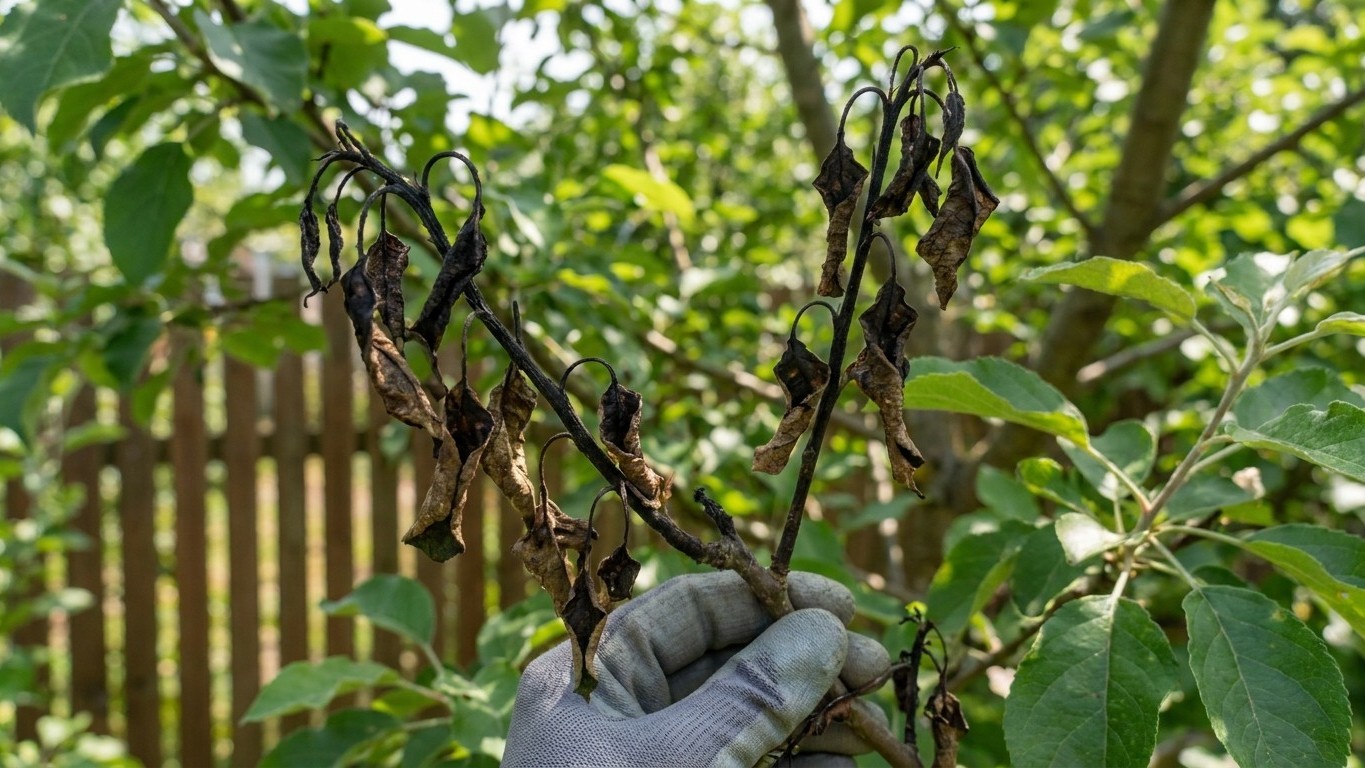

A shoot that looks scorched in midsummer, with the tip curled into a tight hook and the leaves gone black but still clinging to the branch, is almost always fire blight, a bacterial disease and not a fungus or sun damage. There is no local figure to give here because the disease is driven by weather at bloom time, not by a fixed calendar date. Cut the affected shoot out now, well back into wood that shows no discoloration, and disinfect your pruners before the next cut.
What you are looking at

Fire blight announces itself in the shape of the shoot before it announces itself in color. A healthy new shoot grows straight. An infected one bends at the tip into what growers call a shepherd’s crook, and the leaves on it turn dark olive, then brown, then black, without falling off the way frost-killed leaves eventually do. The whole thing looks like someone held a match to the last few inches of the branch, which is where the common name comes from.
The shepherd’s crook and the ooze
Look closely at the bark just below the blackened section, especially early on a humid morning, and you may find a thin bead of amber-colored ooze seeping from the bark or from a crack in it. This ooze carries the bacteria and is one of the more reliable field confirmations, though it doesn’t show up on every strike and dries fast once the sun hits it.
The disease shows up in two waves. In spring it infects open blossoms, which wilt, turn brown, and often ooze at the base of the flower cluster, a phase called blossom blight. By early to mid summer, the same bacteria move into tender new growth, watersprouts, root suckers, and vigorous shoot tips, producing the scorched, hooked look. Watersprouts on the trunk and main scaffold limbs are especially common targets, particularly on a tree that was pruned hard the previous winter and responded with a flush of soft new wood.
Follow the blackened shoot back toward the trunk and you’ll often find a sunken, slightly darker patch of bark where the infection has started to move into older wood. This canker is where the bacteria overwinter, and it’s the reason a shoot that looked like a small, contained problem in July can be the source of a much bigger strike the following spring. Fire blight is one of the more distinctive of the bacterial and fungal apple diseases a home orchardist runs into, mostly because nothing else moves down a branch quite this fast or leaves quite this clean a scorched line.
What it is not
The scorched look sends a lot of growers straight to the wrong diagnosis. Frost or cold injury can blacken blossoms and young leaves in a similar way, but it appears right after a cold night, hits the exposed or low side of the tree hardest, and does not produce a hooked shoot tip or bacterial ooze. If the damage showed up the morning after a spring cold snap, that’s the more likely culprit.
Powdery mildew on apples is another common mix-up, since it also concentrates on new growth. But mildew coats leaves and shoot tips in a white to gray felt-like layer and curls the leaves without blackening them outright. There’s no ooze, no shepherd’s crook, and the shoot underneath the coating is still alive.
Black rot and frogeye leaf spot share the same tree and sometimes the same season, but the signature is different: circular leaf spots with a purple-red margin and a tan center, plus sunken cankers on older wood with a cracked, target-like pattern. Black rot cankers don’t bend the shoot into a hook the way fire blight does.
Herbicide drift is the last common look-alike, especially near a property line that gets mowed and sprayed. Drift damage tends to brown leaf margins evenly across a whole side of the tree or a whole row, rather than concentrating in individual hooked shoot tips, and it never produces the bacterial ooze.
| Look-alike | What you see | Time of year | The tell |
|---|---|---|---|
| Fire blight | Hooked, blackened shoot tip, clinging dead leaves | Bloom, then early-mid summer | Shepherd’s crook, amber ooze |
| Frost injury | Blackened blossoms and young leaves | Right after a cold night | No hook, no ooze, tied to a specific cold event |
| Powdery mildew | White-gray felt on curled leaves | Spring through summer | Coating stays white, shoot survives |
| Black rot / frogeye | Purple-margined leaf spots, target-pattern canker | Summer | Spotted leaves, no crook |
The conditions that bring it on
A bad fire blight year almost always starts with a wet bloom. Rain or heavy dew during the flowering period splashes bacteria from open cankers or infected blossoms onto healthy flowers, and warm, humid nights afterward let the bacteria multiply fast enough to infect before the blossom closes. If bloom coincides with a warm rain, expect blossom blight, and expect it to show up as shoot blight a few weeks later even on branches that looked clean at the time.
Because different apple varieties flower at different points in the season, a mixed home orchard has a longer total bloom window than any single variety would on its own. Clemson Cooperative Extension’s HGIC 1350 fact sheet groups common varieties by relative bloom timing, with Anna and Dorsett Golden in the earliest group, Fuji, Gala, Granny Smith and several others in the middle group, and Golden Delicious, Jonagold and Rome Beauty blooming later. That relative order holds everywhere even though the actual dates shift by climate, and the practical effect is that if rain lands during any one of those bloom windows, the orchard has an infection opportunity, not just the varieties blooming that day.
Wounds matter as much as weather. Hail, wind-whipped leaves, and pruning cuts made during the growing season all give the bacteria an easy way in, which is why storm damage in early summer is often followed by a new round of shoot blight a week or two later. A tree carrying a heavy flush of soft, succulent growth, whether from a hard winter pruning or from a heavy dose of nitrogen fertilizer, is more vulnerable than one growing at a steady, moderate rate, because that tender tissue is exactly what the bacteria move into fastest.
A host tree nearby raises the baseline risk for the whole season. Ornamental and fruiting pears, hawthorn, quince, and crabapple all carry the same bacteria and can reinfect an apple tree that was pruned clean the previous winter, so a strike that seems to come from nowhere sometimes traces back to a hedge or a neighbor’s tree rather than anything done on your own property.
What to do now
Once you see the scorched, hooked shoot, the priority is to stop the bacteria from moving any further into the tree, not to save the individual shoot. Work through the tree methodically:
- Cut each infected shoot back into wood that shows no discoloration at all, since the bacteria travel further inside the branch than the visible blackening suggests.
- Disinfect pruning shears between every cut, not just between trees, using rubbing alcohol or a diluted household disinfectant.
- Work on dry days only. Cutting into wet, infected tissue is one of the more reliable ways to spread the bacteria to the next cut you make.
- Remove every piece of cut wood from the property rather than leaving it under the tree or in the compost pile.
- Hold off on nitrogen fertilizer for the rest of the season, since it encourages the same soft new growth the bacteria prefer.
Exactly how far below the visible margin to cut is a judgment call that extension services phrase slightly differently region to region, so check with your own state or county extension office for their current recommendation rather than guessing at a fixed distance. The same goes for bactericide sprays during bloom: some states register streptomycin or other bactericides for home orchard use and some do not, and rates and timing are set at the state level, so ask your local extension office.
What you cannot do this season is undo an infection that has already reached a scaffold limb or the trunk. If a canker has traveled that far, the realistic goal shifts from saving the branch to protecting the rest of the tree, and a badly infected young tree on a dwarfing rootstock can sometimes be killed outright by a canker that reaches the graft union.
Preventing it next season
Sanitation and pruning for air
Fire blight bacteria overwinter in the margins of last season’s cankers, so a dormant-season cleanup matters as much as anything you do in summer. Walk the tree while it’s leafless, cut out any canker you missed, and open up the canopy so air moves through it freely. A dense canopy holds humidity longer after rain, which extends the window bacteria have to establish on any new wound.
Rootstock and scale
The rootstock a tree is grafted onto sets its mature size and, indirectly, how easy it is to inspect and clean up. USU Extension lists M.9 at 8 to 12 feet and M.26 at 12 to 15 feet, both small enough to scout from the ground and reach every watersprout by hand. Compare that to MM.111 at 30 to 35 feet or a seedling rootstock at 35 to 40 feet, where a strike deep in the upper canopy can go unnoticed for weeks simply because nobody can see it without a ladder. If fire blight has already been a recurring problem on a property, a smaller rootstock is worth weighing for the next tree you plant, purely because it keeps the whole canopy within reach.
What else to manage
Remove or manage nearby host plants where you can. Wild hawthorn, ornamental pear, and volunteer crabapple growing along a fence line all carry the same bacteria and can reinfect a clean tree the following spring. Keep nitrogen moderate rather than heavy, since a slow, steady growth rate produces less of the soft tissue the bacteria need to get started.
Common questions
Will fire blight kill my whole tree?
Usually not outright on a mature tree, but it can kill individual limbs and, on a young tree, can travel far enough down the trunk to kill the whole thing, especially if the canker reaches the rootstock graft union. The younger and more dwarfing the rootstock, the less wood there is between a bad canker and the roots.
How do I know if the ooze I’m seeing is really fire blight and not just sap?
Fire blight ooze is usually amber to reddish-brown, sticky, and appears right at the margin of blackened, hooked tissue, most visible on a humid morning. Sap runs clear or slightly cloudy and doesn’t come with the scorched, curled shoot tip alongside it.
Can fire blight spread from my apple tree to other plants in the yard?
Yes, in both directions. Ornamental pear, hawthorn, quince, and crabapple all host the same bacteria, so check those plants on the property whenever you find a strike on the apple tree, and treat the whole group as one infection risk rather than isolated cases.
Is it safe to prune fire blight in the middle of summer, or should I wait for winter?
Prune out active strikes as soon as you see them rather than waiting for dormancy, since the goal in summer is to stop bacteria from reaching older wood. Save the thorough, whole-tree cleanup for the dormant season, when the wood is easier to see and the bacteria are far less active.