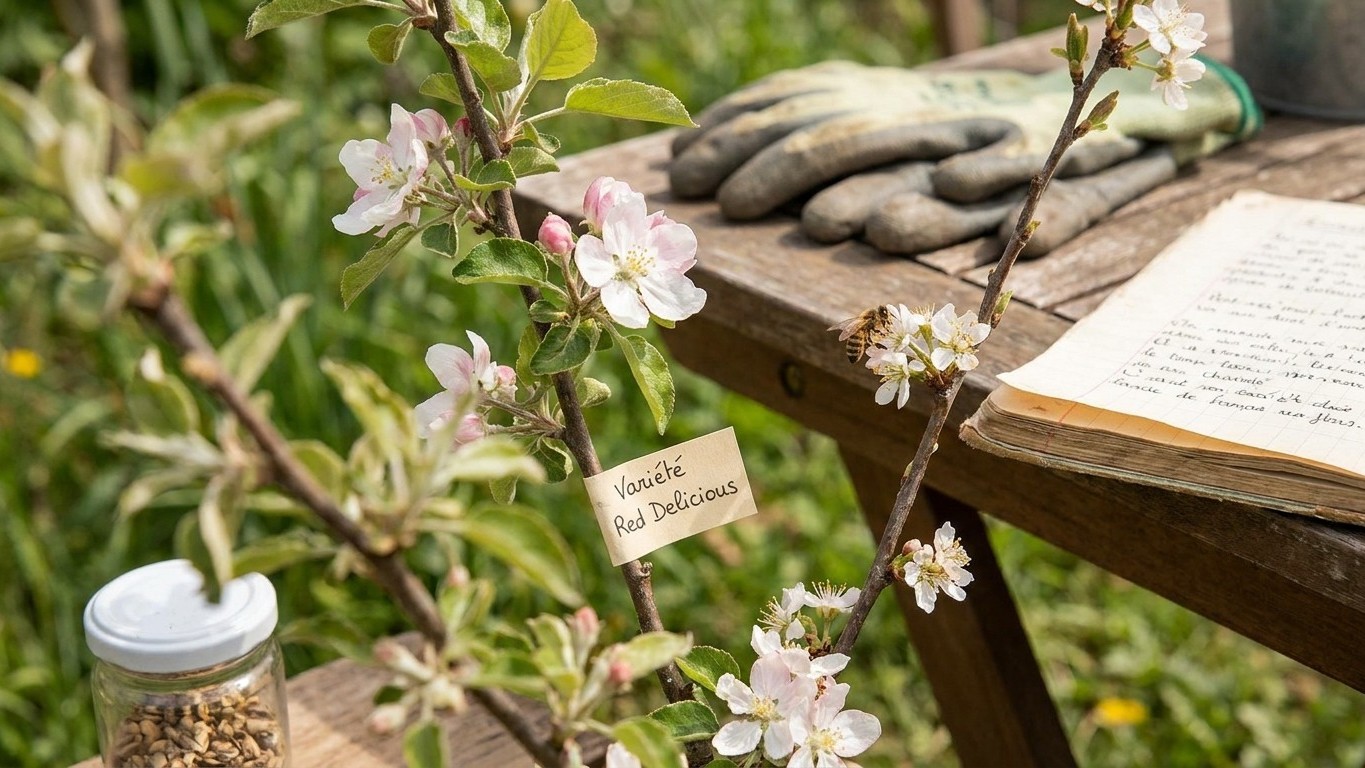

Red Delicious sets a full crop when a second apple tree from bloom group B stands nearby, a group Clemson Cooperative Extension and the University of Georgia both place it in. Fuji, Gala, Ginger Gold, Granny Smith, Jerseymac, Mollie’s Delicious and Yates all flower in that same window and carry pollen Red Delicious can use. Pick one of those seven and plant it in the same yard, not just down the street, before you count on apples this fall.
The short answer
Fuji, Gala, Ginger Gold, Granny Smith, Jerseymac, Mollie’s Delicious and Yates are the varieties named as compatible pollen sources for Red Delicious. Any one of them, planted close enough for bees to move between the two trees, gives you a working pair.
- Fuji
- Gala
- Ginger Gold
- Granny Smith
- Jerseymac
- Mollie’s Delicious
- Yates
Two trees are enough, because each of those seven varieties produces fertile pollen that Red Delicious can use, and Red Delicious returns the favor with pollen of its own. Two trees, one from each side of that arrangement, is a complete pollination pair.
The math changes if the second tree already standing in your yard is Mutsu. Mutsu opens its flowers at the same time as Red Delicious, but its pollen is sterile, so it cannot pollinate anything, Red Delicious included. Two trees that only ever exchange sterile pollen produce nothing on either side. In that case you need a third tree, one of the seven compatible varieties, to carry pollen to both of the others.
Nearly all apple varieties crop better with a compatible partner planted nearby than they do alone, and Red Delicious is no exception. If you are starting a new planting, treat the second tree as part of the plan for the crop, not an afterthought added once the first one fails to set fruit. The broader mechanics of how apple pollen actually moves between trees are worth reading before you buy anything, and Apple Pollination covers that ground.
Why these varieties and not others

Bloom group is the reason this specific list works and a random nearby apple tree might not. Clemson Cooperative Extension groups apple varieties by the order in which they flower each spring, and Red Delicious falls into bloom group B, an order Clemson and the University of Georgia both publish. A tree in group B needs a partner blooming at roughly the same point in that sequence, and Fuji, Gala, Ginger Gold, Granny Smith, Jerseymac, Mollie’s Delicious and Yates all sit close enough to it on the sequence to overlap in flower.
The group is a relative order, not a calendar date. USU Extension separately places Red Delicious in the mid-season bloom window, but that timing shifts earlier or later depending on where you garden and what the spring looks like that year. A cold spring in one region pushes bloom back by a couple of weeks compared to a mild one nearby. What does not shift is the order itself: whatever week Red Delicious opens its flowers in your yard, the varieties sharing its bloom group open theirs within that same stretch, because the whole sequence moves together as a block.
What bloom group does not guarantee
Sharing a bloom group only confirms the timing lines up. It says nothing about whether the pollen that arrives is any good, and it says nothing about the ancestry of either tree. Overlapping flowers is necessary but not sufficient on its own. Two more conditions have to hold before a partnership actually sets fruit.
The first condition is fertile pollen, which is why Mutsu, despite matching Red Delicious for timing, is excluded from the compatible list. The second is parentage: a variety bred as a seedling of another cannot fertilize the parent it came from, even if the two flower at exactly the same time. Rome Beauty and Crimson Crisp both carry their own separate compatibility lists for exactly this reason, and What Pollinates Rome Beauty, and What Cannot or What Pollinates Crimson Crisp, and What Cannot are worth checking if you are planting either of those alongside Red Delicious.
What cannot pollinate it
Mutsu is the variety to watch for, because it does the one thing that catches gardeners off guard: it flowers at the same time as Red Delicious, so the bloom looks perfectly matched from the ground, but its pollen is sterile. A sterile-pollen variety can accept pollen from a compatible partner and still set its own fruit, but it has nothing to send back. Plant Red Delicious and Mutsu together with no third tree in range and you get two trees in full flower every spring and an empty basket every fall.
This is worth separating from the general rule about ancestry. A variety bred as a seedling of another cannot fertilize its own parent even when the bloom windows overlap exactly, because the pollen carries genetics too close to the tree it would be fertilizing. Mutsu’s problem is different and simpler: its pollen does not function at all, on Red Delicious or on anything else. Either fault produces the same result in the orchard, no fruit, but they are not the same fault, and knowing which one you are dealing with matters if you are troubleshooting a tree that already isn’t setting.
Checking anything not on this list
The seven varieties named earlier are the ones documented as compatible with Red Delicious. Mutsu is the one documented exclusion. For any other apple variety you are considering, compatibility with Red Delicious is not published, and the honest answer is that nobody should assume it either way. Two varieties that share a nursery tag or a similar ripening date are not automatically a pollination match. If you already own a tree that isn’t on either list, the safer move is to add one of the seven confirmed varieties rather than gamble on an unlisted pairing. If you want certainty on a variety that isn’t listed here, ask the nursery that sold it or your state’s extension office for its documented pollination compatibility before you plant, rather than guessing from the tag.
How close the second tree has to be

Apple pollen moves on bees, not on wind, which makes distance a practical question rather than a technical one. The closer the two trees stand, the more trips a bee makes between them in a single foraging run, and the better the fruit set on both. Same yard beats same street, and same row beats opposite corners of a large garden.
The second tree does not have to be one you planted yourself. A neighbor’s apple tree across a fence line can do the job if it flowers in the same window and bees regularly cross between the two properties. An ornamental crabapple blooming at the same time works just as well for pollination purposes, since bees don’t distinguish between an apple grown for fruit and one grown for flowers. A single grafted branch of a compatible variety, added onto the Red Delicious tree itself, also solves the distance problem entirely because the two varieties are then carried on one trunk.
What stops pollination even with a good partner
None of that matters if the bees aren’t flying. Cold or wet weather during the bloom window keeps pollinating insects in their hives, and a stretch of poor weather at the wrong moment can flatten fruit set even with a perfectly matched partner standing right next to Red Delicious. There is no substitute tree, no extra variety, that fixes a week of rain during bloom. The only real countermeasure is planting more than one compatible variety, so that some overlap in flowering survives a bad stretch, and keeping the orchard hospitable to bees the rest of the year so there’s a strong population ready when the weather does clear.
If there is no room for a second tree
A small garden does not rule out pollination, it just narrows the options to ones that fit on a single trunk or in a single row. Four choices cover most situations.
| Option | What it involves | What it does not solve |
|---|---|---|
| Multi-grafted tree | Several varieties, including a compatible one, grafted onto one trunk from the start | Still needs mature growth on each graft before bloom is reliable |
| Pollinator branch grafted in | A scion of Fuji, Gala or another compatible variety grafted onto the existing Red Delicious | Takes a couple of seasons to grow enough wood to flower well |
| Columnar variety | A narrow, upright compatible tree planted in the same bed for its footprint alone | Doesn’t fix a bad bloom-weather week any better than a full-size tree would |
| Ornamental crabapple | A flowering crabapple chosen to bloom at the same time as Red Delicious | Won’t give you a second apple crop to eat, only the pollination service |
Grafting a pollinator branch onto the Red Delicious tree itself is the option that costs the least space, since it adds no new trunk to the garden at all. It does ask more of the gardener: the graft has to take, and it needs a season or two of growth before it produces enough flowers to matter. A columnar variety planted in a narrow bed or even a large container solves the space problem outright but still needs the same bloom-window overlap as a full-size tree. Red Delicious itself grows across USDA zones 4 to 8, per USU Extension, so when choosing a crabapple or columnar companion, match it to that same range rather than assuming any ornamental will overwinter alongside it. A crabapple is often the fastest fix, since many nurseries sell them already flowering, but it earns its place in the garden as a pollinator only, not as a second fruit crop.
Common questions
Can Red Delicious pollinate itself?
No. Like nearly all apple varieties, a single Red Delicious tree crops far better with a compatible partner nearby than it does alone, and a lone tree in an otherwise apple-free yard usually sets little to no fruit.
Will a crabapple actually work as a pollinator?
Yes, as long as it flowers in the same window as Red Delicious. Bees move between apple and crabapple flowers without distinguishing them, so a crabapple chosen for bloom timing does the pollination job even though you can’t eat its fruit.
Does it matter which variety ripens first?
No. Red Delicious harvests in October, per USU Extension, but harvest timing has nothing to do with pollination, which happens weeks earlier at bloom. A pollinator variety that ripens well before or after Red Delicious still does the job as long as its flowers overlap.
I already have Mutsu. Do I need to remove it?
No, just add a third tree. Mutsu still benefits from having a compatible variety nearby to fertilize its own flowers, it just cannot return the favor to Red Delicious, so a third tree from the compatible list gets fruit from all three.
Does planting a pollinator raise my fire blight risk?
Not from Red Delicious itself, which USU Extension rates as fire blight resistant. The pollinator variety you choose carries its own separate disease rating, so check that individually rather than assuming it matches Red Delicious.