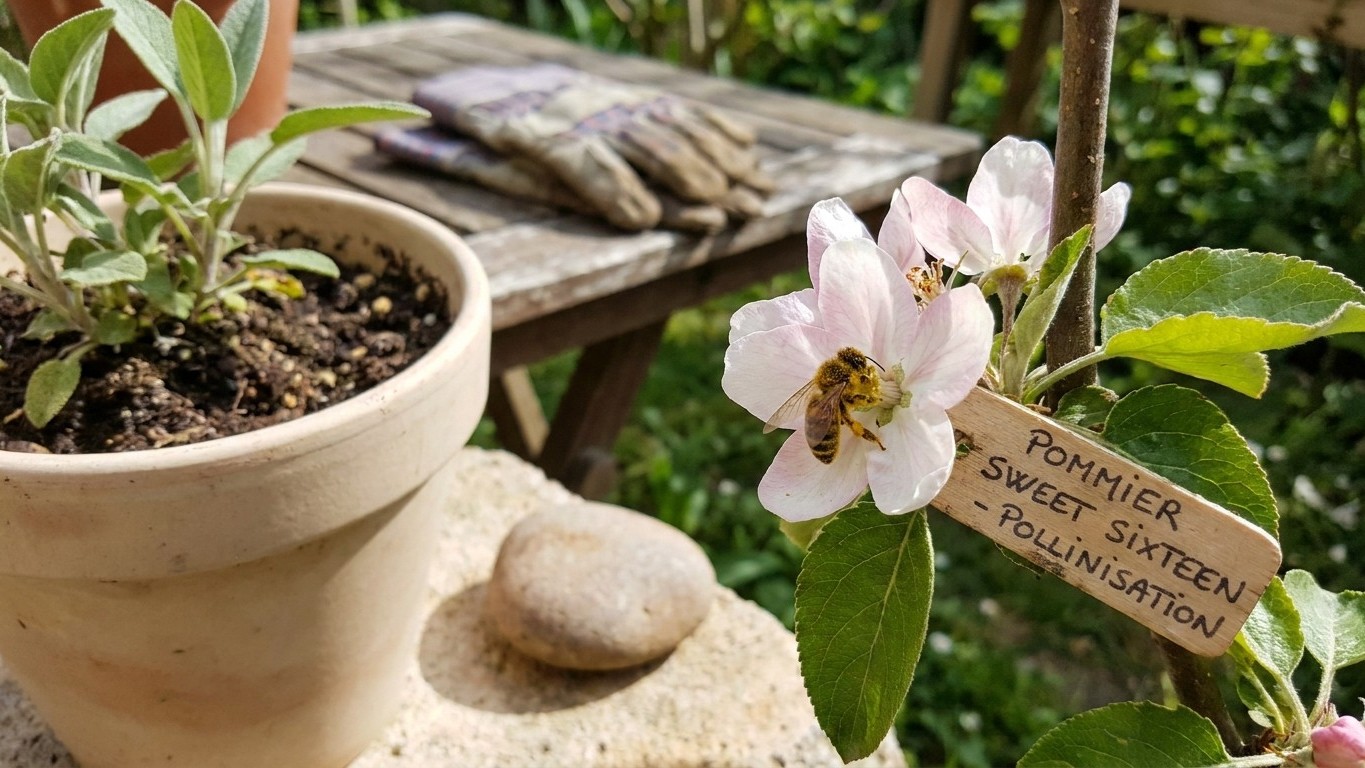

Sweet Sixteen apple trees need a mid-to-late bloomer standing nearby, or you’ll get flowers and no fruit. Hardiness from zone 3 to 7 doesn’t matter if the second tree finishes blooming before Sweet Sixteen even opens — timing, not toughness, is what decides this. So before you plant anything, find out two things about the partner you’re eyeing: when it blooms, and whether the nursery tag actually confirms its pollen is fertile.
The short answer
USU’s production guide gives Sweet Sixteen’s bloom season as mid to late and its hardiness range as zones 3 to 7, but it stops short of naming which other varieties actually pair with it. That gap matters less than it sounds, because the rule behind every named partner list is the same one you can apply yourself: any apple variety flowering in that same mid-late window, and hardy in your zone, is a workable candidate. A tree that finishes blooming two or three weeks before Sweet Sixteen opens, or one that has not even started when Sweet Sixteen is already dropping petals, misses the window and will not do the job no matter how healthy it is. This is the same bloom-timing logic that runs through apple pollination for every cultivar, not something unique to this one.
How many trees you actually need
The part USU’s guide does not report is pollen fertility, and that detail decides whether two trees are enough or whether you need three. If Sweet Sixteen’s pollen turns out to be fertile, two mid-late bloomers, Sweet Sixteen and one partner, will feed each other and that is the end of it. If its pollen is sterile, as it is in a number of dessert apples, it can accept pollen from a partner but never return the job, and a garden with just those two trees sets fruit on one tree only. The safe move is to buy from a nursery that states pollen fertility on the tag, and to plant a third tree in the same mid-late window if that information is missing or unclear. Three compatible bloomers covering each other removes the guesswork, and in most gardens it costs one extra tree beyond what you were already planning to plant.
Why these varieties and not others

Two apple varieties pollinate each other only when their flowers are open on the same days, and the tool orchardists use to predict that overlap is the bloom group, a ranking system Clemson Cooperative Extension uses to sort varieties by when their flowers open relative to the others in a growing region. USU places Sweet Sixteen’s bloom in the mid to late position in that sequence. A variety ranked in an early group has usually finished flowering before a mid-late variety even opens, and the two miss each other regardless of how healthy either tree is.
Bloom groups move, but the order does not
A bloom group is a relative order, not a fixed date on a calendar. The same mid-late ranking that applies to Sweet Sixteen shifts earlier or later depending on that year’s spring weather, sometimes by two or three weeks between a cold location and a mild one. What stays constant is the sequence: a variety ranked early blooms before one ranked mid-late in the same place, year after year, even while the actual calendar dates slide around from one season to the next.
What the bloom group does not guarantee
Sharing a bloom group is necessary but not sufficient. Two varieties can flower on exactly the same days and still fail to set fruit on each other if one of them carries sterile pollen, since overlap only puts pollen within reach, it does not make that pollen viable. A bloom group also says nothing about parentage: two varieties ranked together can be entirely unrelated, or one can be bred directly from the other, and a seedling does not fertilize the parent it came from even with perfectly matched bloom timing. Both of those checks sit outside a bloom-group chart, and both matter more than the calendar once two candidate trees are actually flowering together.
What cannot pollinate it
The gap in the published record
USU’s guide does not name a variety with sterile pollen in Sweet Sixteen’s bloom group, and it does not flag a parent variety that would exclude a pairing by descent. That gap is worth stating plainly rather than filling with a guess: compatibility beyond the mid-late bloom window is not published in the source this page relies on, and a grower who wants a guaranteed pairing should ask the nursery directly or check a fertility-rated variety list before buying.
The two mechanisms worth checking anyway
The general mechanism behind any exclusion is still worth knowing, because it shows up across the apple world even where Sweet Sixteen itself is not named in the record. Some varieties carry three sets of chromosomes instead of two, a well-documented trait in cultivars like Jonagold and Gravenstein, and that extra set makes their pollen sterile. A triploid tree can be pollinated by a diploid neighbor, but it never returns the job, so a garden built from just a triploid and one other variety sets fruit on the diploid tree only, not both. Check any tag that describes a variety as a pollinator only or notes reduced pollen for exactly this reason.
A second exclusion has nothing to do with fertility and everything to do with family. A seedling variety and its own parent do not fertilize each other, even when their bloom overlaps perfectly, because a plant’s pollen does not fertilize the flower it descended from a generation back. This is why pages like What Pollinates Topaz, and What Cannot and What Pollinates Ginger Gold, and What Cannot spend real space on named parentage. That exclusion is specific to each cultivar’s documented breeding, and inventing one for Sweet Sixteen without a published pedigree would be worse than saying nothing.
How close the second tree has to be

What else carries the job
Pollen for apples moves almost entirely on bees, not wind, so distance is a practical question about how far a foraging bee is willing to fly on one trip, not a matter of prevailing breeze. The general answer holds across every bloom group: closer is always better, and a partner tree in the same garden works more reliably than one across the street or on a neighboring property. The second tree also does not have to be a full standard-size specimen to do the job. Anything flowering in the same mid-late window and offering pollen counts, which is why several sources work as well as one dedicated partner tree:
- A neighbor’s apple tree, if it blooms in the same mid-late window and bees regularly cross the space between the two gardens
- An ornamental crabapple, many of which flower on a similar schedule and are planted in small orchards for exactly this reason
- A single grafted branch of a compatible variety added onto an existing tree, which puts pollen inside the same canopy
What stops it regardless of partners
Honeybees, bumblebees, and orchard mason bees all carry pollen between apple flowers, and a garden that hosts any of them through the bloom window benefits regardless of which species happens to be active on a given day. What no partner tree fixes is weather. Cold, wind, or a stretch of rain during the bloom window keeps bees from flying, and a poor week for foraging can cut fruit set even when a perfectly matched partner stands right next to Sweet Sixteen. No amount of extra trees compensates for bad weather during bloom, because the pollen still has to move, and only active bees move it in quantity worth counting on.
If there is no room for a second tree
A city lot or a small backyard often cannot fit two full apple trees, and there are a few real workarounds rather than one perfect fix. Each solves the pollination problem to a different degree, and each carries its own maintenance cost.
The options compared
| Option | Effort | What it solves | What it does not solve |
|---|---|---|---|
| Multi-grafted tree | Buy pre-grafted, or graft it yourself over a year or two | Puts two or more compatible varieties on one trunk in one planting hole | Each graft still needs enough vigor to flower well; a weak graft blooms less |
| Pollinator branch grafted onto Sweet Sixteen | One graft done in late winter, several seasons to reach full bloom | Adds pollen inside the same canopy without a second planting hole | Takes a few years before the branch flowers reliably |
| Columnar variety | Buy as a narrow, upright tree, minimal pruning | Fits a second variety into a narrow bed or a large container | Still needs its own bloom to overlap Sweet Sixteen’s mid-late window |
| Flowering crabapple | Plant as an ornamental, little extra care afterward | Supplies pollen without taking space in the fruit or vegetable beds | Only works if its bloom period actually overlaps Sweet Sixteen’s |
None of these replace the basic requirement that something flowering in the mid-late window has to be within a bee’s working range of Sweet Sixteen during bloom. A columnar tree in a pot on a patio, a grafted branch, or a crabapple two doors down all satisfy that requirement in different ways. The cheapest one to try first is usually the crabapple, since it doubles as an ornamental whether or not its bloom time ever gets confirmed to match.
Common questions
Can I plant just one Sweet Sixteen tree and still get apples?
Nearly all apple varieties crop better with a compatible partner nearby, and USU’s guide does not list Sweet Sixteen as an exception. A lone tree may set a light crop in a neighborhood with other apples or crabapples blooming close by, but do not count on it for a full harvest.
Does Sweet Sixteen bloom at the same time every year?
No. USU Extension gives the bloom season as mid to late, and that is a position relative to other varieties, not a fixed calendar date. A warm spring pushes bloom earlier and a cool one pushes it later, while the position in the sequence stays the same.
Will a crabapple near my Sweet Sixteen tree actually help?
Yes, provided it flowers during the same mid-late window. Ornamental crabapples get planted in small orchards for exactly this reason, since many varieties bloom over an extended stretch and overlap with several apple bloom groups at once.
Does rootstock affect whether Sweet Sixteen gets pollinated?
No. Rootstock controls the eventual size and vigor of the tree, not its bloom timing or pollen fertility. A dwarfing rootstock can make room for a second variety sooner in a small garden, which makes finding space easier, but it does not change the pollination rule itself.
How do I find out if Sweet Sixteen’s pollen is fertile where I am?
Ask the nursery you are buying from, since USU’s production guide does not report a fertility rating for this cultivar. Some nursery catalogs and state fruit-variety lists rate pollen fertility directly, and that is a more reliable source than guessing from bloom group alone.