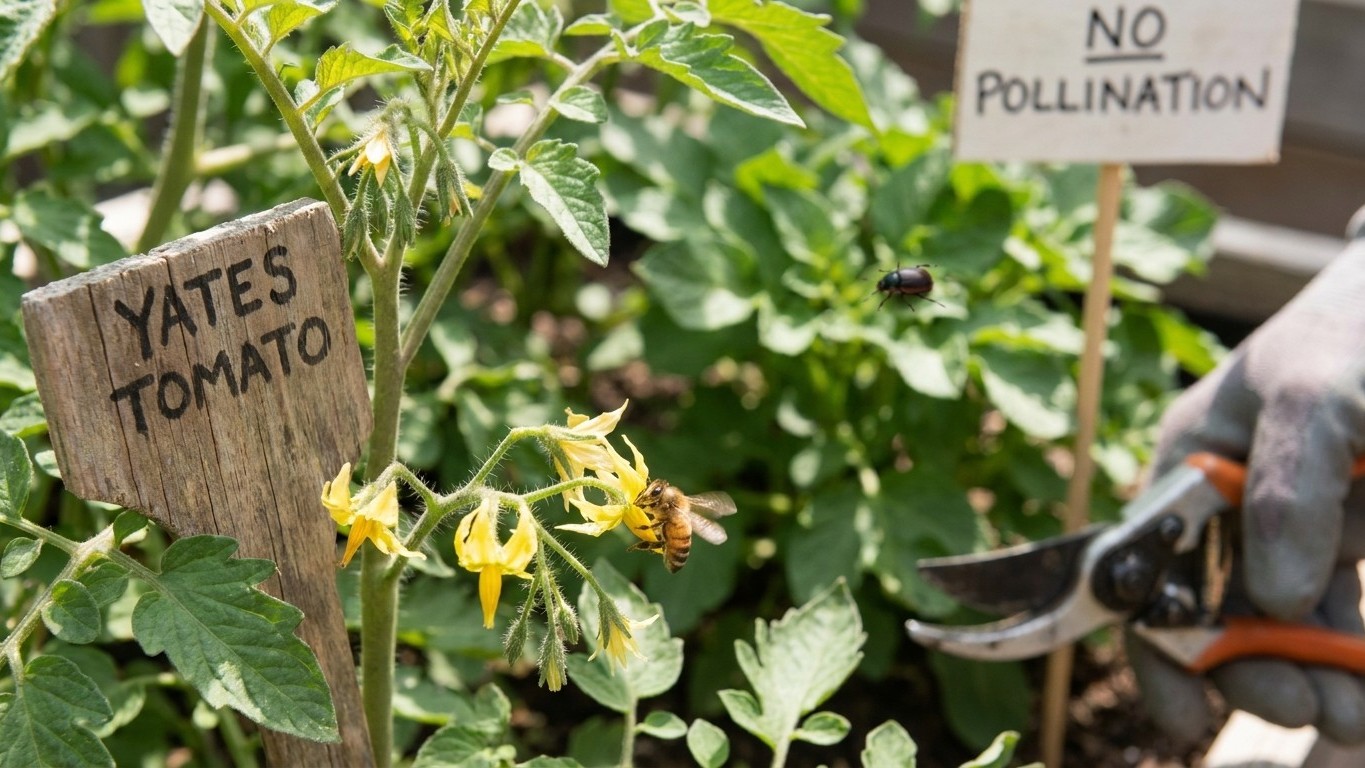

Yates crops best with a second apple tree blooming in the same window, and Fuji, Gala, Ginger Gold, Granny Smith, Jerseymac, Mollie’s Delicious and Red Delicious all qualify, according to Clemson Cooperative Extension’s bloom-group listing (HGIC 1350, with UGA Extension’s C740 in agreement). Yates sits in bloom group B, the same relative flowering slot as those seven. Plant one of them close to your Yates, and make sure it isn’t Mutsu, which blooms right alongside Yates but cannot fertilize it.
The short answer
A Yates tree standing alone won’t set fruit, but it doesn’t need much help — just one other tree from a short list of compatible bloomers, close enough for bees to carry pollen between them. The catch is Mutsu. It flowers at the same time as Yates and looks like a natural partner, but its pollen is sterile, so a Yates-and-Mutsu pair alone will hang blossoms every spring and nothing else. If Mutsu is already planted, it isn’t wasted — it just needs a third tree too.
Two trees are enough. Yates pollen is not listed as sterile, so a single partner from that list, standing near the Yates, does the job in both directions. The partner feeds pollen to Yates, and Yates returns it. That changes if you already own a Mutsu tree and hoped it would double as the partner. Mutsu blooms at the same time but its pollen is sterile, so it cannot fertilize Yates, and pairing Yates with a sterile-pollen variety and nothing else sets no fruit, whatever the bloom charts say about timing.
- Fuji
- Gala
- Ginger Gold
- Granny Smith
- Jerseymac
- Mollie’s Delicious
- Red Delicious
If a Mutsu is already in the ground, keep it, since its own fruit is worth growing. Just add a third tree from the list above so both Yates and Mutsu get pollinated, because Mutsu also needs an outside pollen source of its own.
Why these varieties and not others

Bloom group is a ranking of when a variety opens its flowers relative to other apples, not a calendar date. Clemson Cooperative Extension (HGIC 1350) and the University of Georgia Extension (C740) place Yates in bloom group B, an early-to-mid slot in the sequence most apple varieties are sorted into. Fuji, Gala, Ginger Gold, Granny Smith, Jerseymac, Mollie’s Delicious and Red Delicious sit in that same group, which is why bees moving between them can carry pollen from one open flower to another.
The order itself does not change from one region to the next. A grower in the Upstate opens Yates blossoms on a different date than a grower on the coast, but Yates still flowers ahead of the late-group varieties and behind the earliest ones, wherever the orchard sits. That is the whole value of a bloom-group table: it tells you which trees overlap without pretending to know your local weather. For the general rules that apply across the whole crop, not just Yates, the mechanics are laid out on the Apple Pollination page.
Belonging to the same bloom group answers only one question: are the flowers open on the same days. It says nothing about whether the pollen inside those flowers actually works. Mutsu proves the point, since it sits alongside Yates in timing yet its pollen cannot fertilize anything. Bloom group also says nothing about parentage. Two varieties can share a bloom group despite having no breeding relationship at all, and none of the seven compatible names above are listed as a parent of Yates, so that particular problem does not apply to this pairing. Because the sequence can still shift by a week or more between a warm spring and a cold one, it is worth cross-checking the Clemson or UGA bloom chart for your own varieties rather than relying on catalog descriptions alone.
What cannot pollinate it
Mutsu is the variety to watch for. It flowers in the same bloom-group B window as Yates, so the timing looks perfect on paper, but its pollen is sterile. A tree with sterile pollen can still accept pollen from another variety and produce fruit itself, it just cannot hand pollen back. Plant only a Yates and a Mutsu together and you get two trees in full bloom every spring and no apples on either one, because neither has a fertile partner to complete the job.
This is different from a parentage exclusion, where a variety is bred directly from another and genetically can’t fertilize its own parent. Clemson Cooperative Extension and the University of Georgia Extension have not published a parentage exclusion for Yates, so that particular trap does not apply here. What they do publish is the sterile-pollen warning on Mutsu, and that alone rules out a two-tree Yates-and-Mutsu orchard.
Beyond the seven compatible varieties and the one sterile exception named above, compatibility for Yates with other apple cultivars is not published by either extension service. That does not mean every other variety fails, only that no source backs a claim either way. If you already grow a variety that isn’t on the list and it blooms near the same time, treat it as an unknown rather than assuming it will or won’t work, and add one of the seven confirmed varieties as insurance rather than betting the harvest on a guess. Growers dealing with other old varieties run into the same gap. The Yellow Transparent pollination page and the Golden Supreme pollination page cover what is and isn’t confirmed for those two the same way.
How close the second tree has to be

Honeybees and other pollinating insects carry pollen between Yates and its partner, not the wind, so distance matters more than which side of the tree the flowers face. The closer the two trees stand, the more bees pass between them on a single trip, and a partner in the same yard works better than one three properties over.
What else can do the job
The compatible tree does not have to be one you planted on purpose. A neighbor’s Gala or Red Delicious in bloom at the same time can pollinate a Yates over a fence line, as long as bees regularly cross that distance. A flowering crabapple planted for its own sake counts too, provided it opens its blossoms during the same window as Yates, since crabapples are commonly used as pollen sources in orchards precisely because they bloom heavily over a long stretch. A single grafted branch of a compatible variety, added onto an existing Yates tree, supplies pollen from within the same canopy and solves the space problem without a second trunk at all.
What stops it working
Bloom-group timing and tree distance both assume bees are actually flying. Cold, wind, or wet weather during the bloom window keeps pollinators in the hive regardless of how well the two varieties overlap on paper, and no amount of planning around bloom group compensates for a stretch of bad weather at the wrong week. If a spring turns unusually cool or rainy right when Yates opens, expect a lighter set that year even with a perfect partner already in place, and don’t read it as a sign the pairing itself was wrong.
If there is no room for a second tree
A small yard does not rule out fruit, it just changes which route you take to get a compatible pollen source close enough to matter.
| Option | What it involves | What it does not solve |
|---|---|---|
| Multi-grafted tree | One trunk carrying Yates plus two or three compatible varieties, each on its own branch | Still needs regular pruning to keep one variety from overtaking the others |
| Pollinator branch graft | A single scion of Fuji, Gala or another compatible variety grafted onto an existing Yates | Takes a season or two to grow enough wood to flower well |
| Columnar variety | A narrow, upright compatible tree planted in a strip a full-size tree would not fit | Still needs its own space and light, just less of it |
| Flowering crabapple | An ornamental tree chosen partly for pollen rather than its own fruit | Only works if its bloom time actually overlaps bloom group B |
The multi-grafted tree is the most complete fix, since it puts Yates and a compatible variety on the same root system without a second planting hole, but it demands yearly attention to stop the stronger-growing variety from shading out the others. A pollinator branch grafted onto an established Yates is quicker to add and cheaper than a second tree, though it supplies less pollen than a full-size partner until the graft matures. A columnar variety solves the space problem outright but still needs to be one of the confirmed compatible names, not just any narrow tree. A crabapple is the least effort of the four if you already want one for its flowers, but confirm its bloom timing before counting on it, since not every ornamental crabapple opens during bloom group B.
Remember that the rootstock a tree is grafted onto controls its eventual size, not the variety name on the label, so a dwarf Gala and a full-size Gala carry identical pollen and either will pollinate Yates equally well. Choose the rootstock for the space you have, and pick the variety for compatibility, treating the two decisions separately.
Common questions
Can I use a crabapple instead of a real apple tree to pollinate my Yates?
Yes, as long as the crabapple’s bloom overlaps Yates in bloom group B. Confirm the timing with the nursery tag or a local extension source rather than assuming any crabapple will do.
Will my Yates fruit at all without another apple tree nearby?
Nearly all apple varieties, including Yates, crop better with a compatible partner. A lone Yates may still set a light scattering of fruit some years, but don’t plan a harvest around it.
Is Mutsu a bad tree to grow if it can’t pollinate my Yates?
No. Mutsu still bears its own fruit once it has a fertile pollinator of its own, from the same Clemson bloom-group B list. It simply can’t act as the pollinator for something else.
How long before a new pollinator tree actually starts helping my Yates?
That depends on the tree’s age, rootstock and how it was planted, and isn’t a fixed number. Ask a local nursery or your county extension office what to expect for the specific tree and rootstock you’re buying.
Does this same list of pollinators work for other old apple varieties I’m growing?
No, each variety has its own published bloom group and its own compatibility list. Check the specific page for that variety, such as the ones covering Yellow Transparent or Golden Supreme, rather than assuming the Yates list carries over.