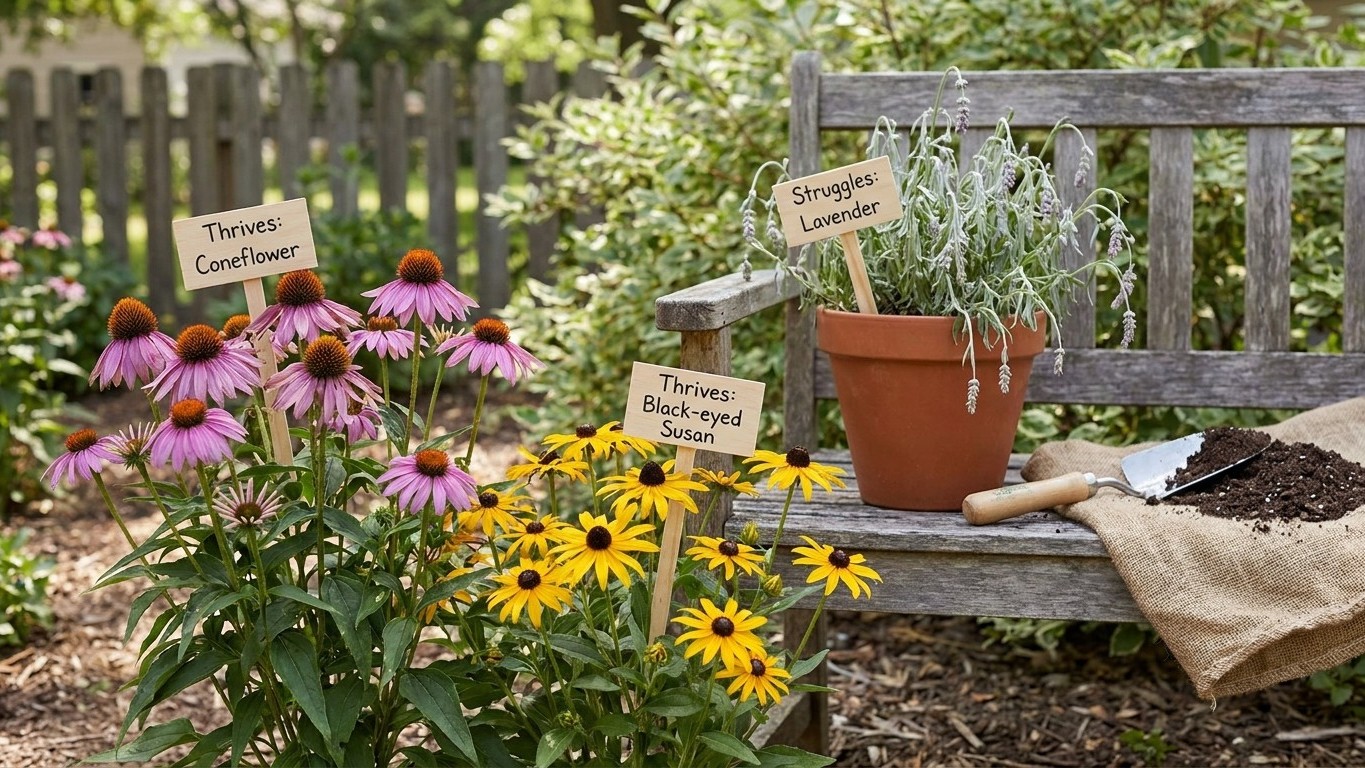

The flowers that come back here are the ones built for real cold, not the ones bred for a longer, gentler summer somewhere else. Peonies, daylilies, coneflowers, and other perennials rated down to zone 3 or 4 shrug off a Minnesota winter and settle in for the long haul, while dahlias, tropical hibiscus, and other warm-climate favorites either die back completely or never really get going before frost cuts them down. Before you buy anything, flip the tag over and check the hardiness zone against your own county, because the pretty display out front doesn’t tell you that.
What thrives in Minnesota

Winter cold: the real filter
The state’s USDA Plant Hardiness Zone Map 2023 range of 3a to 5a is the single biggest filter for what stays alive here. In the coldest month, NOAA’s 1991-2020 climate normals put the mean daily minimum at Minneapolis at 8.8°F, and northern counties run colder still, often into true zone 3 territory. A flower with no answer to a winter that regularly drops well below zero for weeks at a stretch does not get a second season here, no matter how well it blooms in July. Cold hardiness, not drought tolerance or bloom size, is the trait that decides whether a perennial is a one-summer purchase or a fixture in the border for a decade.
Summer heat: a smaller factor
Summer is the opposite problem, in miniature. Minneapolis averages 10.6 days a year at 90°F or hotter, according to NOAA’s normals, which is real heat but a fraction of what a Gulf Coast or Deep South garden absorbs every summer. That matters when you’re picking flowers bred for humid heat: plenty of them just don’t accumulate the degree-days they need to perform well, and a few sulk in a Minnesota July the same way a cool-season plant would wilt outright further south. If you’re comparing notes with a gardener elsewhere, the guide to flowers that actually thrive in Alabama or the one on flowers that thrive in Missouri shows how differently the same “full sun perennial” label plays out once summer heat load roughly triples.
What does well here shares a few traits beyond raw cold tolerance. Cold hardiness rated to zone 4 or colder is non-negotiable for anything left in the ground over winter. Beyond that, tolerance for a short growing season matters more than heat tolerance, since few Minnesota flowers ever face genuine heat stress. Drought resistance helps through a dry August but isn’t the deciding factor it is in the Southwest. Certain plant families carry these traits reliably: Asteraceae (coneflowers, asters, black-eyed Susans), Paeoniaceae (peonies), Ranunculaceae (columbine, clematis), and Iridaceae (bearded and Siberian iris) all include species and cultivars rated to zone 3 or 4. Within those families, read the hardiness number on the tag itself rather than trusting the common name, since two plants sold under the same name can carry different ratings at different retailers.
Native plants worth the space
Plants native to the tallgrass prairie and the wider Upper Midwest evolved with this exact winter and this exact length of summer, so they need far less coddling once established than an imported cultivar bred for a milder climate. No winter mulch, no supplemental water past the first season, no fungicide schedule. The tradeoff is a shorter bloom window on some species and a look that reads more informal than a bedding-plant border.
Purple coneflower (Echinacea purpurea) is the workhorse: sturdy stems, a long midsummer bloom, and seed heads that feed finches through fall if you skip deadheading. Black-eyed Susan (Rudbeckia hirta) does the same job in a shorter-lived, more prolific package that reseeds readily on its own. Wild bergamot (Monarda fistulosa) draws bumblebees and hummingbird moths and shrugs off the dry spells that follow an occasional rainless August. Butterfly milkweed (Asclepias tuberosa) is the one to plant if monarch caterpillars matter specifically, since it’s a larval host plant and not just a nectar source. Blazing star (Liatris ligulistylis) sends up a tall purple spike that migrating monarchs use as a fall fueling stop before heading south.
Sourcing genuinely local stock
These species are native across a wide swath of the Upper Midwest and central prairie region rather than to Minnesota alone, so a plant tagged “native” at a garden center may have originated from seed stock collected hundreds of miles away. That’s usually fine for ordinary garden performance. If matching local genotypes matters, for a restoration project or a natural-area planting, buy from a nursery that sources Minnesota-collected seed rather than relying on the word “native” printed on the label. Little bluestem (Schizachyrium scoparium) and prairie dropseed (Sporobolus heterolepis) aren’t flowers, but pairing them with the species above gives the bed winter structure and habitat for native bees that overwinter in hollow stems rather than underground.
Pollinators are the other half of the argument for planting native. A bed of coneflower, bergamot, and blazing star blooming in sequence keeps native bees fed from June through the first hard frost, without the pesticide residue that some nursery-grown annuals carry from the growing operation. Ask the nursery directly whether bedding plants were treated with a neonicotinoid, since the tag rarely says one way or the other.
Perennials that come back

At Minneapolis, USDA’s map places the metro at the milder end of the state, while far northern Minnesota drops into true zone 3a. Peonies, daylilies (Hemerocallis), hostas, and Siberian iris return reliably across nearly every zone the state covers and are about as close to guaranteed as perennials get here. Sedum ‘Autumn Joy’ and most garden mums sold as fall perennials also overwinter fine once established, though a first-year planting does best going into the ground early enough to root before the soil freezes.
What’s grown as an annual here instead
Plenty of plants sold in the perennial section of a big-box store are only truly perennial in a warmer zone. Dahlias are hardy to roughly zone 8, so in Minnesota’s 3a-5a range they’re either dug up and stored over winter or replanted from tubers each spring, the same way a heat-lover from a southern catalog might get treated as a one-season plant here. Tuberous begonias, canna, and most gladiolus fall in the same category: showy through summer, dead by December if left in the ground. Lavender is a partial exception. Cultivars like ‘Munstead’ and ‘Hidcote’ push into zone 5 hardiness and can survive a mild Minneapolis winter in a sheltered, well-drained spot, but the same plant is usually a lost cause in a low, poorly drained yard further north.
Reading a plant tag against your zone
The tag’s hardiness number is a minimum, not a guarantee. A plant rated to zone 4 is expected to survive a typical zone 4 winter, but “typical” is an average, and a single unusually harsh week can still kill a marginal specimen, especially in its first winter before roots are established. When a tag lists a range like “4-9,” treat 4 as the true floor for Minnesota use, not the midpoint. If you garden in a low spot where cold air pools, or in soil that stays wet into freeze-up, buy one zone hardier than the map suggests for that exact spot rather than for the state average.
Putting a border together
Start with height in three rough tiers: back-of-border plants at 3 to 5 feet (delphinium, joe-pye weed, tall garden phlox), mid-height fillers at 18 to 30 inches (coneflower, daylily, bee balm), and a low front edge under 12 inches (creeping phlox, dianthus, sedum). Plant the tall stuff where it won’t shade the rest, which in most yards means the north or west side of the bed.
Succession of bloom through a short season
Minnesota’s growing season runs, roughly, from the last spring frost to the first fall frost, and at Minneapolis NOAA’s 1991-2020 normals put that window between April 17 to April 30 in spring and October 11 to October 23 in fall. Northern Minnesota runs two to three weeks tighter at both ends, per the same normals. A border needs overlap through that window, not just a sequence, to avoid a bare stretch. Peonies and iris cover late spring into early summer. Coneflower, daylily, and bee balm carry the bulk of summer. Aster, sedum ‘Autumn Joy,’ and goldenrod take the border to the first frost. Gaps most often show up right after the peonies finish, so plant something specifically into that window rather than assuming the rest of the border will cover for it.
| Perennial | Approx. height | Bloom window | Catalog hardiness |
|---|---|---|---|
| Peony | 2-3 ft | Late spring | Zone 3-8 |
| Bearded iris | 2-3 ft | Late spring to early summer | Zone 3-9 |
| Purple coneflower | 2-4 ft | Summer | Zone 3-9 |
| Daylily | 1-3 ft | Summer | Zone 3-9 |
| Sedum ‘Autumn Joy’ | 1-2 ft | Late summer to fall | Zone 3-9 |
| New England aster | 3-5 ft | Fall | Zone 4-8 |
Repeat one or two colors at intervals down the border instead of scattering a different hue every few feet. A border that repeats purple (coneflower, iris, aster) with one accent, like the orange of butterfly milkweed, reads as designed even when the individual plants bloom weeks apart. Leave real gaps at planting, generally 18 to 24 inches between perennial crowns depending on the species’ mature spread, since the urge to pack a new bed tight leads to a mildew-prone tangle by the third summer instead of the full look you were going for.
Local help
The University of Minnesota Extension publishes plant lists and hardiness guidance tuned to the state’s actual zone range rather than a national average, and its Master Gardener program trains volunteers county by county who staff plant clinics and answer site-specific questions for free. Since Minneapolis sits at the milder end of the state’s 3a-5a range, a gardener in Duluth or International Falls should check with their own county office rather than assume a Twin Cities recommendation applies. For more on gardening across the state, the Minnesota guides section covers other seasonal tasks county by county.
Common questions
What zone is Minnesota for planting?
Minnesota spans USDA zones 3a to 5a, according to the USDA Plant Hardiness Zone Map’s 2023 update, with the coldest ratings in the northern third of the state and the mildest around the Twin Cities and the far southeast. Check your specific county rather than assuming a statewide zone, since the gap between 3a and 5a matters for anything borderline hardy.
Can I plant flowers before the last frost date?
You can plant frost-tolerant perennials and hardy bulbs before the average last frost, but tender annuals and warm-season plants should wait. NOAA’s 1991-2020 climate normals put Minneapolis’s last spring freeze between April 17 and April 30, and that window runs two to three weeks later in northern Minnesota, so treat it as a range to watch against your own forecast rather than a fixed calendar date.
Why did my perennial come back one year and die the next?
The usual culprits are a marginal hardiness rating, a root zone that stayed wet and froze solid, or a young plant that hadn’t rooted deeply enough before winter arrived. A perennial rated right at the edge of zone 4 can survive an average winter and still die in a harsher one, since a hardiness zone reflects a typical minimum, not a guarantee against a worse year.
Do I need to mulch flower beds for winter here?
Most established, zone-appropriate perennials don’t need winter mulch, but a fresh fall planting benefits from a few inches of straw or shredded leaves once the ground starts to freeze, applied to insulate the roots rather than to keep them warm. Pull the mulch back in early spring so new growth isn’t smothered underneath it.
Related guides
- Flowers That Actually Thrive in Wisconsin, and the Ones That Struggle
- Flowers That Actually Thrive in Iowa, and the Ones That Struggle
- Flowers That Actually Thrive in Missouri, and the Ones That Struggle