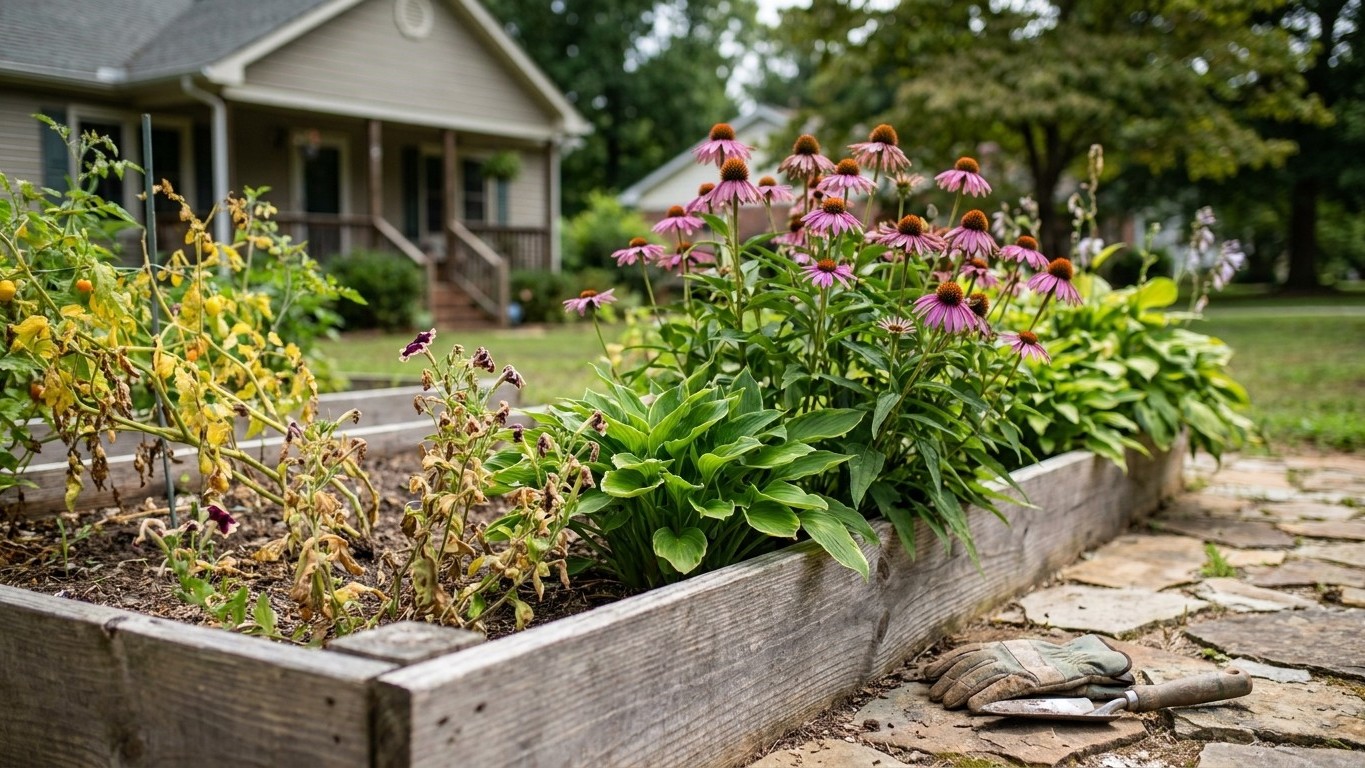

North Carolina runs from USDA zone 5b in the high mountains to 8b along the coast, according to the USDA Plant Hardiness Zone Map, and NOAA’s 1991-2020 climate normals put Charlotte’s coldest month at a mean minimum of 31.8°F with 35 days a year reaching 90°F or hotter. A flower that does well here has to shrug off both a real winter chill and a long, humid summer stretch. Coneflower, black-eyed Susan and daylily manage both across nearly the whole state. Before you buy anything, check the plant tag’s zone range against wherever you actually garden, not against the state as a whole.
What thrives in North Carolina

Thirty-five days a year above 90°F, stacked on humidity that never quite lets foliage dry out by noon — that’s the combination deciding which flowers make it here, not the occasional frost everyone worries about. Powdery mildew and root rot do more damage in a Carolina summer than cold ever will. Plants with glossy or narrow leaves, the kind bred from prairie and open-woodland stock rather than cool, dry climates, shrug off that wet heat instead of rotting in it. That distinction sorts the survivors from the strugglers.
Summer is the other filter. Charlotte averages 35 days a year at 90°F or above under those same NOAA normals, and that heat arrives stacked on top of humidity that keeps foliage wet long after the sun’s up. Powdery mildew and root rot kill more flowers in this state than frost does. Plants with tough, glossy or narrow foliage, and those bred from prairie or open-woodland stock, handle this combination better than plants bred for a cool, dry climate.
Families that carry these traits
A few plant families show up again and again on lists of what actually survives a Carolina summer:
- Asteraceae: coneflower, black-eyed Susan, aster, zinnia. Tough foliage, long bloom, drought tolerant once rooted in.
- Hemerocallis (daylily): shrugs off heat and clay soil, blooms through the worst of July.
- Lamiaceae: salvia, bee balm, catmint. Aromatic foliage resists deer and most fungal issues.
- Iridaceae: bearded iris and Louisiana iris both handle the wet-to-dry swing of a Piedmont spring.
If you garden elsewhere in the state, coastal sand and mountain clay each shift these recommendations, and our broader North Carolina guides break those regional differences down further. Drought resistance matters more once a plant is established than at planting time, since almost everything needs regular water for its first season regardless of its eventual toughness.
Native plants worth the space
Plants native to the wider Southeast and mid-Atlantic region arrive pre-adapted to this exact combination of winter chill and summer humidity, because they evolved under it. That head start means less staking, less spraying and, once a native is established through its first year or two, far less supplemental water than a plant sourced from a different climate. Established is the operative word: a native planted this spring still needs regular watering through its first summer before that reduced-maintenance reputation kicks in.
Natives also carry a second job that imported ornamentals mostly don’t: feeding the insects that in turn feed birds and everything above them. A few reliable choices for the wider region:
- Purple coneflower (Echinacea purpurea): pink-purple daisy flower with a raised orange-brown cone, blooms through summer heat.
- Black-eyed Susan (Rudbeckia hirta): bright yellow petals around a dark brown center, self-seeds freely.
- Butterfly weed (Asclepias tuberosa): clusters of bright orange flowers, a host plant for monarch caterpillars.
- Bee balm (Monarda didyma): shaggy red or pink flower heads, aromatic foliage, draws hummingbirds.
- Joe Pye weed (Eutrochium purpureum): tall stems topped with dusty pink flower clusters, thrives in damp ground.
Why bloom timing matters for pollinators
A single stand of one native species blooms for a few weeks. A mix of the five above, planted together, keeps something flowering from late spring through the first hard frost, which matters more to a bumblebee than any one showy specimen does. Skip the straight species if you want the smallest, tidiest plant: many cultivated selections of these natives are bred for compact habit and can lose some of the nectar value of the wild form, though they still outperform most non-native ornamentals on that score.
Perennials that come back

Whether a perennial actually returns next spring in North Carolina comes down to matching its published hardy zone range against wherever you garden inside the state’s 5b to 8b spread. A tag that says “hardy in zones 4 through 8” is a safe bet almost anywhere in the state. A tag that says “hardy in zones 8 through 11” is only reliable near the coast, and will need to be treated as an annual, or dug and stored over winter, everywhere else.
Reading the tag against your zone
| Plant | Published hardy zones | Behavior across most of North Carolina |
|---|---|---|
| Purple coneflower (Echinacea purpurea) | 3-8 | Reliable perennial, returns every year |
| Black-eyed Susan (Rudbeckia hirta) | 3-9 | Reliable, often self-seeds a new patch |
| Garden phlox (Phlox paniculata) | 4-8 | Reliable in the Piedmont and mountains |
| Lantana (Lantana camara) | 9-11 | Grown as an annual except the mildest coastal spots |
| Dahlia | 8-11 | Tubers usually need digging where winters run colder than zone 8 |
| Tropical hibiscus (Hibiscus rosa-sinensis) | 9-11 | Annual, or a container plant brought indoors for winter |
That last row is where a lot of first-time Carolina gardeners get burned: a big-box store sells tropical hibiscus and dahlias right alongside true perennials, with no obvious sign at the point of sale that one group needs to be lifted or replaced every year here and the other doesn’t. On the flip side, cool-summer perennials such as lupine and delphinium, which put on their best display somewhere like Maine, tend to rot or simply refuse to rebloom once a Carolina July sets in, no matter how hardy their zone tag claims they are for cold. Our guide to flowers that thrive in Maine is a useful contrast if you’re wondering why a plant that does beautifully for a friend up north sulks here.
Putting a border together
Start with height and work backward. Tall perennials like Joe Pye weed or garden phlox go at the back of a bed or the center of an island, mid-height plants such as coneflower and bee balm fill the middle ground, and low, spreading plants like creeping phlox or dwarf zinnia edge the front. Skipping this order is the single most common reason a new border looks messy by its second season, once everything has actually grown to size.
Succession and repetition
A border planted entirely with one season’s favorites blooms hard for six weeks and then sits green and empty for the rest of the year. Stagger it instead: something spring-blooming like bearded iris, something for peak summer like coneflower or daylily, and something that carries into fall like aster or a late-blooming sedum. Repeating the same three or four plants in drifts, rather than planting one of everything, is what makes a border read as designed instead of collected. A single specimen of a dozen different plants looks like a plant sale table. Three coneflowers repeated four times through the bed looks intentional.
Leave real space at planting time. A perennial in a one-gallon pot looks lonely at 18 inches from its neighbor, but by its second or third summer in Charlotte’s growing conditions it will have filled that gap and then some. Crowding at planting is a debt that comes due in two years, in the form of powdery mildew from poor air circulation, exactly the disease this state’s humid summers already favor. If you garden just south of the state line, the same crowding problem shows up even faster: our guide to flowers that thrive in South Carolina covers a climate with even more days above 90°F, where airflow between plants matters even more.
Local help
North Carolina State University’s Cooperative Extension maintains county offices and Master Gardener volunteer programs across the state, and both are set up specifically to answer “will this survive here” questions with local knowledge rather than a national average. A county office in the mountains and one on the coast will often give different answers to the same plant question, which is exactly the point given how wide the state’s 5b to 8b hardiness range runs. Start at the NC State Extension website and search for your county’s office before you commit to anything borderline for your zone.
Common questions
Do I need to worry about the last frost date before planting flowers outside?
Yes, for anything not already hardened to cold. NOAA’s 1991-2020 climate normals put Charlotte’s last spring freeze between March 23 and April 5, with a 30 to 70 percent probability across that window, and the coastal plain typically clears earlier while the mountains run several weeks later. Treat that as a range to watch, not a single calendar date to plant by.
Why do my perennials from a catalog based up north keep dying here?
Most often it’s summer heat and humidity, not winter cold, that kills them. A plant can be perfectly hardy to a Charlotte winter, given NOAA’s normals showing a coldest-month minimum of 31.8°F, and still fail because it can’t handle 35 days a year above 90°F plus the humidity that comes with a Southeastern summer.
Can I still plant flowers if I garden in the mountains where it’s colder?
Yes, but choose from the colder end of any published hardiness range, since the mountains sit toward USDA zone 5b to 6 rather than the 8b found near the coast. Check with your county Extension office, since frost timing there runs meaningfully later than the Charlotte-area dates used elsewhere on this page.
Is it worth buying native plants instead of regular garden center annuals?
For any spot you don’t want to replant every year, yes. Natives establish once and then need far less water and spraying than imported annuals, though they still need consistent watering through their first season like anything else.
Related guides
- Flowers That Actually Thrive in Virginia, and the Ones That Struggle
- Flowers That Actually Thrive in Tennessee, and the Ones That Struggle
- Flowers That Actually Thrive in South Carolina, and the Ones That Struggle