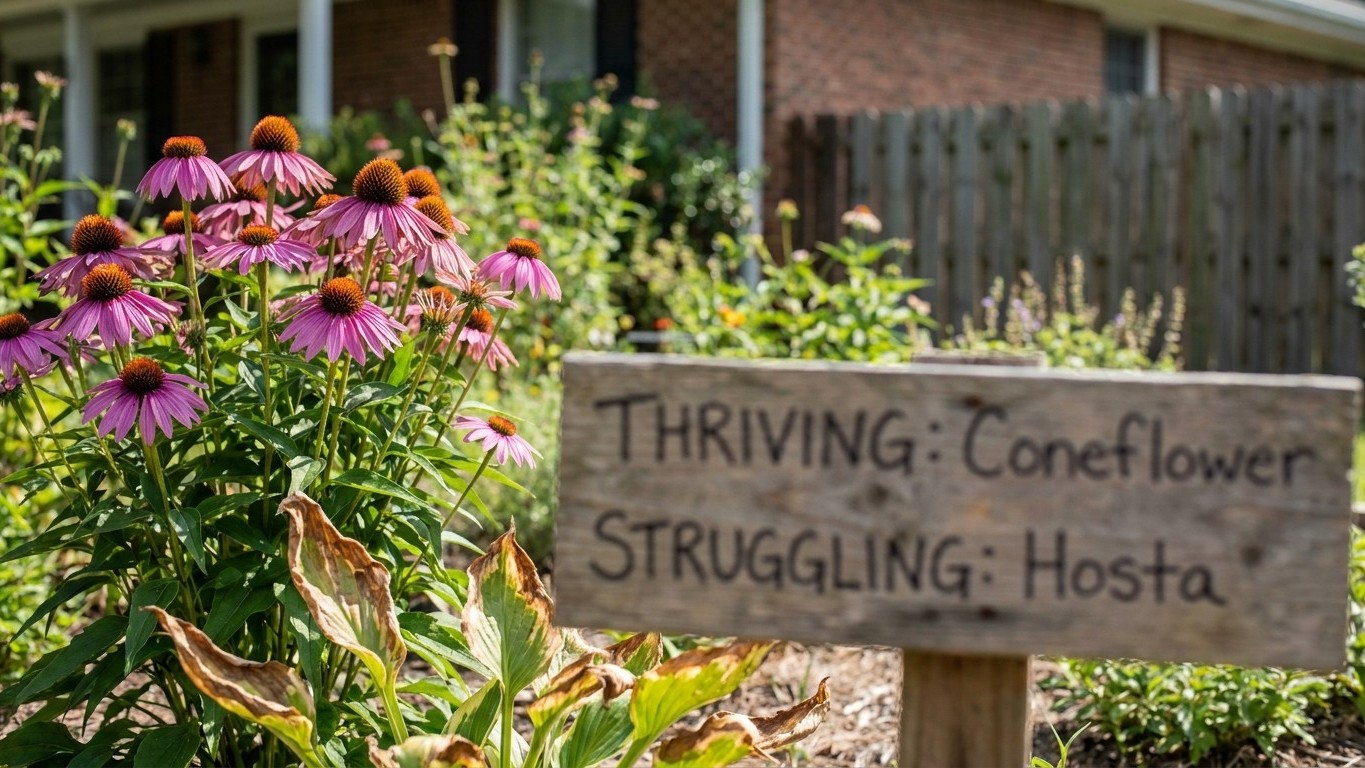

Your yard already tells you the answer: if it bakes through long, sticky summers and barely sees a hard freeze, it wants lantana, coneflower, salvia, and daylily, not delphinium, lupine, or peony bred for cooler, drier air. South Carolina’s winters rarely dip far below freezing, which is exactly why plants sold elsewhere as fussy tender perennials settle in here and come back year after year without a fuss. Before you buy anything, check your specific county’s zone rather than trusting the wide statewide range, since a plant that thrives at the coast can struggle badly in the Upstate.
What thrives in South Carolina

Heat, humidity and a mild winter
Three conditions decide whether a flower makes it here. The first is heat load. Charleston’s 55.1 days a year above 90F, per NOAA’s 1991-2020 normals, means a plant has to keep photosynthesizing and blooming through stretches of real stress, not just tolerate one hot afternoon. The second is humidity, which pushes foliar disease like powdery mildew and black spot onto anything with dense, moisture-trapping leaves. The third is winter, and it is milder than most gardeners moving from farther north expect: Charleston’s coldest month averages a minimum of just 38.9F, according to the same NOAA dataset. That is barely below freezing on an average night, which is why so many plants sold as tender perennials elsewhere overwinter here without protection.
The USDA’s zone 7a to 9a range for South Carolina is wide, and it matters where in that range you actually garden. A gardener near the coast at Charleston sits toward the warmer end, while the Upstate, at higher elevation, runs several zones cooler and closer to a true winter. Always check your specific county rather than assume the statewide range applies to your yard, since a plant that sails through a Charleston winter can die back hard in Greenville or Spartanburg.
The families that handle all three pressures share a few traits: silvery or narrow foliage that sheds heat, taproots or fibrous root systems that reach moisture during dry spells, and a bloom habit that keeps producing even when deadheading lags. Lantana, salvia, coneflower, black-eyed Susan and daylily cover most of that ground. Verbena and agastache do too, and both shrug off the kind of humid, still air that would rot a delphinium in a matter of weeks. Plants bred in cooler, drier climates, by contrast, tend to fail here not from cold but from summer: their leaves stay wet too long after an afternoon thunderstorm, and fungal disease takes over before the plant can recover.
Native plants worth the space
A native plant that has grown in the wider Southeast for generations arrives already adapted to the region’s heat and humidity, which means it needs far less babying once it has a season or two to root in. That is the real payoff of natives: not that they are maintenance-free from day one, but that the first year of watering and mulching pays off for a decade instead of needing to be repeated every summer the way it does for a fussier import.
Purple coneflower (Echinacea purpurea) and black-eyed Susan (Rudbeckia hirta) are two of the most reliable choices, both native across much of the eastern and southeastern United States and both magnets for bees and butterflies through the hottest months. Butterfly weed (Asclepias tuberosa) is worth planting for one reason above all others: it is a host plant for monarch caterpillars, not just a nectar stop for the adults, and a garden without any milkweed species is a garden monarchs pass over entirely.
Swamp sunflower (Helianthus angustifolius) and Joe-pye weed (Eutrochium purpureum) both handle the wetter, low-lying ground common in parts of the state, and both bloom late in the season when most annuals are winding down. Coreopsis, South Carolina’s state wildflower, tolerates poor, dry soil that would stunt a hydrangea and self-seeds enough that a single packet can fill a bed within two years. Beebalm (Monarda didyma) draws hummingbirds reliably, though it wants better air circulation than a tightly packed border gives it, since its leaves are prone to the same powdery mildew that troubles non-native perennials in humid weather.
None of these plants need fertilizer beyond a yearly top-dressing of compost, and most resent rich, heavily amended soil more than they resent neglect. The mistake gardeners make with natives is treating them like nursery annuals: watering daily, feeding monthly, and then wondering why the plant looks leggy and flops. Water deeply but infrequently in the first growing season, then step back.
Perennials that come back

Reading a plant tag against your zone
A plant tag that says “hardy to zone 7” is telling you the coldest zone the plant survives in, not a guarantee for your specific yard. Since the USDA map puts South Carolina anywhere from 7a to 9a, a tag reading “zone 8” is a safe bet in Charleston but a gamble in the colder Upstate, where a harder freeze can settle in and stay. Match the tag to your county’s actual zone, not to the state’s warmest pocket, before assuming a perennial will return.
Black-eyed Susan, purple coneflower, daylily, garden phlox (Phlox paniculata) and hardy salvia varieties such as Salvia greggii all come back reliably across most of the state’s zone range. Lantana (Lantana camara) is the interesting case: it is a true perennial in the warmer end of the state’s range but gets treated as an annual, or dies back to the roots and resprouts, in colder Upstate counties, depending on how hard that particular winter runs. Gardeners in the Upstate, near the Blue Ridge foothills, deal with a tighter frost window that has more in common with mountain Tennessee gardens than with the coast, and it is worth checking a Tennessee-style hardiness expectation if you garden at elevation here.
Peony, lupine and delphinium are the classic disappointments. Peonies need a real stretch of winter chill to set flower buds, and South Carolina’s mild average winter minimum of 38.9F at Charleston, per NOAA’s normals, rarely delivers enough cold hours in the Lowcountry, though gardeners in cooler upstate counties sometimes get a modest bloom. Delphinium and lupine fail for a different reason: both hate humid, wet-leaf conditions, and both tend to rot or succumb to fungal disease well before South Carolina’s summer heat even becomes the deciding factor. Readers gardening farther north, such as those following our Massachusetts flowers guide, get far more reliable results from all three, since that climate delivers the cold and the drier summer air these plants actually evolved for.
| Perennial | Published hardiness | Behavior in South Carolina |
|---|---|---|
| Black-eyed Susan | Zone 3-9 | Reliable perennial statewide |
| Purple coneflower | Zone 3-9 | Reliable perennial statewide |
| Lantana camara | Zone 8-11 | Perennial near the coast, often annual in the Upstate |
| Garden phlox | Zone 4-8 | Reliable perennial, watch for mildew in humid spots |
| Peony | Zone 3-8 | Poor bloom, insufficient winter chill in most of the state |
Putting a border together
Start with height, not color. Put the tallest plants, like Joe-pye weed or tall garden phlox, at the back of a bed viewed from one side or the center of an island bed, then step down through mid-height coneflower and salvia to low edging plants like coreopsis or dwarf lantana at the front. Skipping this layering is the single most common mistake in a new border: everything ends up the same height, and the bed reads as a flat mass instead of a planted space.
Plan bloom succession across the season rather than buying everything in full flower at the garden center in May. A border that leans entirely on spring bloomers goes bare by July, right when South Carolina’s heat is at its worst and the garden needs the most visual interest to distract from a stressed lawn. Pair spring bulbs or early salvia with summer coneflower and lantana, then let swamp sunflower and Joe-pye weed carry the border into fall.
- Back layer: Joe-pye weed, tall garden phlox, swamp sunflower
- Middle layer: coneflower, black-eyed Susan, salvia, daylily
- Front layer: coreopsis, dwarf lantana, verbena
Repeat one or two colors through the length of the border instead of scattering a different hue in every clump. A border of purple coneflower echoed by purple salvia every few feet reads as designed. The same number of plants in five unrelated colors reads as leftover nursery stock. Leave real space at planting, even though a freshly planted bed looks sparse: a coneflower or salvia sold in a one-gallon pot will double or triple in width within two seasons, and crowding them now means digging half of them out later.
Local help
Clemson Cooperative Extension runs South Carolina’s Master Gardener program and keeps plant lists suited to specific counties, which matter given how much the state’s zone 7a to 9a range varies between the coast and the Upstate. Check with your local Extension office before committing to a large perennial order, since their county-level recommendations reflect local frost timing better than any statewide range can. Find your county’s office and current plant lists through Clemson Extension, and browse our other South Carolina guides for related planting timing.
Common questions
Can I grow peonies in South Carolina?
You can try, but expect a weak show in most of the state. Peonies need sustained winter chill to set flower buds, and Charleston’s mild average winter minimum of 38.9F, per NOAA’s 1991-2020 normals, rarely provides it. Gardeners in the colder Upstate counties have somewhat better luck, but even there results are inconsistent compared to a true peony climate.
Why do my flowers keep getting fungal spots in summer?
That is almost always humidity combined with poor air circulation. South Carolina’s heat and moisture together create ideal conditions for powdery mildew and black spot, especially on plants set too close together. Space plants to their mature width, water at the soil line instead of overhead, and choose disease-resistant selections where the catalogue names one.
Is lantana invasive in South Carolina?
Common lantana (Lantana camara) can reseed aggressively in the warmer parts of the state and has escaped cultivation in some areas. Ask your county Clemson Extension office about current guidance for your specific area before planting it near natural areas, and consider sterile cultivars where available.
When is it safe to plant tender annuals outside?
Wait until after your local last spring frost date has passed. At the Charleston-area reference station, NOAA’s 1991-2020 normals put that window between February 28 and March 17, though the true date varies with the specific spring and inland areas run later. Watch your local forecast in that window rather than planting by the calendar alone.
Related guides
- Flowers That Actually Thrive in North Carolina, and the Ones That Struggle
- Flowers That Actually Thrive in Georgia, and the Ones That Struggle
- Flowers That Actually Thrive in Tennessee, and the Ones That Struggle