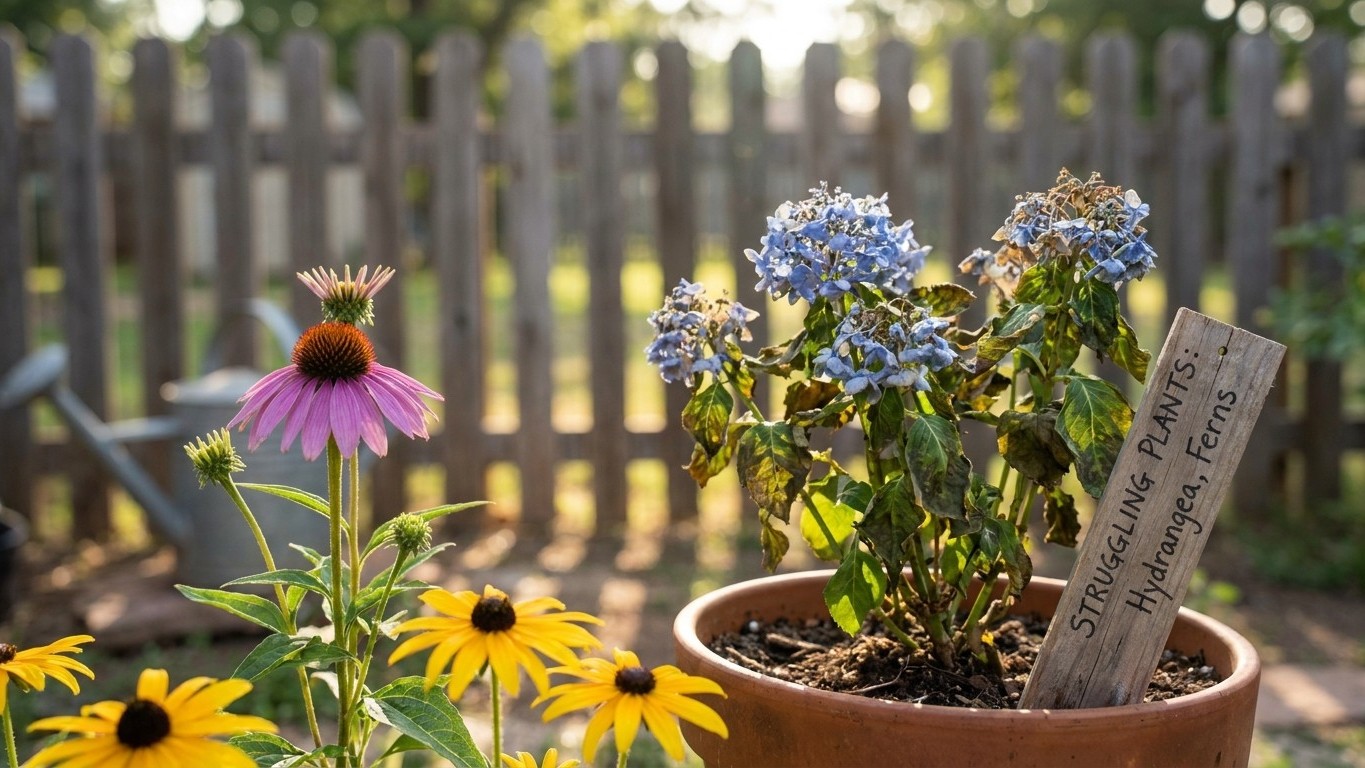

Purple coneflower, blanket flower, and daylilies actually thrive here — they shrug off a cold snap in January and keep blooming through the worst of a July heat wave without much fuss. Delphinium, foxglove, and most primroses will fight you the whole way and lose by August, no matter how well you baby them. Before you plant anything, walk your yard and picture it holding up under both extremes: a hard freeze and weeks of 90-degree heat back to back. That’s the real test, not how pretty the tag photo looks in April.
What thrives in Oklahoma

Oklahoma asks three things of a flower: survive a cold snap, tolerate a long stretch of summer heat, and keep going without constant water. The USDA Plant Hardiness Zone Map places the state across zones 6a to 8a, with the coldest pockets in the Panhandle and the mildest in the far southeast. That range matters more than most gardeners realize, because a plant tag that reads “hardy to zone 7” will winter over fine in Tulsa or Ardmore but may die back to the ground, or die outright, in a colder zone 6a county further north or west.
Cold hardiness only tells half the story. NOAA’s 1991-2020 climate normals for Oklahoma City put the mean daily minimum of the coldest month at 27°F, a figure that decides which plants survive winter here, not the occasional harder freeze that makes the news. A flower that only needs to dodge a mild winter minimum, then gets asked to sit through roughly 71 days a year of 90°F or hotter (the same NOAA dataset), is under a very different kind of stress. That combination of a moderate winter and a punishing summer is what separates flowers that thrive here from the ones sold at every big-box garden center that quietly fail by August.
Heavy clay soil, common across much of the state, holds water long after a spring rain and then bakes hard by late summer. Flowers that do well in Oklahoma tend to tolerate both extremes, wet feet in April and cracked, dry soil in July, rather than needing the evenly moist conditions assumed on many nursery tags written for a milder climate.
Families that carry the right traits
The plant families that handle this combination best share a few traits: taprooted or deeply fibrous root systems that reach past a dry topsoil, silvery or narrow foliage that sheds heat, and a bloom habit that doesn’t collapse the first week temperatures top 95°F. The aster family (Asteraceae) covers most of the reliable performers: coneflower, black-eyed Susan, blanket flower, and the various coreopsis. The mint family (Lamiaceae), which includes salvia and bee balm, brings the same drought tolerance along with square stems and aromatic foliage that deer tend to leave alone. Legumes like baptisia fix their own nitrogen and build a root system in the first two years that makes them nearly impossible to move by year three, which is worth knowing before you plant one in the wrong spot.
None of this rules out flowers that need more coddling. It just means treating them as a smaller, more deliberate part of the bed rather than the backbone of it.
Hardiness also works in both directions. A perennial bred for Vermont’s colder winters, covered in Flowers That Actually Thrive in Vermont, and the Ones That Struggle, often can’t handle Oklahoma’s summer heat load even in a county where the winter minimum alone would suit it fine.
Native plants worth the space
A native flower has already solved the local problem before you plant it. It has spent generations adapting to the same freeze-thaw winters and 90-degree summers described above, so once its root system is established, usually by the second season, it asks for far less supplemental water and almost no fertilizer. That’s the trade a native asks you to make: slower to look full the first year, cheaper to keep alive every year after.
Top natives for Oklahoma gardens
- Purple coneflower (Echinacea purpurea): upright, drought-tolerant once rooted, and one of the most reliable nectar sources through midsummer.
- Black-eyed Susan (Rudbeckia hirta): self-seeds readily, filling gaps in a new bed faster than almost anything else.
- Blanket flower (Gaillardia pulchella): tolerates poor, sandy soil better than most garden perennials.
- Butterfly milkweed (Asclepias tuberosa): the host plant monarch caterpillars need, not just a nectar stop for the adults.
- Blazing star (Liatris spicata): a vertical spike that draws swallowtails and skippers.
- False indigo (Baptisia australis): slow to establish, then essentially permanent once it is.
These species and their close relatives range across the central and southern Great Plains, which is a wider claim than saying they are native to any one Oklahoma county, but it is the honest one. A regional plant list from your county extension office is the place to confirm what grows wild closest to home. Gardeners across the southern plains, including in neighboring Texas, lean on many of these same species for the same reason, and the calculation shifts with even more heat and less winter cold, as covered in Flowers That Actually Thrive in Texas, and the Ones That Struggle.
Pollinators benefit from natives in a way ornamental hybrids often can’t match. Many modern cultivars are bred for double flowers or unusual color, and that breeding sometimes reduces or eliminates the nectar and pollen the original species offered. A straight species Echinacea or Rudbeckia keeps that resource intact, and planting several of the same species in a cluster, rather than one of each, makes it easier for bees and butterflies to find and use.
Resist the urge to treat natives like the rest of the border. Extra fertilizer or a regular sprinkler schedule pushes many of them into soft, floppy growth that flops over in the first summer storm. A single deep watering during the first growing season, tapering off as roots establish, produces a sturdier plant than a schedule built for petunias.
Perennials that come back

“Perennial” on a plant tag is a promise with fine print, because perennial in one climate doesn’t mean perennial in another. A grower in Georgia and a grower in Oklahoma can buy the same lantana and get a completely different answer the following spring. The number that matters is the hardiness zone printed on the tag, checked against your own zone, not the word “perennial” by itself. Oklahoma spans USDA zones 6a to 8a, so a plant rated hardy to zone 7 will likely return in Oklahoma City or points south, and may not survive the winter in a colder 6a county in the Panhandle or northwest.
Reading the tag against your zone
Some of the most reliable perennials at this hardiness level need almost no zone math at all. Peony (Paeonia lactiflora), daylily (Hemerocallis), and most of the hardy salvias and yarrows are rated to zone 3 or 4 on the cold end, which means the mild end of Oklahoma’s range is never in question. Others sit right at the edge. Salvia greggii is usually rated to zone 6, which puts it in reliable perennial territory across most of the state but leaves it marginal in the coldest pockets, where a hard winter can kill it back to the roots or take it out entirely.
Plenty of popular bedding flowers are perennial somewhere, just not here. Lantana camara and most gerbera daisies are usually rated no colder than zone 8 or 9, which means Oklahoma gardeners grow them as annuals, replacing them each spring, even though a gardener in Florida or south Texas keeps the same plant for years.
| Plant | Typical catalogue hardiness | Status in most of Oklahoma |
|---|---|---|
| Peony (Paeonia lactiflora) | Zone 3-8 | Reliable perennial |
| Daylily (Hemerocallis) | Zone 3-9 | Reliable perennial |
| Salvia greggii | Zone 6-9 | Perennial in most counties, marginal in the coldest 6a pockets |
| Lantana camara | Zone 9-11 | Grown as an annual |
| Gerbera daisy | Zone 8-10 | Grown as an annual or short-lived perennial |
Catalogue hardiness ratings are consistent nationwide because they describe the plant, not the county, so it’s safe to compare them directly to the zone map. What isn’t safe is assuming a nursery near you has already made that adjustment. A big-box store restocks the same regional shipment across several states, and a tag that says “perennial” doesn’t know which of those states it landed in.
Divide or plant most herbaceous perennials in spring after the last frost has passed, which at the Oklahoma City reference station falls between March 28 and April 10 according to NOAA’s 1991-2020 normals, or in early fall once the worst summer heat has broken. Gardens outside the metro, especially at higher elevation or further from the urban heat island, often see their last frost later than that window, so treat it as a starting point to check against your own county rather than a fixed date.
Putting a border together
A border that looks intentional in July was planned on paper first, not improvised plant by plant at the garden center. Three decisions do most of the work: height, timing, and repetition.
Layering by height
- Back row: tall, upright bloomers like false indigo, tall garden phlox, or ornamental grasses that reach 3 to 5 feet.
- Middle row: the workhorses, coneflower, black-eyed Susan, salvia, and daylily, most landing between 18 and 36 inches.
- Front row: low edging plants like blanket flower, dwarf yarrow, or creeping thyme that stay under a foot and hide the base of taller stems as they lose their lower leaves.
Skip the temptation to run a single straight height gradient from front to back. A few taller plants pulled forward, in twos or threes, break up the wall-of-height look and read as more natural.
Succession of bloom
The single biggest planning mistake in a new border is buying everything in bloom on the same nursery visit, which guarantees three weeks of color and then a long green gap. Stagger bloom time deliberately: something for spring (peony, baptisia), something that carries the heat of midsummer (coneflower, blanket flower, salvia), and something that holds on into fall (aster, goldenrod, ornamental grasses going to seed). Write the approximate bloom window of each plant on a garden map before you buy, then check the map for gaps rather than relying on memory in October.
Repeating a color or a shape at least three times through the length of a bed does more for cohesion than adding another different plant. A border built from twelve different single plants looks busy and disorganized even when every one of them is healthy. The same twelve plants, grouped into three or four repeated color blocks, reads as designed.
Leave real space at planting time. A one-gallon coneflower or salvia looks lonely at 12 inches across, but most of these perennials reach two to three times that spread by their second or third year. Planting at mature spacing from day one, then filling the temporary gaps with annuals for the first season or two, saves the expense and labor of ripping out and dividing an overcrowded bed three years later.
Leave a maintenance path, even an informal one, wide enough to reach the back row without stepping on the middle plantings. A border that can’t be weeded or deadheaded without crushing something gets neglected by midsummer, and neglect shows fast during the roughly 71 days a year Oklahoma City records 90°F heat or higher, per NOAA’s 1991-2020 climate normals.
Local help
Oklahoma State University Extension keeps county-level plant lists and publishes guidance calibrated to the state’s zones, and it’s worth checking before finalizing a plant order. Visit the OSU Extension site and search for your county office, since recommendations for the Panhandle differ from those for the southeast corner of the state. Many county offices also run a Master Gardener volunteer program, usually the fastest way to get a plant question answered by someone who gardens in your actual soil. For more on planning around the state’s growing conditions, the Oklahoma guides section covers vegetable planting windows and soil prep alongside flower beds.
Common questions
What zone is Oklahoma for planting flowers?
Oklahoma spans USDA hardiness zones 6a to 8a, according to the USDA Plant Hardiness Zone Map, with the coldest zone in the Panhandle and the warmest in the southeastern part of the state. Check your county specifically rather than assuming the whole state matches one number, since a plant that survives winter in the southeast can die back further north or at higher elevation.
Can I plant perennials in the fall in Oklahoma?
Yes, early fall works well for most herbaceous perennials, giving roots time to establish before the ground gets cold. NOAA’s 1991-2020 normals put the first fall freeze at the Oklahoma City reference station between October 29 and November 8, so aim to plant well ahead of that window to give roots time to settle in, and expect the freeze to arrive earlier at a rural or higher-elevation site further from the city.
Why do my flowers wilt every afternoon even when the soil is wet?
That’s usually heat stress rather than drought stress, especially during the roughly 71 days a year the Oklahoma City area reaches 90°F or higher, per NOAA’s climate normals. Broad-leafed plants can wilt in early afternoon heat and recover fully by evening even with adequate soil moisture, so check the soil before adding more water, since overwatering a heat-stressed plant causes root rot without solving the actual problem.
Do I need to water native flowers once they’re established?
Established natives need far less water than nursery bedding plants, but “established” usually means a full growing season or two of active root growth, not the first few weeks after planting. Water regularly through that first season, then taper off, and expect to still water during an extended dry stretch in the hottest part of summer even on a mature planting.
Related guides
- Flowers That Actually Thrive in Kansas, and the Ones That Struggle
- Flowers That Actually Thrive in Missouri, and the Ones That Struggle
- Flowers That Actually Thrive in Texas, and the Ones That Struggle