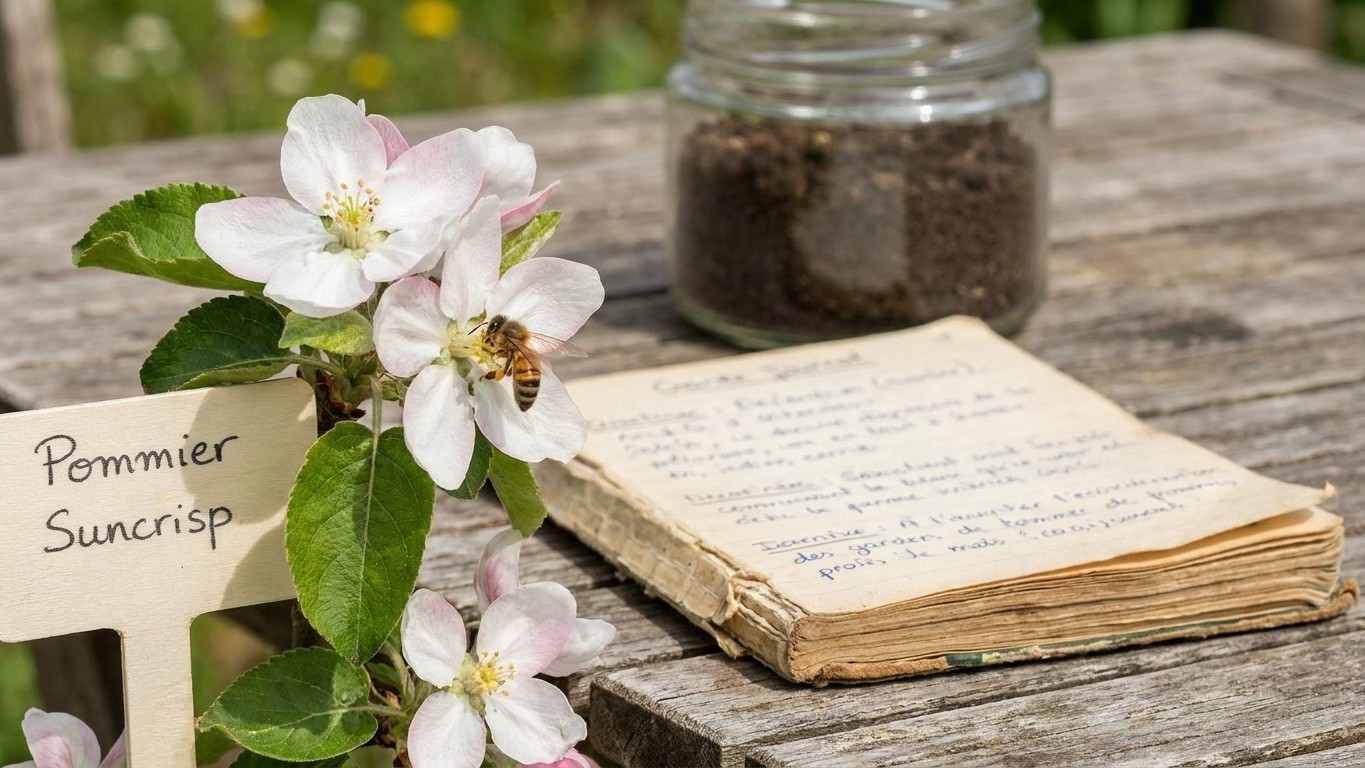

Suncrisp blooms in USU Extension’s mid-season window, and there is no published list of confirmed pollination partners for this variety in our sources. Plant another apple variety that also blooms mid-season and is hardy in the same USU-listed zones 4-7, then confirm the pairing with your local extension office before you buy either tree. USU also lists Suncrisp as susceptible to fire blight, so pick a partner you can prune and inspect without spreading that disease between the two.
The short answer
Start with bloom timing, not a name
Suncrisp needs another apple tree blooming at the same time to bear fruit, and no specific partner variety is confirmed for it. What is known is its bloom timing: mid-season, not early or late. So start there instead of guessing a name — walk your yard, decide where a second tree could go, and look for an apple variety tagged mid-season bloom that also survives your winters, since that shared timing matters more than matching names or matching colors on two nursery tags.
The extension tables name only four pollen-sterile varieties—Jonagold, Mutsu, Stayman, and Winesap—and Suncrisp is not among them, so plan around your partner variety’s pollen status rather than Suncrisp’s. If Suncrisp’s pollen turns out fertile, two trees, Suncrisp and one confirmed mid-season partner, are enough for both to set a full crop most years. If it turns out sterile, that partner tree will still set fruit from Suncrisp’s pollen, but Suncrisp will not get anything back, and you need a third tree, or a second confirmed partner, so two fertile pollen sources exist in the garden. Until that fertility is confirmed locally, the safer plan is to include two different mid-season partners rather than betting on one.
Why these varieties and not others

What bloom group actually means
Bloom group is not a calendar date, it is a ranking. Clemson Cooperative Extension explains that apple bloom groups sort varieties by the order in which their flowers open relative to one another, not by a fixed day of the year, because that order holds steady from one climate to the next even though the actual dates shift by weeks between a warm valley and a cold bench. A variety Clemson lists as mid-season opens its flowers after its early-season neighbors and before its late-season ones wherever it is grown, whether that is a Carolina orchard or a Utah backyard. That relative order is what makes bloom group useful for pairing two trees: it tells you Suncrisp’s flowers, described by USU Extension as mid-season, should be open at the same time as another mid-season variety’s flowers, even without ever pinning down the exact date either one opens in your yard. For the general mechanics of pollination groups and how bees move between trees, Apple Pollination covers the topic across all apple varieties rather than one.
What matching bloom group does not guarantee
Matching bloom group only clears one hurdle. It says nothing about whether the partner’s pollen is fertile, a separate trait some apple varieties lack entirely, and nothing about whether the two varieties share ancestry. A seedling apple cannot be fertilized by the parent tree it was bred from, even when both bloom at the same time and stand side by side in the same row. Neither of those two facts, pollen fertility or parentage, is settled by bloom group alone. A mid-season tag is a starting point for choosing a Suncrisp partner, not a guarantee by itself, and it is worth checking both points before you commit a second planting spot to a tree that will take years to bear.
What cannot pollinate it
No pollination partner for Suncrisp is named in USU Extension’s guide, and no exclusion is named either, so this page cannot tell you a specific variety that fails to pollinate Suncrisp. What can be said with confidence is which categories of apple tree fail regardless of variety, and that list is longer than most gardeners expect.
Sterile-pollen varieties
Some widely grown apples, Jonagold and Mutsu among the better known examples, carry sterile pollen: they need a partner tree to set their own fruit, but they cannot supply usable pollen back to whatever they are paired with. Planting a sterile-pollen variety as Suncrisp’s only companion solves nothing, because Suncrisp would spend the season pollinating that tree without ever being pollinated in return. If a nursery tag or catalogue lists a variety as pollen-sterile, treat it as a one-way partner only, useful alongside a third, pollen-fertile tree, never as a stand-alone pair with Suncrisp.
Parent and seedling pairs
A variety bred as a seedling of another cannot be pollinated by that same parent tree, whatever their bloom timing happens to be. This trips up gardeners who assume a shared name or a family resemblance means compatibility. It is closer to the opposite: shared ancestry raises the odds of failure rather than success, because the two trees are genetically too alike to fertilize each other’s flowers.
Beyond sterile pollen and parent-seedling pairs, no exclusion specific to Suncrisp is published in the sources behind this page. If you are choosing between two mid-season varieties and want to rule one out, ask your local extension office whether either carries sterile pollen or shares parentage with Suncrisp before you plant, rather than assuming compatibility from bloom timing alone.
How close the second tree has to be

Why distance matters
Pollen moves on bees, not on wind, so proximity matters far more for apples than for a wind-pollinated crop. The practical target is the same garden, not the same street: a partner tree thirty feet away in your own yard gets far more visits carrying Suncrisp pollen than one two properties over, because a foraging bee tends to work one tree heavily before moving on to the next close one, not the nearest one overall.
The second bloom source does not have to be a full standard apple you planted on purpose. A neighbor’s flowering apple can do the job if bees regularly cross the fence line, which they often do over a distance of a few dozen feet. An ornamental crabapple blooming at the same time works just as well as a full-size eating apple, since bees do not distinguish decorative fruit from dessert fruit when they forage. A single pollinator branch grafted onto an existing tree, covered in the next section, puts the partner flowers a few feet away instead of a few dozen. If you already grow a different apple pairing and are weighing whether it does double duty for Suncrisp too, the same bloom-timing logic applies elsewhere. See What Pollinates Sweet Sixteen, and What Cannot and What Pollinates Gala, and What Cannot for two other worked examples of the same problem.
What stops pollination regardless of distance
None of the above helps if weather turns against you during bloom. Cold, wind, or wet conditions keep honeybees and other pollinators grounded, and a well-matched partner standing right next to Suncrisp will not set fruit if nothing flies while the flowers are open. No amount of proximity substitutes for flying insects doing the actual work, which is one reason growers who rely on a single nearby partner see a strong fruit set some years and almost none the next.
If there is no room for a second tree
A small garden does not rule out cross-pollination, it just changes which option makes sense. Four approaches let one planting site support more than one bloom source.
Four ways to fit a partner in
- Multi-graft tree: several varieties grafted onto one trunk, so the whole tree carries its own pollination group.
- Pollinator branch: a single scion of a compatible variety grafted into an existing mature tree.
- Columnar variety: an upright, narrow-growing apple planted a few feet away purely to supply pollen.
- Flowering crabapple: an ornamental tree chosen for bloom timing rather than fruit, planted anywhere within bee range.
| Option | Effort | What it does not solve |
|---|---|---|
| Multi-graft tree | High: grafting skill or a pre-grafted nursery tree | Every variety on it still needs its bloom timing checked against the others |
| Pollinator branch | Moderate: one graft, done once | Only as reliable as that single graft union taking and surviving |
| Columnar variety | Low: plant and grow like any tree | Needs its own bloom-timing and hardiness check, same as any partner |
| Flowering crabapple | Low: many are sold purely as ornamentals | Produces no eating fruit itself, pollen supply only |
Whichever route you take, the underlying requirement does not change: something with open, compatible flowers has to be blooming within bee range of Suncrisp at the same time. A multi-graft tree or a pollinator branch shrinks the distance to almost nothing, but it does not remove the need to check bloom timing and hardiness for whatever variety goes in, the same homework a second full tree would require.
Common questions
Can I grow just one Suncrisp tree and still get apples?
Possibly a light crop, but nearly all apple varieties crop better with a compatible partner nearby, and Suncrisp is no exception given the mid-season bloom timing USU Extension lists for it. Do not plan around a single tree if a full harvest matters to you.
Will a crabapple in my neighbor’s yard pollinate my Suncrisp?
It can, if the crabapple’s bloom overlaps Suncrisp’s mid-season window and bees regularly cross between the two yards. Ornamental status does not matter to a foraging bee, only open flowers and timing do.
How do I know if two apple varieties actually bloom at the same time in my yard?
Watch both trees through their first few springs rather than trusting a catalogue date alone. Bloom group tells you the relative order flowers open in, but the exact overlap in your own garden depends on local weather that season, so a season or two of direct observation beats guessing from a chart.
Does Suncrisp need a fire-blight-resistant partner specifically?
Not for pollination purposes. USU Extension lists Suncrisp itself as susceptible to fire blight, which is a disease-management issue you handle through pruning and sanitation, separate from choosing a partner for bloom timing and pollen fertility.
When is Suncrisp actually ready to pick?
USU Extension puts Suncrisp’s harvest at mid to late October, though that window shifts earlier or later depending on your local season. A good pollination season shows up first in a heavy bloom and fruit set in spring, well before harvest tells you how it turned out.