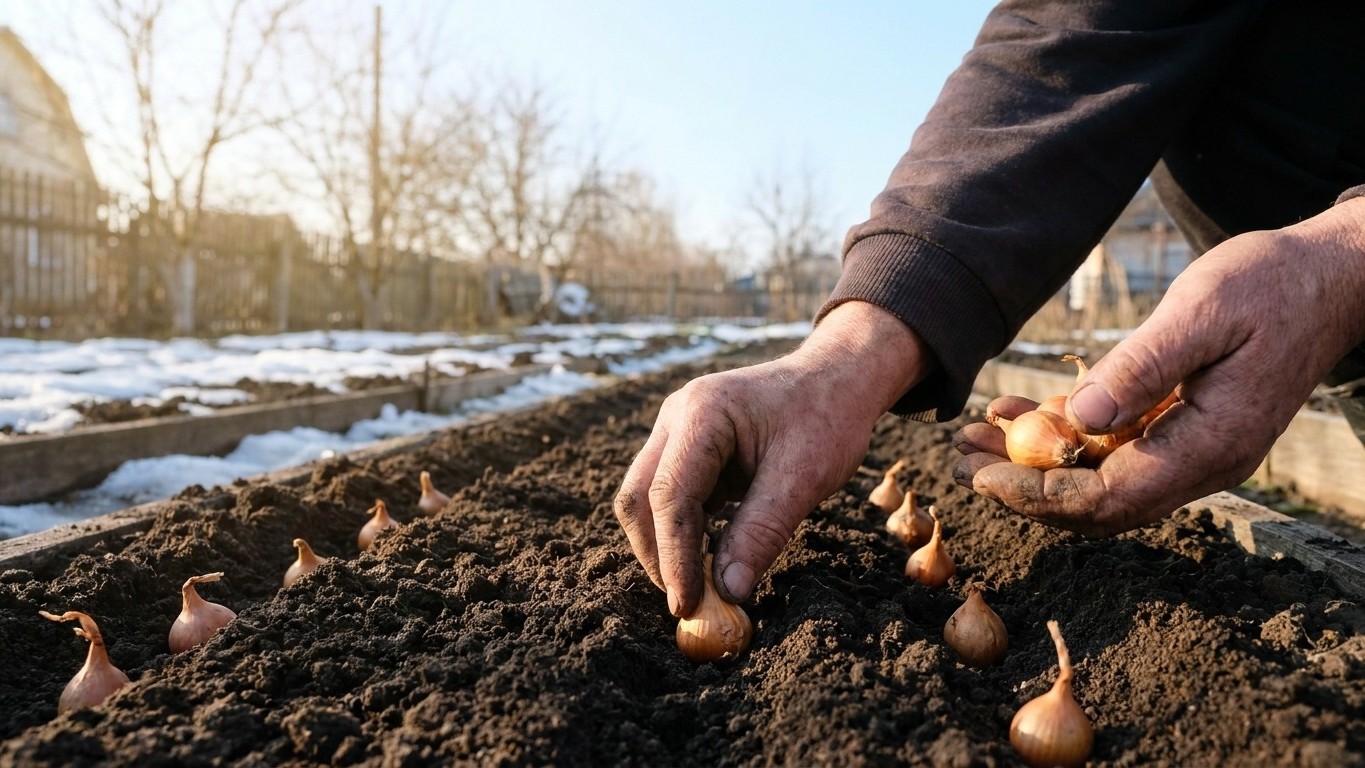

Michigan’s growing season runs on daylight, not warmth, and that single fact decides everything about the calendar. At 42.23 degrees north, the Lansing area gets 15 hours and 5 minutes of daylight on the June solstice, which puts the whole state firmly in long-day onion territory. Onions here go in early, as soon as soil can be worked, typically March through April for sets or transplants, never in fall.
The short answer for Michigan

Onions don’t decide to bulb based on temperature. They measure daylight, and once the day stretches past their genetic trigger point, the plant stops making leaves and starts making a bulb, whatever size it happens to be at that moment. At 42.23 degrees north, the reference point for this piece (Lansing, based on NOAA climate station USW00094847), the longest day of the year delivers 15 hours 5 minutes of sunlight. That number puts Michigan squarely in long-day onion territory, since long-day varieties need somewhere between 14 and 16 hours of daylight before they’ll switch modes.
This is why Michigan planting dates look nothing like planting dates in Georgia or Texas. In the Deep South, growers Plant Onions in fall and let them overwinter as small plants, because the mild winter allows months of leaf growth before the shorter southern day length triggers bulbing. Michigan winters kill that strategy outright. Instead, Michigan gardeners plant in early spring, sets or transplants going into the ground as soon as the ground thaws and can be worked, usually somewhere in March or April depending on the year and the region of the state.
The logic runs in reverse of what most new gardeners expect. Because the solstice arrives on essentially the same calendar date every year regardless of when the onion went into the ground, the plant has only whatever window exists between planting and the solstice to build leaf mass. Every week the onion spends underground before that trigger fires becomes leaf growth, and every leaf becomes stored energy the bulb will draw on later. Get the onion in the ground early and it walks into the solstice with a strong root system and a dozen or more leaves. Get it in late and it walks into that same solstice half-built, and the bulb that forms will reflect exactly that size, not a bigger one.
That’s the entire planting calendar in one sentence: as early as the soil allows, because the calendar doesn’t wait, the onion just runs out of runway.
What will not work here
Planting onions late in Michigan doesn’t push the harvest back a few weeks the way it might with tomatoes or peppers. It shrinks the bulb permanently, because the solstice trigger fires on schedule whether the plant is ready or not. An onion set in the ground in early May instead of late March has lost roughly a month of leaf-building time, and that lost month shows up as a smaller onion at harvest, not a later one. There’s no catching up once day length starts declining after the solstice; the plant simply bulbs with whatever it’s got.
Variety choice makes the same mistake even worse. Several onion types sold nationally are built for latitudes far south of Michigan and will bulb here at the wrong time, when the plants are still tiny, because their trigger threshold sits closer to 12 hours of daylight rather than 14 to 16. Plant a short-day onion in mid-Michigan and it reads the daylight signal early in the season, well before it has built any real size, and it bulbs anyway. The result isn’t a small crop failure. It’s a season of leaves, then a handful of undersized bulbs, then rot in storage because a tiny bulb has almost no keeping power.
- Candy (intermediate-day, published range 33-40N): bulbs too far south of Michigan’s latitude to size up here.
- Gabriella (short-day, 20-35N): triggers bulbing at low daylight thresholds the Michigan solstice blows past early, leaving tiny bulbs.
- Madalyn (short-day, 20-35N): same short-day mismatch, bulbs prematurely at this latitude.
- Red Rock (short-day, 30-36N): built for a much shorter summer day length than Michigan provides.
- White Castle (short-day, 30-38N): bulbs too early in the leaf-growth cycle to reach usable size.
None of these are feeding mistakes or watering mistakes. Fertilizer and irrigation can’t fix a variety that’s reading the wrong daylight signal. It’s a seed-catalog decision made before the first onion ever went into the ground.
What changes across Michigan
Michigan isn’t one climate zone stacked on top of itself. The state runs from around 42 degrees north at the Ohio border to nearly 48 degrees north at the tip of the Upper Peninsula, close to six degrees of latitude packed into one state, which is a wider spread than a lot of gardeners assume. The 42.23-degree figure used throughout this piece belongs specifically to the Lansing area, near the southern half of the state. A gardener up near Marquette or the Keweenaw Peninsula is gardening at a meaningfully different latitude, and the day-length math shifts with it.
Farther north, the summer day stretches longer than Lansing’s 15 hours 5 minutes, which pushes some onions right up against the edge of their published range. Two varieties sit in that blurred zone for the northern part of the state:
| Location | Approx. latitude | What changes |
|---|---|---|
| Lansing (reference city) | 42.23N | 15h05m on the solstice; solidly long-day territory, most catalog long-day varieties fit comfortably |
| Northern Michigan / Upper Peninsula | roughly 43-47N | Longer solstice daylight than Lansing; Powell (43-47N) and Redwing (43-65N) sit in the edge zone here and may bulb well, but they’re borderline rather than a sure thing |
A gardener near that northern edge shouldn’t treat Lansing’s numbers as their own. The safer move is planting a week or two earlier relative to local frost dates than a Lansing-area gardener would, since the growing window between thaw and solstice is shorter the further north you go, even though the day itself runs longer once summer arrives.
Sweet now, or onions that last
Every onion gardener in Michigan eventually runs into the same trade-off, and it isn’t random. The compounds that give an onion its sharp bite are volatile sulfur compounds, and those same compounds double as the onion’s natural defense against rot in storage. Fewer of them and the onion tastes milder, sweeter, better on a burger fresh out of the garden, but it also breaks down faster once it’s sitting in a bag in the pantry. More of them and the onion bites back at the cutting board, but it holds for months. University of Missouri Extension puts it plainly: sweet onions do not store as well as the more pungent types.
This lines up with the day-length pattern already at work. Shorter-day varieties, grown in the South, tend to run sweeter. Longer-day varieties, the kind that actually work at 42.23 degrees north, tend to run more pungent and keep considerably longer. That’s not a coincidence of breeding preference; it’s the same chemistry showing up twice.
For a Michigan pantry, that means the realistic choice sits mostly on the storage side of the ledger. A gardener growing long-day onions here can reasonably expect bulbs that are still sound in the pantry come March, months after harvest, because the sulfur load that makes them sharp on the cutting board is doing quiet work protecting the cell walls the whole time. Anyone chasing a sweeter bite should treat it as a summer-eating crop, used up within weeks of harvest, not something to plan a winter’s worth of cooking around.
Checking this against your own garden
Every figure in this piece comes from one weather station near Lansing, and Michigan is too long a state for one station to speak for all of it. Before locking in a planting date or a variety, it’s worth confirming a few things specific to the actual plot of ground involved rather than trusting a statewide average.
- Look up the latitude of your own town or county if you’re gardening well north or south of Lansing; a few degrees changes both the daylight trigger and the safe planting window.
- Check your local average last-frost and first-frost dates rather than relying on a statewide range, since the Upper Peninsula and the southern Lower Peninsula can differ by several weeks.
- Call or visit your county MSU Extension office; they track soil temperature and workability for your specific county, which matters more than the calendar date for deciding when to plant.
- Watch actual soil conditions in early spring rather than a fixed date, since a wet or still-frozen field pushes planting back regardless of what the calendar says.