
New Hampshire’s growing season runs on long days, not mild winters, so onions here get started early rather than late. With a longest-day daylight total of 15 hours 10 minutes at the reference city of Concord (42.93°N), the state sits squarely in long-day onion territory. That means seeds go indoors in late winter, transplants move outside once the ground can be worked, and anything planted too late simply makes a smaller bulb, not a later one.
The short answer for New Hampshire

Concord, New Hampshire sits at 42.93°N. On the longest day of the year, the sun there provides 15 hours and 10 minutes of daylight. That number is the whole story for onions, because bulbing isn’t triggered by temperature or by the calendar. It’s triggered by day length. Long-day onions need somewhere between 14 and 16 hours of daylight to switch from making leaves to making a bulb, and Concord’s 15 hours 10 minutes lands right in that window. Intermediate-day types, which trigger a bit earlier, also work here.
What this rules out is fall planting. Gardeners in mild-winter states can tuck onion sets into the ground in October and let them overwinter as small plants, ready to take off in spring. New Hampshire winters don’t allow that. The ground freezes hard, and a young onion left outside from autumn has no chance of surviving to spring.
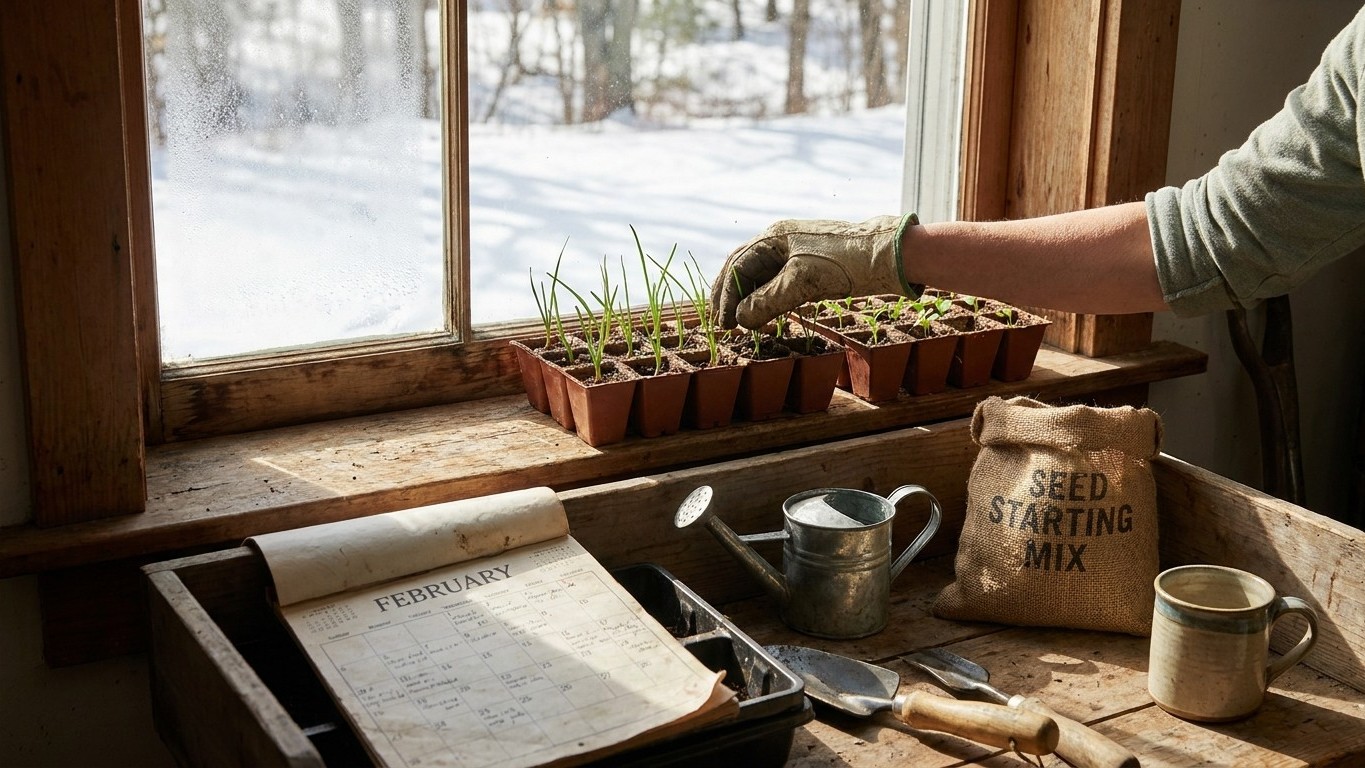
Instead, the New Hampshire calendar runs the other direction. Seeds started indoors in February give transplants roughly eight to ten weeks of growth before they go into the garden. Those transplants (or purchased onion sets) move outdoors once the soil can be worked and the worst of the hard frosts have passed, which for most of the state means sometime in April. Gardeners in the Connecticut River valley or along the Massachusetts border may get into the ground a week or so earlier than gardeners in the state’s interior.
Why the group matters as much as the date
Getting the timing right only pays off if the variety is built for this latitude. Among the onions documented for this region, the long-day and intermediate-day groups are the ones whose published range covers 42.93°N: Ailsa Craig, Barolo, Blush, Bridger, Frontier, New York Early, Patterson, Red Carpet, Red Long of Florence, Red Long of Tropea, Rossa di Milano, Safrane, Talon, and Walla Walla Sweet among the long-day types, with Cabernet, Calibra, Elsye, Expression, Monastrell, Scout, and Sierra Blanca among the intermediate-day types. Two more, Powell and Redwing, fall close enough to the edge of their published range that they may bulb here but shouldn’t be counted on without a backup plan.
What will not work here
Planting an onion late in New Hampshire doesn’t push the harvest back a few weeks. It shrinks the bulb outright. An onion keeps making leaves until day length crosses its bulbing threshold, and whatever size the plant has reached at that moment is roughly the size the bulb will end up. A transplant that goes into the ground in May instead of April has lost weeks of leaf growth it will never get back, and no amount of extra water or fertilizer after bulbing starts will make up the difference. The plant has already moved on to storing sugars in the bulb, not building more top growth.
The second failure mode has nothing to do with timing and everything to do with variety choice. Short-day onions are built for latitudes far south of New Hampshire, where the day only needs to reach about 12 hours to trigger bulbing. Planted this far north, they start bulbing almost as soon as they sprout, while the plant is still tiny, and the result is a golf-ball-sized onion no matter how well it was grown. Planted here anyway, some varieties never bulb at all and simply keep making leaves through the season before rotting in the ground once the cold sets in.
Eight varieties documented on this site fall into that category for New Hampshire:
- Candy (intermediate-day, published for 33-40N): the threshold is met too late here for reliable sizing
- Gabriella (short-day, 20-35N): bulbs far too early at this latitude
- Madalyn (short-day, 20-35N): same short-day mismatch
- Red Rock (short-day, 30-36N): built for a much shorter summer day
- Red Sensation (short-day, 25-35N): triggers bulbing before the plant has size
- Texas Grano 1015Y (short-day, 25-35N): a Gulf Coast onion, not a New England one
- Vidora (short-day, 25-35N): same short-day limitation
- White Castle (short-day, 30-38N): still too far south of Concord’s day length
What changes across New Hampshire
New Hampshire is a narrow state on a map, but it stretches a surprising distance north to south, from the Massachusetts border up past the White Mountains to the Canadian line near Pittsburg. That range covers more than two degrees of latitude, and it matters because day length keeps climbing the farther north you go. A gardener near the southern border works with conditions close to the Concord figures used above. A gardener in the North Country sees a longer longest day than 15 hours 10 minutes, along with a shorter frost-free season squeezed in around it.
| Region | Approx. latitude | What it changes |
|---|---|---|
| Southern NH (near Nashua) | ~42.7°N | Closest match to the Concord figures; earliest safe transplant dates in the state |
| Central NH (Concord, reference city) | 42.93°N | 15h10 on the longest day; long-day and intermediate-day varieties both suit this window |
| North Country (near Pittsburg) | ~45.3°N | Longer summer daylight favors long-day varieties even more strongly, but a later last frost pushes the outdoor transplant date back |
A gardener at either edge of the state shouldn’t lean too hard on Concord’s exact numbers. The direction of the trend holds statewide, but the specific hours and dates shift by a real margin over that much latitude.
Sweet now, or onions that last
New Hampshire’s long-day climate pushes gardeners toward a trade-off that has nothing to do with taste preference and everything to do with chemistry. The compounds that give an onion its bite are volatile sulfur compounds, and those same compounds are what keep the bulb from breaking down in storage. A sweet onion has fewer of them. That’s why it tastes milder raw, and it’s also why it won’t make it through the winter in a pantry or root cellar.
Among the varieties suited to this latitude, that split shows up directly. Walla Walla Sweet, a long-day onion on the list for 42.93°N, is prized for eating fresh but isn’t built for long storage. Varieties on the sharper end of the same long-day and intermediate-day groups, the ones grown more for keeping than for slicing raw, hold their sulfur compounds and their firmness much longer in storage.
For a New Hampshire gardener, that translates into a real planning decision. Onions grown mainly for summer salads and fresh eating can lean sweet, since they’ll be used up within a couple of months of harvest anyway. Onions meant to carry a household through a New Hampshire winter, the ones still sitting in a basement or unheated pantry in March, need to come from the pungent, longer-keeping end of the long-day lineup. Planting both in the same garden, in separate rows, covers both needs without asking one variety to do a job it was never built for.
Checking this against your own garden
Concord’s numbers are a starting point, not a guarantee for every yard in the state. A garden thirty or forty miles north or south of Concord, or up in the mountains, is working with a slightly different day length and a different frost calendar. Before locking in a planting date, it’s worth confirming a few things locally.
- Check your own approximate latitude if you’re well north or south of Concord, especially near the Massachusetts border or up in the North Country
- Look up your average last spring frost date, since that sets the earliest safe date for moving transplants outdoors
- Contact your county’s UNH Cooperative Extension office for planting windows calibrated to your specific area
- Note how quickly your soil dries out and warms in early spring, since heavy or low-lying ground stays workable later than sandy or south-facing plots
- Track which onion varieties you’ve grown successfully in past seasons and compare their published day-length group against your results