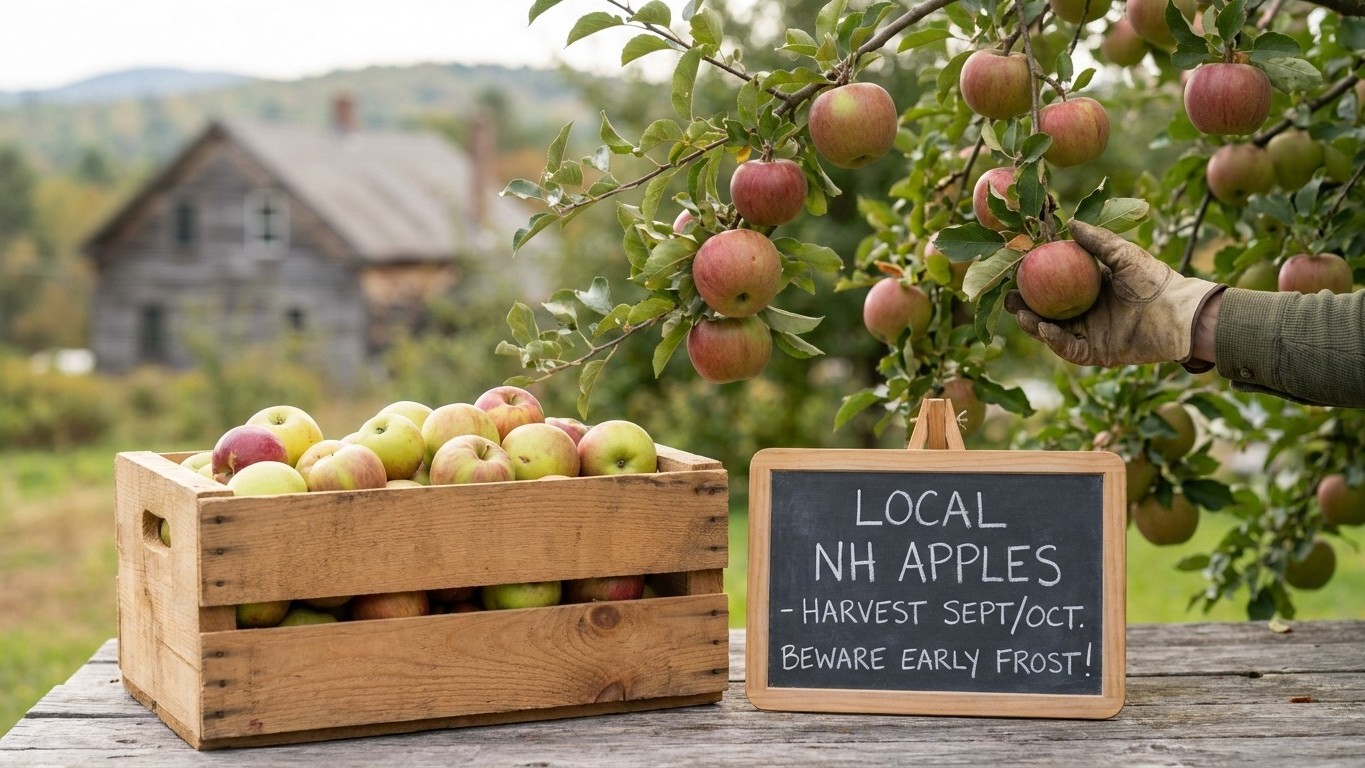

Apples do fine in New Hampshire, but only if you’ve matched the tree to the county you’re standing in, not to the state as a whole. A ‘Wealthy’ or ‘Haralson’ shrugs off a Coos County winter that would kill a ‘Honeycrisp’ outright, while that same ‘Honeycrisp’ is perfectly happy down in the Merrimack Valley. So before you order anything, look up your own zone — 3b in the mountains, 6a on the Seacoast — and pick the variety and rootstock rated for that number.
Can you grow apples in New Hampshire
The zone range across the state
New Hampshire spans a bigger climate range than most states its size. The USDA map puts the state anywhere from zone 3b in the higher elevations of the White Mountains and the northern Connecticut River valley to zone 6a along the Seacoast and lower Merrimack Valley. That six-zone spread matters more for apples than for most fruit, because a tree bred for the milder end of that range can lose wood or fail to set fruit reliably at the colder end.
NOAA’s 1991-2020 climate normals, measured at the Manchester reference station, put the average low of the coldest month at 15.7°F. That is a manageable winter for a hardy apple tree on a hardy rootstock, and it is one reason the Merrimack Valley and the Lakes Region have supported orchards for generations. Further north and at elevation, winter minimums run colder than the Manchester figure, sometimes by a wide margin, and a grower in Coos County or on a hilltop in the White Mountains should check their own county’s zone rather than assume Manchester’s numbers apply.
Where it’s easiest, and where it isn’t
The workable part of the state, in practical terms, is the southern tier: the Merrimack and Connecticut River valleys, the Seacoast, and the Lakes Region, where zone 5 and zone 6 varieties on standard or semi-dwarf rootstocks perform well most years. North Country growers are not shut out. They just need to shop from the cold-hardy end of the catalogue, on rootstocks bred for extreme winters, and accept a shorter, later-starting growing season.
None of this means apples fail anywhere in New Hampshire. It means the variety list and the rootstock choice have to match the specific county, and a tree that thrives forty miles south may sulk or die at a colder site. Talk to growers near your own town before ordering, and treat the state’s hardiness range as a starting filter, not a final answer.
Which varieties suit this climate

Cold-hardy choices
Start from cold-hardiness, not flavor preference. For a full rundown of cultivars suited to the state’s climate, stage by stage through the growing season, see The New Hampshire Apple Calendar, Stage by Stage.onditions, see The Best Apple Varieties for New Hampshire. Varieties carrying a published hardiness rating down to zone 3 or zone 4 are the ones that hold up across most of New Hampshire, including the colder valleys and hill towns where the USDA map drops to zone 3b. ‘Wealthy’, ‘Haralson’ and ‘Zestar!’ are all rated hardy to zone 3, bred in Minnesota for exactly this kind of winter. ‘Honeycrisp’, ‘McIntosh’, ‘Cortland’ and ‘Liberty’ carry a zone 4 rating and do well through the Merrimack Valley, the Lakes Region and most of the Seacoast, where winters run closer to the Manchester normal of 15.7°F than to the harder cold of the North Country.
| Variety | Published hardiness | Bloom timing | Notes |
|---|---|---|---|
| ‘Wealthy’ | Zone 3-7 | Mid-season | Very cold-hardy, tart-sweet, keeps poorly |
| ‘Haralson’ | Zone 3-7 | Mid to late | Minnesota-bred, tart, stores well |
| ‘Zestar!’ | Zone 3-7 | Early | Early-ripening, crisp, short storage life |
| ‘Honeycrisp’ | Zone 3-8 | Mid-season | Widely planted, needs a pollinator, biennial tendencies |
| ‘Liberty’ | Zone 4-8 | Mid-season | Scab-immune, a low-spray option |
| ‘McIntosh’ | Zone 4-7 | Mid-season | New England standard, drops fruit early if stressed |
| ‘Cortland’ | Zone 4-7 | Mid to late | Good pollinizer for McIntosh, resists browning |
Winter chill: the other filter
Hardiness answers whether the tree survives winter. Winter chill answers whether it flowers well the following spring, and it is a separate filter that catalogues rarely spell out for northern buyers. New Hampshire’s long, cold winters supply chill hours in abundance, so a variety practically never fails to bloom here for lack of cold. The risk runs the other way. A variety bred for a mild winter, the kind grown in South Carolina, where low-chill selections are the only ones that flower reliably, would simply freeze out in a New Hampshire yard, chill needs met or not. States in between, like the ones covered in our guide to growing apples in New Jersey, work from a wider list because their winters are milder and shorter, so both the chill and the hardiness math loosen up.
No New Hampshire-specific variety list from UNH Extension is cited here. Treat the zone ratings above as the starting filter, and confirm local performance with a nearby orchard or extension office before committing to an order.
Planting a pair that works here
Realistic pairs
Apples do not self-pollinate reliably. Plant two different varieties that bloom at the same time, close enough for bees to move between them.
Most of the varieties suited to New Hampshire’s winters bloom in the mid-season window, which makes pairing straightforward. ‘McIntosh’ and ‘Cortland’ flower together and are a traditional New England pair for exactly that reason. ‘Wealthy’ and ‘Haralson’, both bred for zone 3 winters, overlap closely enough to work in the coldest parts of the state. ‘Honeycrisp’ blooms mid-season too and sets well next to either ‘Liberty’ or ‘McIntosh’, though it tends toward biennial bearing regardless of pollination partner, a heavy crop one year and a light one the next.
Avoiding sterile pollen
Avoid pairing around a triploid. Varieties such as ‘Jonagold’ and ‘Rhode Island Greening’ carry sterile pollen. They need a pollinizer themselves and can’t serve as one for another tree, so an orchard built around a triploid actually needs three trees blooming together, not two. Check the catalogue listing for any variety before ordering. It will say plainly whether the pollen is fertile.
Keep the two trees close enough that bees will cross between them on a single foraging trip, especially since bloom in New Hampshire often falls during raw, damp weather that keeps pollinators grounded for hours at a stretch. A flowering crabapple works as a pollen source too, and takes far less space than a second full-size tree, an option worth considering on a small lot where two mature apple trees would crowd each other by year ten.
The frost that costs a crop here

NOAA’s 1991-2020 climate normals put the last spring freeze at the Manchester reference station between April 16 and April 27, based on the 30 to 70 percent probability band for a 32°F freeze. That is an airport-station figure. Gardens away from Manchester, especially low-lying or rural spots, often see their last frost run later, sometimes by one to two weeks, and mountain valleys later still. Check your own county’s typical last frost date before assuming Manchester’s window applies to your yard.
Why timing matters more than the date itself
The date on the calendar matters less than what the tree is doing when a frost arrives. A frost that hits while buds are still tight and green does little damage. Once buds reach the pink stage, shortly before bloom, the flower parts are exposed, and a freeze in the mid-to-high 20s°F can kill them outright. The tree itself survives. Wood, bark and next year’s buds come through fine. But the flowers that would have become this year’s apples are gone, and there is no second bloom to fall back on.
This is the actual frost risk in New Hampshire apple growing: not a hard freeze that damages the tree, but a light, late freeze that arrives after the buds have opened past the safe stage. Because the Manchester window runs from mid to late April, and colder inland sites run later still, a variety that blooms early is gambling every year that frost will not land during that narrow pink-to-bloom stretch. Among the varieties named earlier, ‘Cortland’ and ‘Haralson’ tend to open a few days later than ‘Zestar!’ or ‘McIntosh’, which buys a small but real margin in a year when frost lingers into the later end of the Manchester window.
At the site level, plant on a slope or high ground rather than in a frost pocket at the bottom of a yard, since cold air drains downhill and settles low. Hold off on any pruning that would push early growth. Cover young, small trees with row cover or an old sheet on a night when frost is forecast during bloom. None of that changes the calendar. The real protection where frost lands late, as it can well into the Manchester window and beyond it inland, is choosing a variety that blooms later in the sequence, giving the flowers a better chance of opening after the last freeze has already passed.
The apple year in New Hampshire
Apple timing runs off the tree’s stage, not a fixed date on the wall, but the stages line up loosely with the frost windows NOAA tracks at the Manchester station.
Dormancy
From leaf drop through late winter the tree is fully dormant. This is when to prune, while wood is bare and disease pressure is at its lowest. Pruning later, once sap starts moving, slows healing and can push growth later than intended.
Green tip
Buds swell and show a sliver of green, usually while there is still real frost risk. Dormant oil sprays for scale and mite eggs go on at or just before this stage, before green tissue is exposed enough to burn.
Pink
Flower buds show color but have not opened. This is the stage where a freeze does the most damage, since the flower parts are exposed but not yet pollinated or set. Given that the Manchester station’s last spring frost normally falls between April 16 and April 27, and rural sites often run later, pink stage anywhere near that window is the point to watch the forecast closely.
Bloom and petal fall
Flowers open, bees move pollen between the two varieties planted for that purpose, and petals drop within about a week. A frost during bloom itself is just as damaging as one at pink stage, sometimes more, since the open flower is even more exposed.
Fruit set
Small fruit begins to swell within a few weeks of petal fall. Some natural drop follows, the tree shedding fruit it can’t support, and thinning the remainder by hand improves the size and quality of what is left.
Harvest
Harvest timing depends on the variety, with early types like ‘Zestar!’ picked well before the first fall frost and later keepers like ‘Haralson’ hanging closer to it. NOAA’s 1991-2020 normals put the first fall freeze at the Manchester station between October 13 and October 26, and growers further from the airport station, or at higher elevation, should expect it earlier rather than later.
Local help
UNH Extension publishes New Hampshire-specific variety trial results, rootstock guidance and a seasonal spray calendar tuned to New England disease pressure such as apple scab and fire blight. Reach the UNH Extension website for county contact information and current publications before ordering trees or setting up a spray schedule, since recommendations shift as new pest pressure or new resistant varieties come through the trials.
Common questions
Do apple trees need a second tree nearby to produce fruit?
Almost always, yes. Most apple varieties need pollen from a different variety blooming at the same time, and a single tree standing alone will flower but set little or no fruit.
How long before a new apple tree produces apples in New Hampshire?
Expect roughly two to four years on dwarfing rootstock and five to eight years on a standard rootstock, regardless of state, since that timeline comes from the rootstock rather than the local climate. A hard winter or a frost during bloom can push that first crop back a year.
What USDA zone is my part of New Hampshire in?
Somewhere between zone 3b and zone 6a, depending on where you are. The USDA map runs colder in the White Mountains and the North Country and milder along the Seacoast and lower river valleys, so look up your specific town rather than relying on a statewide figure.
My apple tree bloomed but never set fruit. What went wrong?
The three usual suspects are a missing or mismatched pollinator, a late frost that killed the open flowers, or cold, rainy weather during bloom that kept bees from flying even without a frost. Any one of the three can produce the same result: a tree full of spent blossoms and no fruit.
Can I grow apples on a small lot or in a container?
A dwarfing rootstock keeps a mature tree small enough for a small yard, and two dwarf trees still need to be planted for pollination. A large container can work for a few years but apple trees eventually want more root room than most pots provide, so plan to move a container tree into the ground within its first several years.