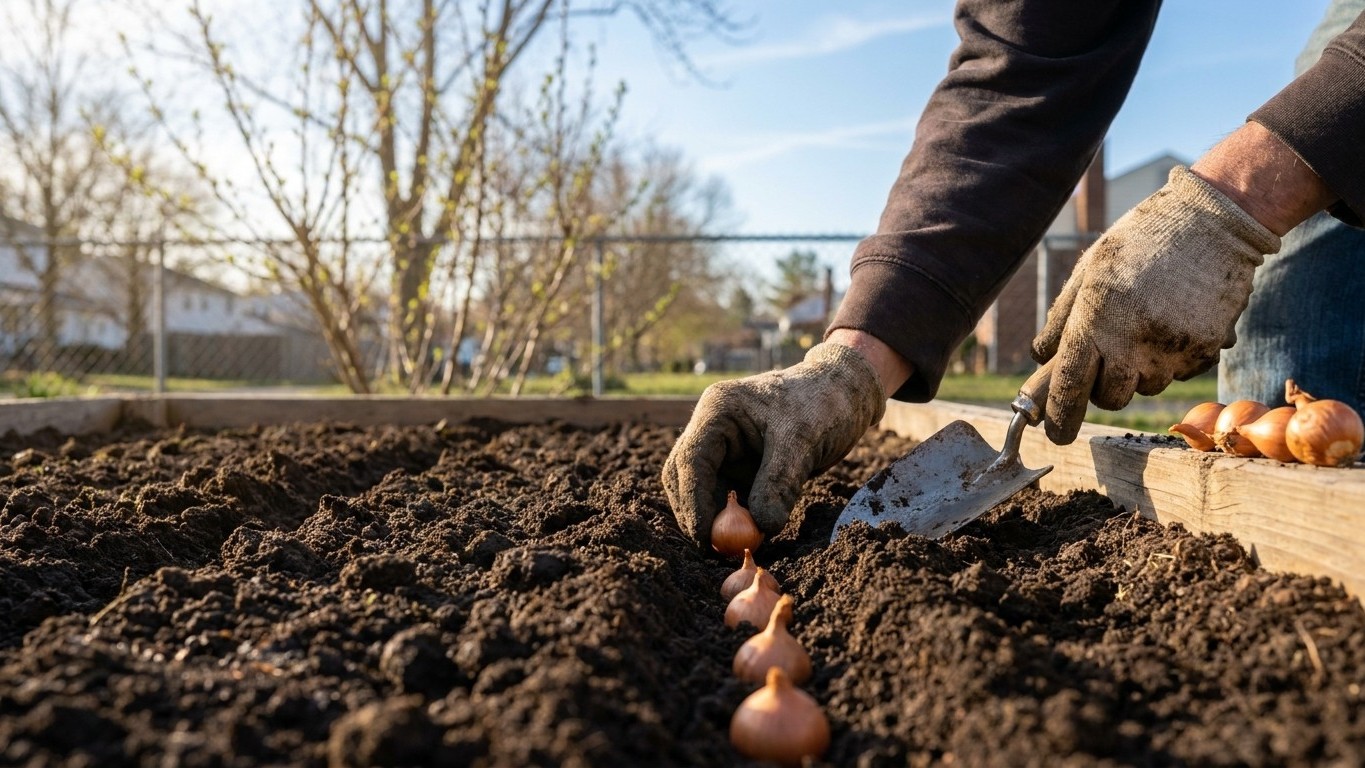

New Jersey gardeners put onion sets and transplants in the ground in late winter to early spring, usually March into April, well before the summer solstice arrives. That window isn’t a tradition or a guess. At 40.68 degrees north, the latitude of Newark, home to the National Weather Service station this planting calendar is built on, New Jersey gets 14 hours and 55 minutes of daylight on the longest day of the year. That single figure is what tells an onion plant when to quit making leaves and start making a bulb.
The short answer for New Jersey

New Jersey is long-day onion country. With 14 hours 55 minutes of daylight at the June solstice, the state sits well past the 12-hour mark that triggers bulbing in short-day types, and it lands squarely inside the 14-to-16-hour window that long-day and intermediate-day onions need before they’ll bulb at all. That’s the whole logic behind the planting calendar: because the trigger is daylight length, not the calendar date and not the weather, the goal in New Jersey is to get plants as large as possible before the days reach that threshold, since whatever size the plant has reached is roughly the size of onion you’ll pull.
That’s why timing runs backward from the way many people assume. In the Deep South, where winters barely dip below freezing, growers Plant Onions in the fall and let them overwinter as small plants, because the day length never drops low enough to hurt them and the bulbing trigger doesn’t arrive until spring anyway. New Jersey doesn’t get that option. Hard freezes, often well into the teens Fahrenheit, will kill young onion plants left in open ground over winter. So the calendar shifts: seed goes in trays indoors in January, transplants or sets go into garden soil once it’s workable, typically March into early April depending on the season, and the plant has roughly two to three months to bulk up before the solstice does its work in June.
This is also why New Jersey gardeners should be shopping for long-day and intermediate-day varieties, not the short-day sweet onions sold as sets at big box stores in early spring displays meant for southern climates. Of the varieties whose published latitude ranges are tracked for this region, 19 fall comfortably within New Jersey’s range and lean long-day or intermediate-day, with three more sitting close enough to the edge of their published range that they may perform here but shouldn’t be counted on without a trial row. The season is short and specific: get plants in the ground early, choose varieties built for long days, and let June sunlight do the rest.
What will not work here
Planting an onion variety built for the wrong latitude doesn’t produce a smaller version of what you wanted. It produces a different failure depending on which direction you missed. Short-day varieties, bred for latitudes well south of New Jersey, start bulbing at around 12 hours of daylight, a threshold New Jersey blows past by early May most years. The plant hasn’t had time to grow real leaf mass yet, so it bulbs anyway, small, because the daylight told it to. You end up with onions the size of golf balls instead of the size of a fist, and no amount of fertilizer fixes it, because it isn’t a feeding problem.
Go too far the other direction and the failure is worse: no onion at all. A handful of long-day varieties are bred for latitudes north of New Jersey, where summer days stretch past 15 or 16 hours. Planted in New Jersey, where the longest day tops out at 14 hours 55 minutes, those varieties never see the day length they’re waiting for. The plant just keeps making leaves all summer, then the cold arrives, the leaves collapse, and the bulb that should have formed simply rots in the ground.
Here’s what to avoid, by name, based on published latitude ranges:
- Gabriella (short-day), bulbs far too early here, giving a tiny onion instead of a full-size one
- Madalyn (short-day), same early-trigger problem, undersized bulbs
- Red Rock (short-day), bulbs before the plant has grown enough to fill out
- Red Sensation (short-day), triggers too soon at this latitude, small yield
- Texas Grano 1015Y (short-day), built for latitudes far south of New Jersey, bulbs small here
- Vidora (short-day), same early-bulbing issue as the other short-day types
- White Castle (short-day), undersized bulbs from an early trigger
- Powell (long-day, 43-47N), the day here never gets long enough to trigger bulbing; leaves grow all season, then rot with no bulb
- Redwing (long-day, 43-65N), same failure, built for far more daylight than New Jersey ever provides
The timing mistake compounds the variety mistake. Plant the right variety two months late and the outcome looks the same as planting the wrong variety: a small onion, because the plant simply hadn’t reached its potential size by the time the solstice pulled the bulbing trigger. Late planting doesn’t push the harvest back. It shrinks it.
What changes across New Jersey
New Jersey runs roughly 170 miles north to south, from Cape May at the southern tip near 38.9 degrees north up to the state’s northwestern corner near High Point, around 41.4 degrees north. That’s about 2.5 degrees of latitude, enough to matter for anyone gardening at either edge rather than near Newark, the reference city this calendar is built on.
| Location | Approximate latitude | What it changes |
|---|---|---|
| Cape May area (south) | ~38.9°N | Slightly shorter summer day length than Newark; closer to the boundary zone where intermediate-day varieties perform better than long-day types, and frost dates run a week or two earlier in spring |
| Newark (reference city) | 40.68°N | 14 h 55 min of daylight at the solstice; the baseline this entire planting calendar is calculated from |
| High Point area (northwest) | ~41.4°N | Slightly longer summer day length than Newark; last spring frost tends to arrive later, which can push transplant dates a week or two behind the Newark schedule |
A gardener near Cape May isn’t gardening in a different day-length world, the difference is small, but they are closer to the line where some intermediate-day varieties start to make more sense than a straight long-day choice. A gardener near the northwestern highlands, meanwhile, is dealing with a shorter growing season on the ground even though the daylight trigger arrives at nearly the same point on the calendar, because frost lingers longer into spring and returns earlier in fall. That squeezes the window for building leaf mass before the solstice does its work, which argues for starting transplants indoors a little earlier rather than waiting on outdoor soil temperatures.
Sweet now, or onions that last
Every onion variety carries a trade-off, and it isn’t about taste preference so much as chemistry. The compounds that give an onion its bite, volatile sulfur compounds, are the same compounds that protect the bulb in storage. A sweet onion has fewer of them, which is why it tastes mild raw and why it also breaks down in the pantry within weeks. A pungent onion has more of them, which is why it makes your eyes water and why it can sit in a mesh bag in a cool closet until March without going soft. University of Missouri Extension puts it plainly: sweet onions do not store as well as more pungent types.
This lines up directly with the day-length map. Short-day varieties, grown in the South, tend to run sweeter, and southern gardeners eat their onion harvest through summer and fall rather than banking on it lasting the winter. New Jersey’s long-day and intermediate-day territory tips the other way. Most of the varieties suited to Newark’s latitude, names like Ailsa Craig, Patterson, and Frontier among the long-day group, or Cabernet and Monastrell among the intermediate-day group, lean toward the sharper, better-keeping end of the spectrum. There are exceptions inside that group too. Walla Walla Sweet is a long-day variety that still trades toward mild flavor and short storage life, so even within New Jersey’s suitable range, the sweet-or-lasting choice doesn’t disappear, it just narrows.
What that means for a New Jersey kitchen: onions harvested in July and August from a long-day crop, cured properly, can realistically still be usable in March, months after a southern sweet onion from the same planting date would have gone soft. That’s not a guarantee tied to any single variety, but it’s the general shape of the trade-off this latitude hands New Jersey gardeners.
Checking this against your own garden
Every figure in this calendar is built around Newark’s latitude and the National Weather Service data tied to it. That’s a solid baseline for most of the state, but it isn’t a promise for every backyard, especially near the state’s northern and southern edges. Before locking in a planting date, it’s worth confirming a few things specific to where you actually garden:
- Look up your own latitude if you’re gardening near Cape May, the Highlands, or anywhere more than 20 or 30 miles from Newark, since a degree of latitude can shift which day-length group actually fits your yard
- Confirm your average last spring frost date and first fall frost date, since these vary by microclimate even within the same county
- Check with your county’s Rutgers Cooperative Extension office, which tracks local frost data and soil temperature trends than any statewide average can
- Note your site’s exposure, since a south-facing slope or a low frost pocket in your own yard can shift real-world timing by a week or two from any published date
- Test soil temperature directly before transplanting, since onion roots establish poorly in cold, wet soil even when the calendar says it’s time