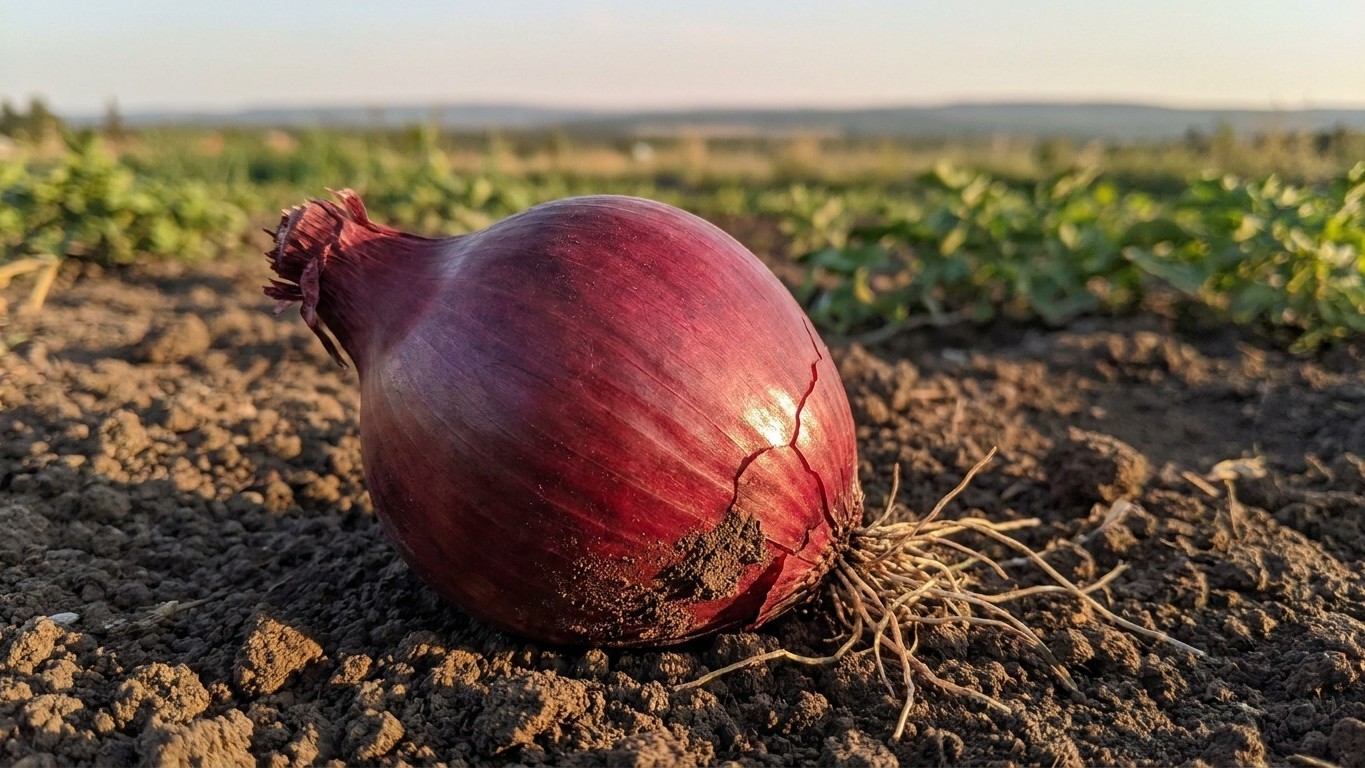

Only one onion variety on record has a published growing range that reaches Northwest Territories: Redwing. At Yellowknife’s 62.46 degrees north, gardeners get roughly 19 hours and 30 minutes of daylight on the summer solstice, and that number, not the average summer temperature, is what tells an onion plant whether to keep growing leaves or start building a bulb.
The short answer for Northwest Territories

Onions are sorted into three groups based on how many hours of daylight they need before they switch from leaf production to bulb production: short-day (around 12 hours), intermediate-day (13 to 14 hours), and long-day (14 to 16 hours). Yellowknife’s 19 hours 30 minutes of daylight on the longest day of the year comfortably clears even the top end of that long-day threshold, which is exactly why long-day varieties are the only group that makes sense this far north.
Among the onion varieties documented on this site, Redwing is the single one whose published range, 43 to 65 degrees north, actually covers 62.46°N. It’s a long-day type, so it waits for those long summer days before it starts sizing up a bulb, and in a territory where the sun barely dips below the horizon in June and July, it gets that signal early and holds it for weeks. That combination of long daylight and a long, cool growing window is what lets a long-day onion bulk up before the short-day types would have already quit growing leaves and rotted in the ground.
Why day length beats warmth here
It would be easy to assume that the deciding factor in a place as cold as the Northwest Territories is frost risk or soil temperature. Those matter for planting dates and survival, but they don’t determine whether a bulb forms at all. A short-day onion started in Yellowknife will still hit its 12-hour trigger sometime in late spring, when the plant has barely had time to grow more than a few leaves. At that point it locks into bulb mode with almost nothing to work with, and the result is a marble-sized onion, not a small crop failure but a variety mismatch. Redwing avoids that trap because its threshold sits high enough that the plant has the whole long NWT growing window to put on leaf growth before the trigger fires.
What will not work here
This is the part most seed catalogs leave out, and it matters more than which variety to pick: nearly every other onion on the market is built for a different day-length world than the one Yellowknife sits in. Thirty documented varieties have published ranges that stop short of 62.46 degrees north, and planting any of them here does not mean a smaller harvest, it means the wrong outcome for that group entirely.
Short-day and intermediate-day types will still bulb, because their trigger is set so low that even a partial NWT summer clears it easily. The problem is timing, not failure to bulb at all: they hit that 12 to 14 hour mark while the plant is still young, and a young plant makes a small bulb no matter how good the soil is. Long-day varieties whose published range tops out well south of Yellowknife face a different limit: their catalog data reflects a shorter, warmer growing season than the NWT offers, and a variety bred around that assumption runs out of frost-free days before it finishes sizing up, even though the daylight itself would trigger bulbing just fine.
- Gabriella (short-day, 20-35N), bulbs within weeks of emergence here; the plant never gets big enough first.
- Madalyn (short-day, 20-35N), same early trigger, same undersized result.
- Red Rock (short-day, 30-36N), bulbs far too early for a Yellowknife-length season.
- Red Sensation (short-day, 25-35N), locks into bulb mode long before leaf mass builds up.
- Texas Grano 1015Y (short-day, 25-35N), a southern staple, wrong trigger entirely for this latitude.
- Vidora (short-day, 25-35N), same early-bulbing outcome as the rest of this group.
- White Castle (short-day, 30-38N), trigger fires while the plant is still small.
- Cabernet (intermediate-day, 35-45N), bulbs before the NWT’s long daylight window is put to use.
- Calibra (intermediate-day, 35-45N), same mismatch, small bulbs guaranteed.
- Candy (intermediate-day, 33-40N), its 13 to 14 hour trigger arrives too soon here.
- Elsye (intermediate-day, 32-45N), falls well short of the latitude this needs.
- Expression (intermediate-day, 32-45N), bulbs early relative to the growing window available.
- Monastrell (intermediate-day, 35-46N), range ends more than 15 degrees south of Yellowknife.
- Red Long of Florence (intermediate-day, 38-50N), southern range, wrong trigger for this far north.
- Red Long of Tropea (intermediate-day, 35-48N), same early-bulb problem as its group.
- Scout (intermediate-day, 32-46N), range tops out well short of the territory.
- Sierra Blanca (intermediate-day, 32-45N), bulbs before the plant has size to show for it.
- Ailsa Craig (long-day, 38-60N), range ends just south of Yellowknife; season too short to finish sizing.
- Barolo (long-day, 38-55N), bred for a shorter, warmer season than NWT offers.
- Blush (long-day, 38-55N), same seasonal mismatch as Barolo.
- Bridger (long-day, 35-50N), range stops more than 12 degrees south.
- Frontier (long-day, 40-50N), not documented as suited past 50N.
- New York Early (long-day, 38-50N), a mid-latitude variety, not an arctic one.
- Patterson (long-day, 38-55N), range ends south of Yellowknife.
- Powell (long-day, 43-47N), narrow range that stops well before 62N.
- Red Carpet (long-day, 40-45N), nowhere near the NWT’s latitude.
- Rossa di Milano (long-day, 38-50N), built for a much shorter summer daylight window.
- Safrane (long-day, 42-50N), range tops out 12 degrees south of Yellowknife.
- Talon (long-day, 42-50N), same gap as Safrane.
- Walla Walla Sweet (long-day, 35-55N), a Pacific Northwest classic, out of range this far north.
What changes across Northwest Territories
Yellowknife’s 62.46 degrees north is a reference point, not a rule that applies from one end of the territory to the other. Northwest Territories stretches from a southern border near 60 degrees north down toward Alberta and British Columbia, up past the Arctic Circle (66.5 degrees north) toward communities close to the Beaufort Sea. That’s a wide enough spread that the advice above shifts depending on where a garden actually sits.
| Location | Approximate latitude | What changes |
|---|---|---|
| Southern NWT (near the Alberta/BC border) | ~60°N | Slightly less extreme daylight swing than Yellowknife; Redwing still fits comfortably within its 43-65N range. |
| Yellowknife (reference city) | 62.46°N | Baseline for the figures on this page; Redwing sits inside its published range but past the midpoint. |
| Communities near or past the Arctic Circle | ~66-69°N | Daylight approaches or reaches 24 hours around the solstice; Redwing’s published range tops out at 65N, so gardens here fall outside every documented variety on this list. |
Gardeners near the southern border are working with numbers close enough to Yellowknife’s that the same variety choice holds. Anyone gardening near or above the Arctic Circle is in different territory, literally: continuous or near-continuous daylight changes the growing math in ways none of the 31 documented varieties on this site have published data for, which means local trial and error, or advice from a territorial source, matters more than any catalog range.
Checking this against your own garden
A latitude figure and a daylight number describe Yellowknife, not necessarily the yard where the onions will actually go in the ground. Before betting a season on Redwing or anything else, it’s worth confirming a few things specific to the actual garden site.
- Look up the latitude of the nearest town or community, especially if it’s more than a degree or two north or south of Yellowknife.
- Check local frost-free dates rather than relying on a territory-wide average, since NWT’s growing season length varies sharply from south to north.
- Contact the territorial agriculture extension office or a local gardening group for onion performance data specific to that community.
- Ask whether raised beds, cold frames, or transplants (rather than direct seeding) are commonly used locally to stretch a short growing season.
- Confirm current soil temperature at planting depth, since onion sets and transplants both stall in soil that’s still too cold, regardless of day length.
The Clemson Cooperative Extension’s guidance on the roughly 12-hour bulbing threshold for short-day onions is a useful baseline for understanding how the mechanism works, even outside South Carolina, because the trigger itself doesn’t change with geography, only the daylight available to reach it does.