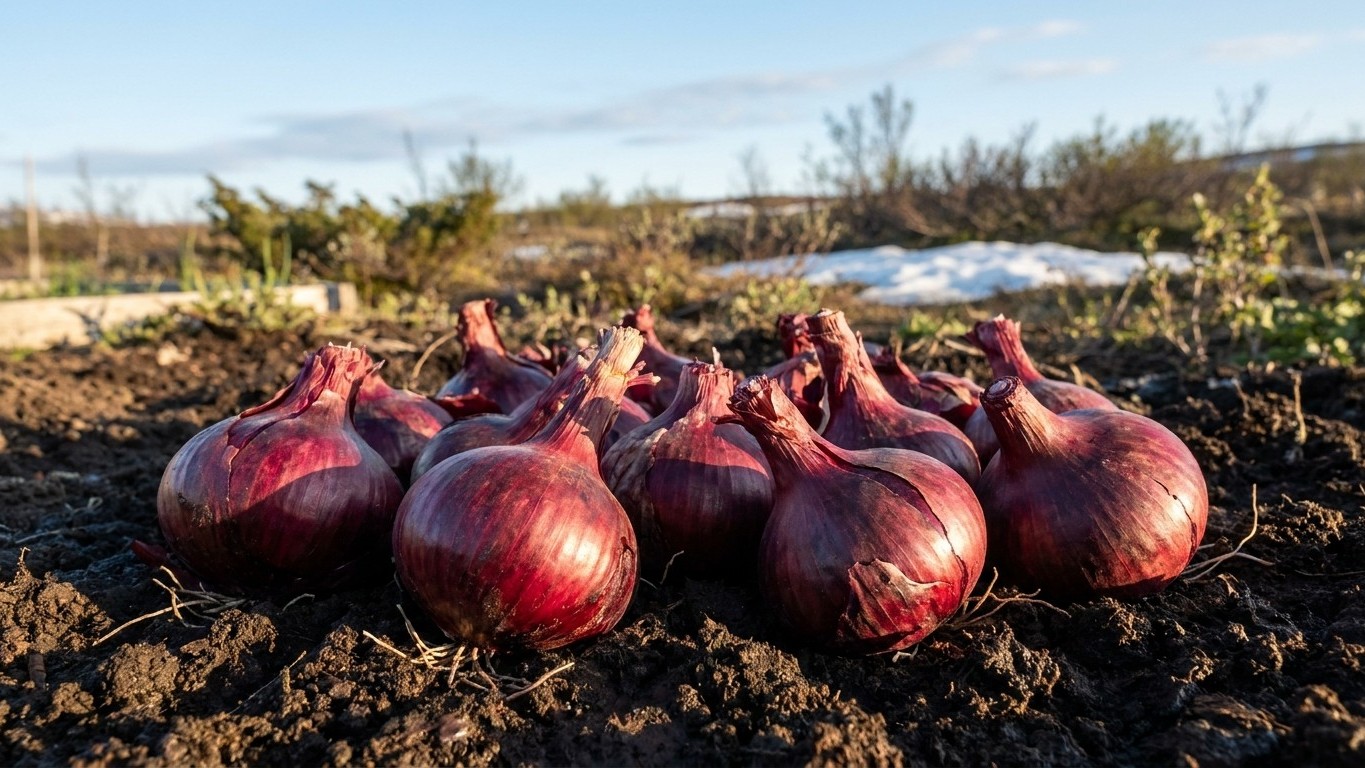

Northwest Territories sits far enough north that the usual onion advice stops applying. Only one long-day variety documented on this site is bred for a latitude this high, and the planting window is set less by frost than by daylight itself. At 62.46 degrees north, Yellowknife sees roughly 19 hours and 30 minutes of light on the longest day of the year, and that single number decides which onions will ever form a bulb here. Get the timing wrong and there’s no second chance this season.
The short answer for Northwest Territories

Onions don’t bulb because of heat. They bulb because of day length, and each variety is bred to respond at a different threshold. Short-day types start at around 12 hours, according to Clemson Cooperative Extension’s home garden guidance on onions. Intermediate types wait for 12 to 14 hours. Long-day types hold off until 14 to 16 hours of daylight. At Yellowknife’s 62.46°N, the longest day of the year delivers 19 hours and 30 minutes of light, blowing straight past every one of those thresholds well before the solstice arrives.
That extreme daylight is exactly why this territory belongs to the long-day group and nowhere else. Of the 31 onion varieties tracked on this site, exactly one has a published range that reaches this far north: Redwing, rated for 43 to 65 degrees north. Nothing bred for a lower ceiling gets close.
Because day length climbs so fast here in spring, the 14-to-16-hour bulbing window arrives weeks before the actual solstice, not on it. A plant that hasn’t grown a healthy set of leaves by the time daylight crosses that threshold will bulb anyway, just small. The fix isn’t a different fertilizer schedule. It’s starting earlier than a grower two thousand miles south would ever need to.
In practice, that means starting onion seed indoors in late winter, well ahead of the last frost, so the transplants already have real leaf mass by the time they go into the ground in late spring. The goal is to bank as many weeks of leaf growth as possible before daylight itself flips the switch to bulbing. Sow later, or transplant a small seedling, and the plant simply runs out of time to build size before it’s told to stop growing leaves and start forming a bulb.
This is the opposite of how gardeners in much of the Lower 48 think about onions, where frost dates dominate the conversation and day length is an afterthought. Here it flips: frost matters, but daylight sets the ceiling on how big the onion can ever get, and that ceiling is fixed no matter how good the soil is.
What will not work here
Thirty of the thirty-one varieties documented on this site have a published range that never reaches 62.46°N, and each fails for a specific, predictable reason tied to its day-length group.
Short-day varieties: bulb almost immediately, stay tiny
These are built for daylight thresholds around 12 hours, a number Yellowknife’s summer sky clears before the plants have grown much of anything. The bulb forms while the plant is still a seedling, essentially. This is a variety mistake, not a feeding mistake, and no amount of nitrogen fixes it.
- Gabriella (short-day, 20-35N), triggers to bulb almost as soon as it’s planted, leaving marble-sized onions
- Madalyn (short-day, 20-35N), same early trigger, same undersized result
- Red Rock (short-day, 30-36N), bulbs before real leaf growth has happened
- Red Sensation (short-day, 25-35N), reaches its threshold long before the plant is ready
- Texas Grano 1015Y (short-day, 25-35N), a variety built for a much shorter, milder day-length curve
- Vidora (short-day, 25-35N), bulbs at a fraction of its potential size this far north
- White Castle (short-day, 30-38N), the same story: tiny bulbs, wasted growing space
Intermediate-day and long-day varieties bred for latitudes south of here
These varieties wait longer to bulb than short-day types, but their published ranges still stop short of 62.46°N. That means the seed source never guaranteed performance here in the first place. Left in the ground, they either bulb late and undersized before an early fall frost ends the season, or keep pushing leaves without ever fully committing to a bulb.
- Cabernet (intermediate-day, 35-45N)
- Calibra (intermediate-day, 35-45N)
- Candy (intermediate-day, 33-40N)
- Elsye (intermediate-day, 32-45N)
- Expression (intermediate-day, 32-45N)
- Monastrell (intermediate-day, 35-46N)
- Red Long of Florence (intermediate-day, 38-50N)
- Red Long of Tropea (intermediate-day, 35-48N)
- Scout (intermediate-day, 32-46N)
- Sierra Blanca (intermediate-day, 32-45N)
- Ailsa Craig (long-day, 38-60N), tops out two degrees south of Yellowknife
- Barolo (long-day, 38-55N)
- Blush (long-day, 38-55N)
- Bridger (long-day, 35-50N)
- Frontier (long-day, 40-50N)
- New York Early (long-day, 38-50N)
- Patterson (long-day, 38-55N)
- Powell (long-day, 43-47N)
- Red Carpet (long-day, 40-45N)
- Rossa di Milano (long-day, 38-50N)
- Safrane (long-day, 42-50N)
- Talon (long-day, 42-50N)
- Walla Walla Sweet (long-day, 35-55N)
Every one of these was catalogued against a growing region that never sees anything close to 19 hours and 30 minutes of June daylight. Planting them here means gambling on leaves all season, no bulb forming in time, and rot setting in once the ground freezes.
What changes across Northwest Territories
Yellowknife is the reference point for every figure above, but Northwest Territories stretches from a southern border shared with Alberta and British Columbia near 60°N up through the Arctic Circle at roughly 66.5°N and beyond into the high Arctic. That’s a wide enough spread that a gardener at either edge shouldn’t assume Yellowknife’s numbers apply exactly to their own yard.
| Location | Approximate latitude | What it changes |
|---|---|---|
| Southern border area | ~60°N | Slightly shorter longest-day daylight than Yellowknife; still comfortably inside Redwing’s 43-65N range, but plant a little later than the reference date |
| Yellowknife (reference) | 62.46°N | Baseline for this page: 19h30 of daylight on the longest day |
| Arctic Circle and north | ~66.5°N and beyond | Daylight approaches continuous in June; this is right at or past the edge of Redwing’s published 65N ceiling, so even the one documented variety is no longer a safe bet without checking locally |
A gardener near the southern border is working with a slightly shorter summer day than Yellowknife, which pushes the bulbing trigger a few days later in the calendar and gives a small cushion for a slightly later transplant date. A gardener north of the Arctic Circle is in different territory entirely: daylight there stretches close to around the clock in midsummer, past what any variety on this site has been catalogued for. That’s not a reason to give up on onions, but it is a reason to treat Redwing’s 65N ceiling as a real limit rather than a rounding error.
Checking this against your own garden
Every figure above comes from one weather station in Yellowknife, not from a survey of the whole territory. Before betting a season’s onion crop on it, run through a few checks specific to where the garden actually sits.
- Look up your own latitude if you’re more than an hour’s drive from Yellowknife; a few degrees north or south shifts both the daylight math and the safe transplant window
- Confirm your local last and first frost dates with your regional agricultural extension or territorial gardening office rather than relying on a territory-wide average
- Track how large your onion transplants are by early June; if they’re still small seedlings as daylight approaches its peak, the bulbs will be small too, regardless of variety
- If you’re gardening north of roughly 65°N, treat Redwing’s published range as a boundary worth double-checking locally rather than assuming it still applies
- Start seed indoors early enough that transplants have real leaf growth before the earliest safe outdoor planting date in your specific area
A single weather station can tell you what the sky is doing over Yellowknife. It can’t tell you what’s happening in a garden two hundred miles away, in a microclimate shaped by a lake, a hillside, or a stand of trees. That part still has to be checked on the ground, every year.