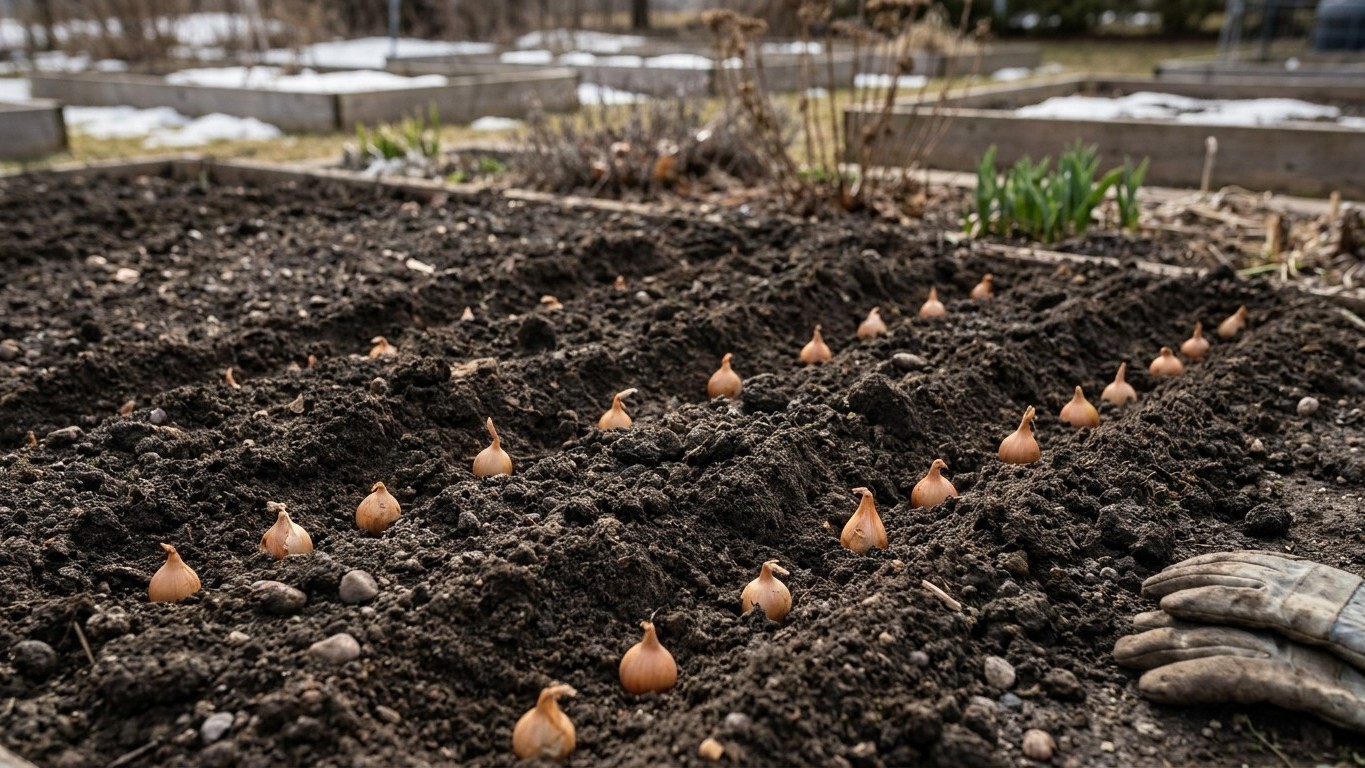

Plant onions in Ontario in early spring, not fall, and time it by day length rather than the calendar. Toronto Buttonville, the reference station for the region at 43.86 degrees north, sees 15 hours and 17 minutes of daylight on the longest day of the year. That single number rules out short-day onions entirely and points every Ontario gardener toward long-day and intermediate-day varieties planted as soon as the soil can be worked.
The short answer for Ontario

Onions don’t bulb because the weather warms up. They bulb when the length of the day crosses a threshold hard-wired into the variety. Clemson Cooperative Extension’s Home & Garden Information Center puts the short-day trigger at roughly 12 hours of daylight, a mark most of North America blows past by mid-spring. Long-day types wait for something closer to 14 to 16 hours before they’ll switch from making leaves to making a bulb.
At 43.86N, Toronto Buttonville’s 15 hours and 17 minutes on the June solstice sits well inside that long-day window and comfortably above the intermediate-day range too. That’s the whole answer, really: Ontario has enough summer daylight to satisfy long-day and intermediate-day onions, but the growing season itself is short and cold, bracketed by real winter on both ends.
Because there’s no mild winter to grow through, fall planting (the norm in places like the Gulf Coast, where onions overwinter as small plants under short days) doesn’t apply here. Ontario growers plant in early spring instead, as soon as the ground thaws and can be worked, typically weeks ahead of the last expected frost since onion seedlings and sets tolerate cold better than most garden vegetables. The goal is to give the plant the longest possible run of daylight hours to build leaves before the solstice arrives and flips the bulbing switch.
That’s the mechanical difference between states and provinces on this crop. Farther south, where the day never gets long enough to satisfy a long-day onion, growers plant short-day types in autumn and let them mature on a short-day trigger through winter. In Ontario, the day gets plenty long, so the variety choice runs the opposite direction and the planting window shifts to the front of the growing season instead of the back.
What will not work here
Planting an onion late in Ontario does not push the harvest back. It shrinks it. The bulbing trigger fires on the calendar, tied to day length, whether the plant is six inches tall or sixteen. Whatever size the onion has managed to reach by the time daylight crosses its threshold is roughly the size the bulb will be. A late-planted onion doesn’t catch up later in the season; it just runs out of leaf-building time before the switch flips, and the result is a small bulb, not a delayed one.
The other mistake is picking the wrong day-length group altogether. Short-day onions planted this far north hit their roughly 12-hour trigger by mid-spring, long before the plant has put on any real size, so they bulb early and tiny. Some varieties on the market are marketed broadly but carry a published latitude range that stops well south of Toronto’s 43.86N, which means the same shrinking problem applies to them even if they aren’t labeled strictly short-day.
Eight varieties with catalogue-documented ranges that fall below Ontario’s latitude, and why they don’t hold up here:
- Candy (intermediate-day, published range 33-40N): tops out ten degrees south of Toronto, meaning it bulbs before reaching size at 43.86N.
- Gabriella (short-day, 20-35N): triggers around 12 hours, which arrives in Ontario while the plant is still small.
- Madalyn (short-day, 20-35N): same short-day mechanism, bulbs far too early this far north.
- Red Rock (short-day, 30-36N): its range sits entirely south of the Great Lakes region.
- Red Sensation (short-day, 25-35N): a Gulf Coast and Deep South range, not a Great Lakes one.
- Texas Grano 1015Y (short-day, 25-35N): built for a much shorter summer day than Ontario ever offers a short-day plant.
- Vidora (short-day, 25-35N): same story, bulbs on a trigger Ontario passes too early in the season.
- White Castle (short-day, 30-38N): closer, but still well south of 43.86N and still on the wrong day-length clock.
Plant any of these in Ontario and the pattern is the same: healthy green tops all spring, a bulb that never gets past marble size, and rot setting in once the foliage collapses in midsummer. That’s a variety mismatch, not a soil or fertilizer problem, and no amount of feeding fixes it.
What changes across Ontario
Every figure above comes from one station, Toronto Buttonville, and Ontario is not a single point on the map. The province runs from the Lake Erie shoreline and the Windsor-Point Pelee area in the south, one of the mildest and earliest-warming corners of the province, all the way north to the shores of James Bay and Hudson Bay, a stretch of many degrees of latitude and a genuinely different climate.
| Region | Compared to Toronto Buttonville (43.86N) | Practical effect |
|---|---|---|
| Southwestern Ontario (Windsor / Point Pelee area) | Several degrees south, slightly shorter summer days | Soil warms earlier; intermediate-day varieties do reliably well and spring planting can often start a bit sooner than around Toronto |
| Greater Toronto Area (reference station) | Baseline: 43.86N, 15h17 on the longest day | Long-day and intermediate-day onions both work; plant as soon as soil is workable |
| Northern Ontario (toward James Bay / Hudson Bay) | Many degrees north, meaningfully longer summer days | True long-day varieties get plenty of daylight to trigger bulbing, but frost lingers later into spring and the whole season is compressed |
A gardener near Windsor is working with a longer, milder season than the Toronto figures suggest, and might get away with an intermediate-day variety and an earlier start date. A gardener near the northern edge of the settled part of the province is dealing with more summer daylight but a much shorter frost-free window, which usually means planting a bit later than the calendar would suggest just to avoid a late spring freeze, even though the variety itself would tolerate the extra daylight just fine.
Checking this against your own garden
The Toronto Buttonville figures are a solid starting point for most of southern and central Ontario, but they’re not a substitute for what’s happening in your own yard. A few things worth confirming before you commit seed or sets to the ground:
- Look up your own latitude if you’re well north or south of the Greater Toronto Area; a few degrees changes both your summer daylight total and your frost calendar.
- Check your local average last-frost and first-frost dates rather than assuming the Toronto dates apply, since lake effect and elevation shift these by weeks in parts of the province.
- Contact your local agricultural extension office or county agricultural office for frost-date records specific to your township, especially if you’re near the Canadian Shield or far from Lake Ontario’s moderating effect.
- Watch the actual soil condition each spring rather than a fixed date; onions go in as soon as the ground can be worked, and that date moves year to year.
- Confirm the day-length range printed on any variety you’re considering against the 15h17 figure for this region before you buy, especially for anything marketed as short-day or Deep South.