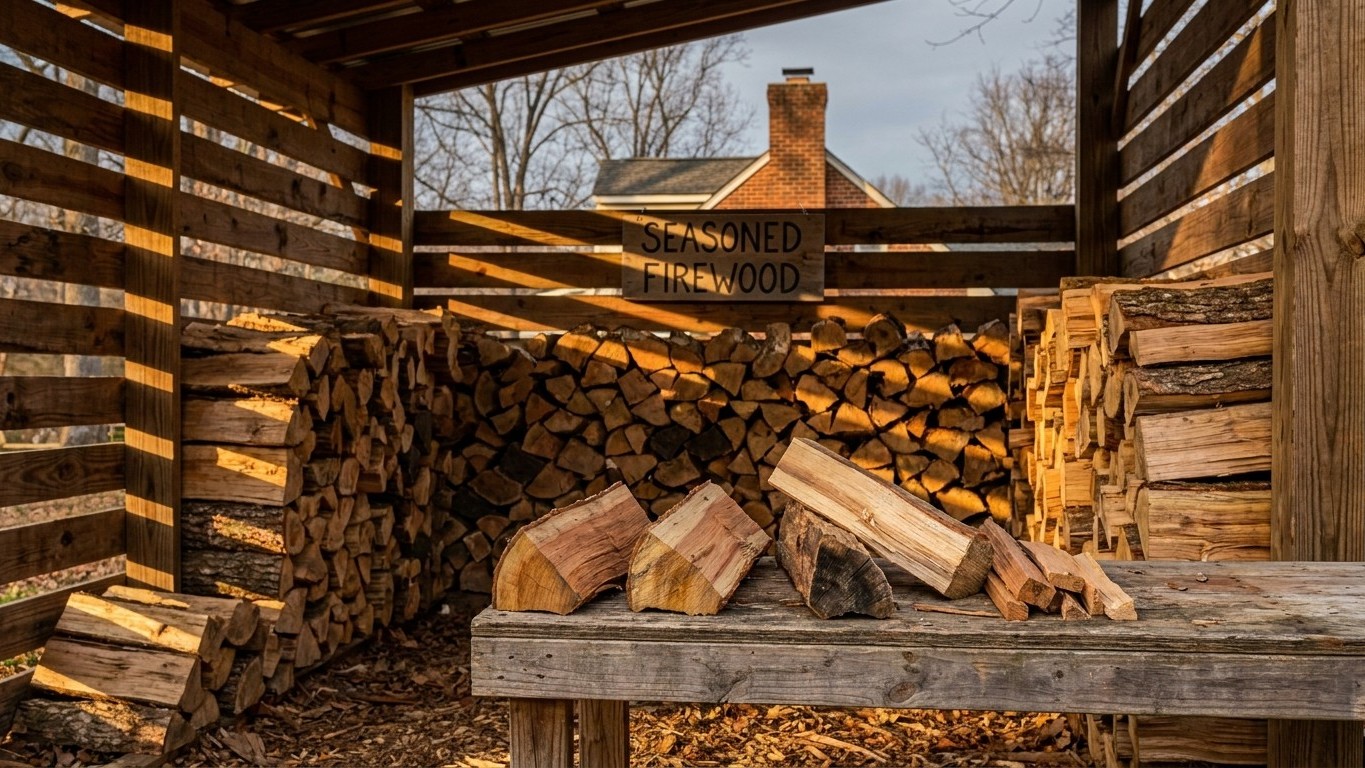

Virginia Beach’s coldest month averages a daily low of 31.6°F, cold enough to freeze standing water most nights but nowhere near brutal. That single number, more than any species chart, tells you what kind of firewood buyer you are: someone heating through real winter, not just burning logs for ambiance. This guide sorts out which woods earn their space in your woodshed, how much you’ll actually need, and why the timeline for drying matters as much as what you cut.
How cold it actually gets here

The NOAA Climate Normals for 1991-2020, using Virginia Beach as the reference station, put the average daily minimum for the coldest month at 31.6°F. That’s not the record low, and it’s not some abstract seasonal average. It’s the typical overnight temperature during the worst stretch of the year, which usually lands in January. A number just above freezing means most nights dip below it, some considerably.
That matters because 31.6°F sits in an odd middle ground. It’s cold enough that a house without supplemental heat gets uncomfortable fast, but it’s not the kind of sustained sub-zero cold that makes wood heat a matter of survival. Compare it to the mountain valleys and higher elevations further west and north in the state, where the same NOAA dataset (measured at different stations) runs consistently colder. If you’re heating a home in Highland County or up in the Blue Ridge, expect harder nights than this coastal reference implies. Virginia Beach represents the milder end of the state’s winter range, not the whole picture.
What this means for your woodpile
A winter that bottoms out around 31.6°F on an average night still demands real heat output, just not the extreme cord-burning pace you’d see in New England or the upper Midwest. Wood heat here works well as a serious supplement to a furnace or heat pump, or as the main source for a well-sealed home. What it doesn’t require is the absolute densest, slowest-burning species just to survive till dawn. You have some room to choose based on availability and cost, not just raw BTU output.
The practical takeaway: don’t assume the coastal number applies statewide. If you’re closer to the coast or in the Piedmont, 31.6°F as a baseline is a reasonable planning figure. If you’re further inland or at higher elevation, budget for colder nights and a heavier reliance on your densest wood.
Which woods are worth the effort here
Once you know how cold your winter actually runs, the next question is what a cord of wood is really giving you. Michigan State University Extension puts the energy content of a well-seasoned cord of hardwood at roughly 20 million BTU. A cord, by definition, is a stack measuring 4 feet by 4 feet by 8 feet, or 128 cubic feet. That measurement matters because it’s the single most common way firewood buyers get shorted: a “truckload” or a “rick” is not a cord, and pricing should always reference the actual cord measurement.
To put that 20 million BTU figure in terms a homeowner can use, MSU’s comparison lands it at roughly the heat output of 145 gallons of #2 fuel oil, or 215 gallons of LP gas. That’s a useful anchor when you’re deciding how many cords to order relative to what you’d otherwise spend on oil or propane deliveries.
Moisture changes everything, more than species does
Here’s the part that gets skipped in most firewood advice: that 20 million BTU average assumes the wood is properly seasoned, at 20 percent moisture or less. Green wood can run over 60 percent moisture, and every bit of that water has to boil off before the wood gives you any usable heat. A cord of unseasoned wood might carry the same weight and the same species label, but it delivers a fraction of the heat, because so much of the fire’s energy goes into driving off water instead of warming your house.
Red oak is worth naming specifically here because MSU flags it as an exception: its cell structure makes it dry slower than most other hardwoods, so it needs more time stacked and exposed to air before it hits that 20 percent target. If you’re planning around red oak, buy or cut it further ahead than you would other species.
| Wood condition | Approx. BTU per cord | Heating equivalent | Practical note |
|---|---|---|---|
| Well-seasoned hardwood (20% moisture or less) | ~20 million BTU | ~145 gal. fuel oil / ~215 gal. LP gas | The standard to aim for before burning |
| Green/unseasoned hardwood (60%+ moisture) | Significantly less usable heat | Much less than the equivalents above | Wastes energy boiling off water; produces more smoke and creosote |
| Red oak specifically | Same seasoned target as other hardwoods once dry | Same equivalents once at 20% moisture | Dries slower due to cell structure; needs extra stacking time |
None of this replaces knowing what species you can actually source locally and get properly seasoned. A modest hardwood you can buy split, stacked, and already dry beats a theoretically superior species you can only find green. Ask any seller directly how long the wood has been split and stacked, not just what species it is.
How much wood a winter takes
Any number you see published for “cords per winter” in Virginia is close to meaningless without knowing your specific situation. The honest answer is that it depends on three things working together, and the same climate can produce wildly different wood consumption depending on the house.
- How cold your specific location runs, using the coldest-month average low as your baseline rather than a statewide figure
- How well your house holds heat, since insulation, air sealing, window quality, and even ceiling height all change how fast heat escapes
- Whether wood is your main heat source or a supplement to a furnace, heat pump, or other system, since a supplemental setup burns far less than a house relying on wood alone
The mechanism that makes these variables matter so much: a poorly insulated house sitting in a genuinely hard winter can burn through double what a tight, well-sealed house uses in that exact same climate. Two neighbors on the same street, same winter, same thermostat setting, can end up needing three cords and six cords respectively, purely because one house leaks heat through old windows and an uninsulated attic while the other doesn’t.
Start your own estimate by being honest about which of those three variables you’re dealing with. If you’re supplementing a functioning HVAC system in a reasonably sealed home near the coast, you might get through a mild winter on one to two cords. If wood is doing the bulk of the heating in a drafty older farmhouse further inland, that number climbs fast, and you should plan for more than you think you’ll need rather than running short in February.
Drying wood in this climate
Seasoning matters more than species selection almost everywhere firewood gets burned, and Virginia’s climate adds its own wrinkle to that timeline. Humid summers slow drying because the air itself is already carrying moisture, which means the water inside split wood has less of a gradient to escape into. Compare that to a drier climate where the same wood might season noticeably faster over the same stretch of months.
The target doesn’t change based on where you live: 20 percent moisture or less before you burn it. What gets the wood there is air moving through a stack and time passing, not direct sunlight. Wood tucked into a shaded, breezy spot with good airflow between the splits often dries better than wood baking in full sun but stacked too tightly for air to circulate.
Green, freshly split wood can run over 60 percent moisture. Getting from that starting point down to 20 percent typically takes one full summer of proper stacking, split (not left in rounds) and elevated off the ground so air moves underneath as well as around the stack. Red oak, as noted, often needs longer than that single summer because of how its cell structure resists moisture loss.
This is where the most common local mistake happens. Wood cut and split in spring, with the idea of burning it that same coming winter, usually isn’t ready. The moisture hasn’t had enough time to drop, especially given Virginia’s humid summer stretch working against it. If you’re cutting or buying wood now for a winter that’s only months away, you’re very likely still working with wood well above the 20 percent target, and it will smoke more, produce more creosote, and give you noticeably less heat per log than the same species properly seasoned a full year out.