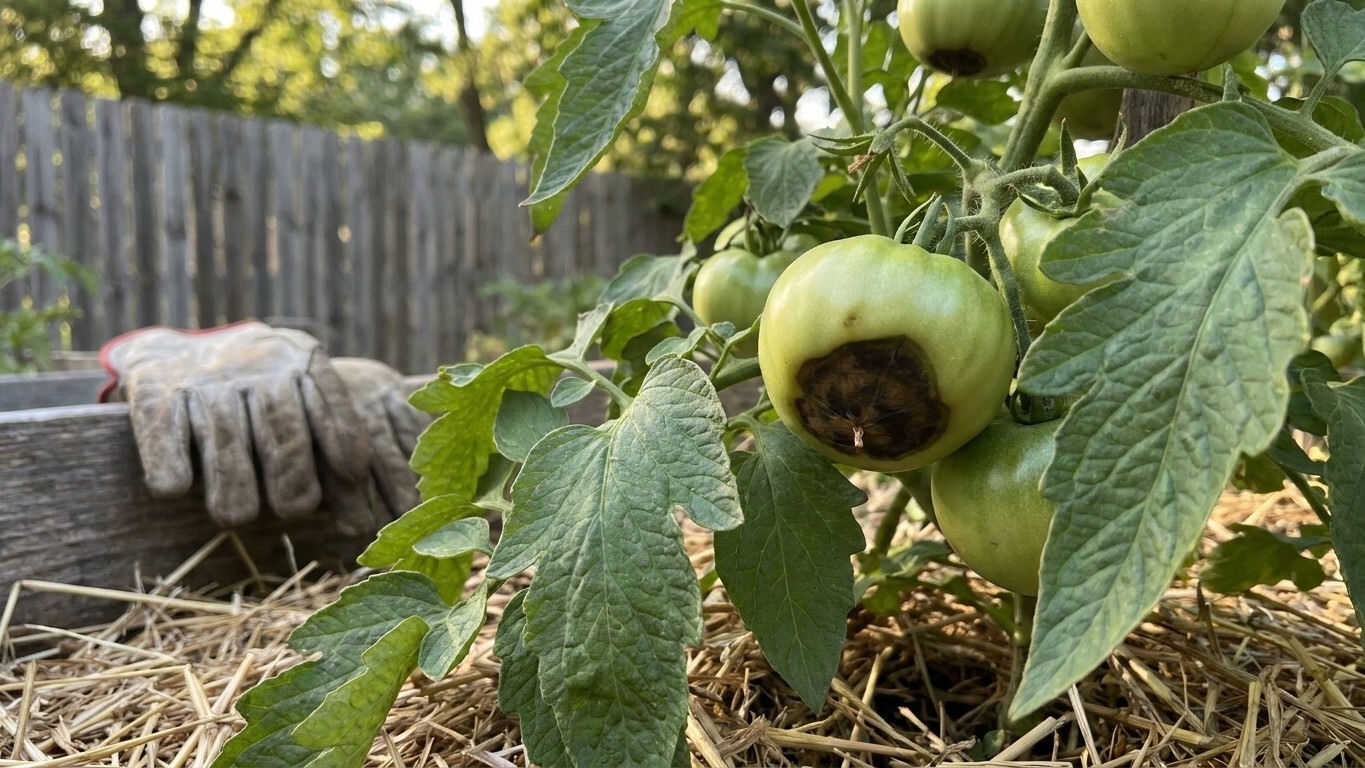

Blossom end rot is a physiological disorder caused by uneven water delivery to the fruit, not a disease and not usually a calcium shortage in the soil. It is not contagious and will not spread to other plants, though it can affect several fruits on the same truss if the water stress continues. The single action that helps most right now: check whether your watering has been irregular over the past week or two, because that is almost always the trigger, and start watering on a consistent schedule rather than adding calcium to the soil.
What you are looking at

Blossom end rot shows up at the blossom end of the fruit, the rounded end opposite the stem, where the flower used to be. It starts as a small water-soaked patch, often when the fruit is still green and about a third to half grown. Within a few days that patch turns tan, then dark brown or black, and the tissue collapses inward to form a sunken, leathery scar that can range from the size of a dime to covering half the fruit.
The texture is the giveaway. A true blossom end rot lesion feels dry, tough and slightly caved in, not soft or mushy, at least until secondary mold or bacteria move into the dead tissue later on. On paste tomatoes like Roma types and large beefsteaks, the lesion often forms flat and wide because the blossom end is broader to begin with.
What it is not
Do not confuse it with anthracnose, a fungal fruit rot that produces small, sunken, water-soaked circles anywhere on a ripe or ripening fruit, often with faint concentric rings inside the spot, not confined to the blossom end. It is also different from cracking, which splits the skin around the stem or in radial lines from the top of the fruit. If you are seeing splits rather than a sunken dead patch, that is a separate watering-related problem covered in Why Tomatoes Crack and Split, and How to Stop It Happening Again. Blossom end rot is confined to the blossom end and does not have rings or a fuzzy growth until it has been sitting for a while.
First fruits of the season are hit hardest, because they are sizing up fast while the root system is still small and less able to buffer swings in soil moisture. If only your earliest tomatoes show it and later trusses come in clean, that is the normal pattern, not a sign something is getting worse.
What actually causes it
The fruit tissue at the blossom end is short of calcium at the exact moment it needs it to build cell walls, and that calcium shortage is almost always a delivery problem, not a supply problem. Calcium moves through the plant in the xylem, carried along by the transpiration stream, the same flow of water pulled up from the roots and out through the leaves. Leaves transpire constantly and pull calcium toward themselves. Fruit barely transpires at all, so it only gets calcium when there is a strong, steady flow of water moving through the whole plant.
Anything that interrupts that flow starves the fruit of calcium even when the soil has plenty. A pot or bed that dries out between waterings, then gets soaked, forces the plant to redirect its limited water to the leaves first and the fruit last. Heavy nitrogen fertilizer, especially in the ammonium form, pushes rapid leafy growth that competes with fruit for the same calcium supply. Root damage from close cultivation, transplant shock, or waterlogged soil that suffocates roots all reduce the plant’s ability to take up and move calcium at all, regardless of how much sits in the ground.
Telling the causes apart
Container-grown plants and those in fast-draining sandy soil are more prone simply because moisture swings happen faster and more often there. If the plant is also showing curled, cupped leaves alongside the fruit symptom, check whether that curling tracks with drought stress rather than a virus or herbicide drift, since the two can look similar at a glance; see Curling Tomato Leaves: Telling Stress Apart From Herbicide Damage and Virus for how to separate them. A true soil calcium deficiency is uncommon and shows up mainly in very sandy, acidic soils with low organic matter, and a soil test through your state extension service is the only reliable way to confirm it rather than guessing from the fruit symptom alone.
What to do now

Pull off any fruit already showing the sunken brown scar. It will not heal, and it will not improve as it ripens, it just sits there as dead tissue while the rest of the fruit grows around it or starts to rot from the inside. Removing it early saves the plant’s energy for fruit that still has a chance.
The plant itself is not sick, so there is nothing to treat on the vine. Your job now is to protect the trusses that have not sized up yet. Get the plant onto a consistent watering routine: soak deeply rather than sprinkling lightly, and aim for the same rough interval each time rather than reacting to whichever day feels driest. A two to three inch layer of mulch over the root zone evens out soil moisture between waterings and is one of the fastest changes you can make mid-season.
Expect improvement within a couple of weeks, since fruit that has not yet started sizing up is the fruit that benefits from steadier calcium delivery. Fruit already past the affected stage when you fix the watering usually comes through clean. If you are also noticing pale or uneven ripening on fruit that escaped blossom end rot, that is more likely a heat effect than a calcium issue, and is covered separately in Tomatoes Not Ripening: What Heat Does, and What to Do About It.
Do not pull the whole plant or assume the season is lost. One rough truss early on, followed by steady watering, commonly gives way to clean fruit for the rest of the harvest.
What does not work
Most of the remedies gardeners reach for first treat the wrong problem, because they assume the soil is short on calcium when the actual bottleneck is getting calcium into the fruit fast enough.
- Crushed eggshells in the planting hole break down far too slowly to supply calcium during the growing season, and by the time they release anything useful the fruit that needed it has already scarred.
- Foliar calcium sprays applied to leaves rarely reach the fruit at all, because calcium moves upward through the xylem toward whatever is transpiring hardest, and fruit barely transpires. Once calcium lands in a leaf it largely stays there.
- Garden lime or gypsum added to soil that already tests adequate for calcium does nothing for this season’s fruit and, since lime also shifts soil pH, adding it without a soil test can create a new problem while failing to solve the old one.
- Calcium chloride sprays marketed specifically for blossom end rot show the same limitation as any foliar spray: they can slightly firm the fruit surface but do not reliably prevent the disorder, because the failure is in delivery, not raw supply.
None of this means calcium is irrelevant. It means the fix has to work on water delivery to the whole plant, not on adding more of a nutrient that is usually already sitting in the soil unused.
Preventing it next time
The single change that matters most is even soil moisture, and everything else is secondary. A drip line or soaker hose on a timer does more to prevent blossom end rot than any product you can buy, because it removes the human tendency to water in feast-or-famine bursts. Mulch heavily around the base of the plant, since bare soil dries and swings in moisture far faster than mulched soil, especially through a hot stretch.
Go easy on nitrogen once fruit starts forming. A plant pushed hard with high-nitrogen fertilizer grows leafy fast and pulls calcium toward that new growth at the fruit’s expense, so switch to a fertilizer with less nitrogen relative to phosphorus and potassium once flowering begins, and check the guidance in How to Grow Tomatoes if you are unsure how your feeding schedule should shift through the season.
Protect the root system. Keep cultivation shallow near the base of established plants, avoid letting the root zone sit waterlogged after heavy rain, and if you are growing in containers, size up rather than crowding roots into a small pot that dries out within hours on a hot day. Large-fruited varieties, including most beefsteaks and paste types, are more prone simply because they demand more calcium per fruit over a longer fill period, so if you have had repeated trouble, choosing a smaller-fruited slicer for a season can reduce how often you see it, even though the underlying fix is still consistent watering.
Common questions
Can I eat tomatoes with blossom end rot if I cut the bad part off?
Yes, if the rest of the fruit is firm and shows no mold or off smell, cutting away the sunken brown section and eating the remainder is fine. Once the lesion has gone soft, watery or fuzzy, secondary rot has set in and the whole fruit should be discarded.
Does it happen on peppers and squash too?
Yes, blossom end rot affects peppers, squash, watermelon and eggplant through the same calcium delivery mechanism, and the same watering fixes apply across all of them.
Will it keep happening for the rest of the season once it starts?
Not necessarily. It often clusters on the first one or two trusses while the root system is still small, then eases off once watering steadies and the plant matures, even without any change on your part.
Should I stop fertilizing altogether if I see it?
No, but switch away from a high-nitrogen feed toward one with more balanced or higher potassium content, since excess nitrogen accelerates leafy growth that competes with fruit for calcium. Keep feeding at a normal rate otherwise.