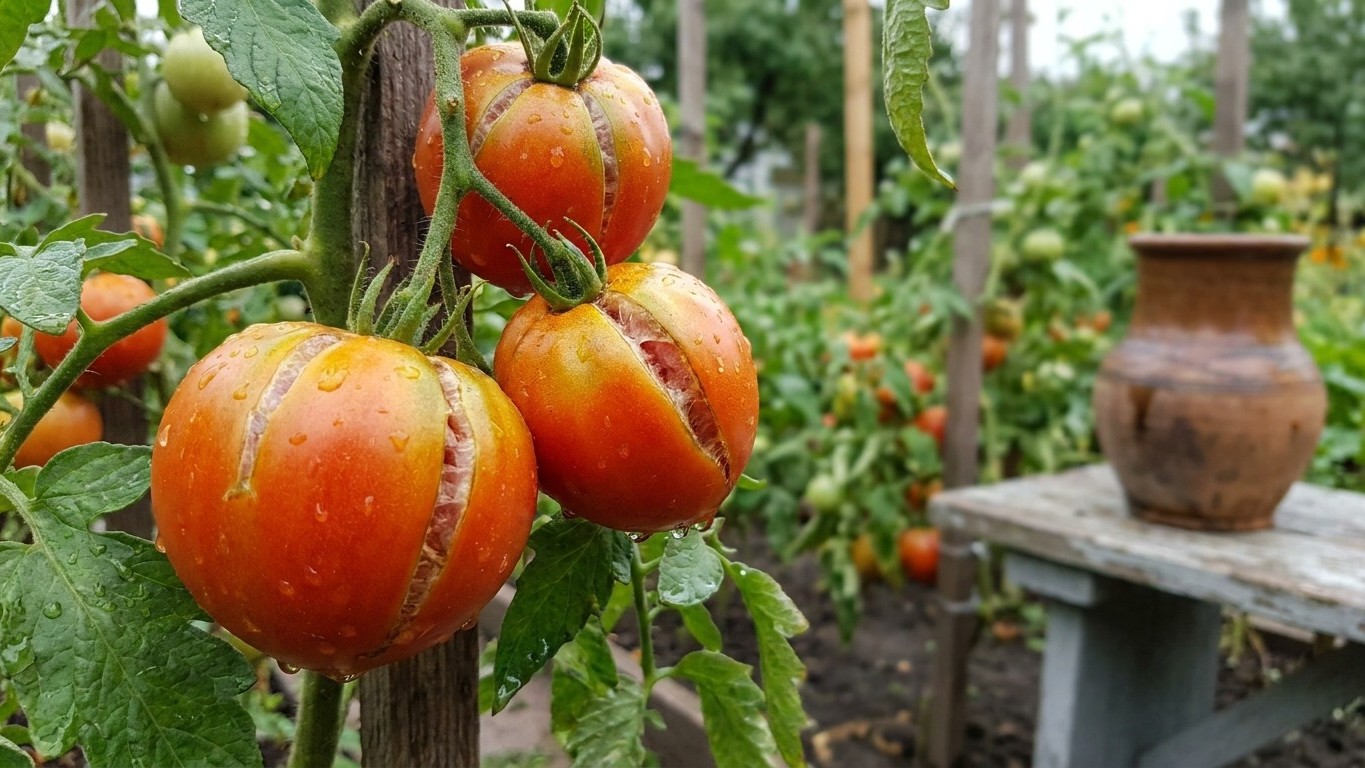

Cracked and split tomatoes happen when the fruit’s flesh swells faster than its skin can stretch, almost always because a dry stretch was followed by a heavy soaking. It looks bad but it rarely threatens the plant itself, just the fruit already on it. Check your watering pattern first: if the soil went bone dry for days and then got a deep watering or a hard rain, that’s your cause.
What you are looking at

There are two distinct patterns, and telling them apart matters less than you’d think, because they share one cause. Radial cracking runs in lines outward from the stem scar at the top of the fruit, like spokes on a wheel. Concentric cracking forms rings around the stem scar, following the shoulders of the fruit. Both usually appear on fruit that is ripening or already turning color, though green fruit can crack too if the swelling is severe enough.
The cracks themselves are shallow at first, sometimes just a hairline split in the skin. Left on the vine, they widen, and the exposed flesh underneath dries, discolors, or draws fruit flies and starts to rot within a day or two in warm weather. That’s the real damage: not the split itself, but what gets in through it.
Don’t confuse this with blossom end rot, which shows up as a flat, sunken, leathery brown-to-black patch on the bottom of the fruit, opposite the stem, not a crack at the top. Don’t confuse it either with catfacing, which is puckered, scarred tissue near the blossom end caused by cool weather during flowering, or with the sunken, target-shaped spots of anthracnose, a fungal disease that shows up on ripe fruit as the season wears on. Cracking is a physical failure of the skin. The others are a nutrient delivery problem, a pollination-stage weather problem, and a disease, respectively, and each needs a different fix.
What actually causes it
The water mechanism
As a tomato ripens, its skin loses elasticity, the same way a balloon gets tighter and less forgiving the longer it’s inflated. If the plant takes up a large volume of water quickly, usually after a dry spell breaks with a heavy watering or a soaking rain, the flesh inside the fruit swells faster than that stiffening skin can expand to match. The skin splits because it has nowhere left to stretch, not because anything is wrong with the fruit’s contents.
This is where the common explanation goes wrong. Cracking gets blamed on too little calcium or too much nitrogen, the same nutrients blamed for blossom end rot, but the mechanism here has nothing to do with nutrient supply. It’s a plumbing problem, not a feeding problem. A tomato plant with perfectly adequate calcium and nitrogen will still crack its fruit if you let it dry to wilting point and then give it a heavy soak.
Sorting out the contributing factors
A few things make cracking worse without being the root cause on their own:
- Heat spikes speed up ripening and make the skin more brittle right when it needs to be most flexible. High heat around ripening is also the main driver behind fruit refusing to color up properly, covered in our piece on why tomatoes stop ripening in heat.
- Variety matters a lot. Large beefsteak types with thin skins crack far more readily than small-fruited or thick-skinned cultivars.
- Overhead watering or irregular rain creates the boom-and-bust soil moisture that triggers the swelling. Drip irrigation and mulch smooth this out.
- Heavy nitrogen feeding pushes rapid, soft growth that is more prone to splitting under moisture swings, even though nitrogen itself isn’t the direct cause.
If you see cracking alongside leaves that are curling or cupping, don’t assume it’s one problem. Inconsistent watering stresses the whole plant, and our guide to telling curling leaves from herbicide damage or virus can help you separate ordinary drought stress from something more serious.
What to do now

Any fruit that has already cracked is not going to heal, and it will not stop widening on its own. Harvest cracked fruit right away, even if it’s still green or just turning, rather than leaving it on the vine hoping it seals over. It won’t. Cut away the split portion and use the rest, or ripen it indoors on a windowsill away from direct sun if it’s still pale. Once you see soft spots, mold, or a sour smell at the crack, that fruit is done and belongs in the compost, not the kitchen.
What you can save is everything still developing behind it. Cracking tends to come in waves tied to weather, so a truss that split during one dry-spell-then-rain cycle doesn’t mean the next truss is doomed if you change the watering pattern now. Get the soil to an evenly moist state and hold it there rather than swinging between parched and saturated.
Check nearby fruit closely even if it looks intact. Hairline cracks are easy to miss, especially on the shoulders where concentric cracking starts, and a fruit that looks fine on Monday can have visible rot at the split by Thursday in warm, humid weather. Pull anything questionable before it attracts fruit flies to the rest of the truss.
If entire trusses are cracking and you’re also seeing poor fruit set higher up the plant, it’s worth ruling out a temperature or pollination problem running alongside the water issue. Our page on tomato plants not setting fruit covers how heat and irregular watering can suppress fruit set at the same time cracking is happening lower down.
What does not work
Gardeners reach for calcium first because cracking looks like it belongs in the same family as blossom end rot. It doesn’t, and the fixes for one don’t touch the other.
- Crushed eggshells worked into the soil release calcium far too slowly to affect fruit already forming, and most garden soils have plenty of calcium already. Adding more doesn’t change how fast the plant can move water into ripening fruit.
- Foliar calcium sprays sit on the leaf surface and barely penetrate to where they’d need to go. Calcium moves through the plant in the transpiration stream, driven by water uptake at the roots, not by what’s sprayed on top.
- Garden lime raises soil pH and can add calcium, but if a soil test hasn’t shown a calcium deficiency, adding lime does nothing for cracking and can push pH too high for the plant to take up other nutrients properly.
The pattern in all three: they treat cracking as a shortage of something, when the actual problem is a rate of water movement the plant can’t buffer on its own. None of these remedies change soil moisture consistency, which is the one variable that actually drives the symptom. Save the eggshells for the compost pile and the calcium spray for a soil test result that actually calls for it.
Preventing it next time
Even soil moisture matters more than anything else
Water on a regular schedule rather than reacting to how dry the surface looks, and aim for a consistent depth of moisture rather than a good soak followed by neglect. This single change fixes cracking more reliably than any other adjustment, because it removes the dry-then-flood swing that causes the skin to fail in the first place. A layer of organic mulch, two to three inches of straw, shredded leaves, or bark, buffers soil moisture between waterings and reduces how sharply it swings during a stretch of hot, dry weather.
Variety choice is your second lever
Some cultivars simply hold up better. Catalogue figures below are counted from transplant and shift by a week or two depending on the season, so treat them as a planning range, not a fixed date.
| Variety | Fruit type | Days to maturity | Crack resistance |
|---|---|---|---|
| ‘Jasper‘ | Red cherry | ~60 | Bred specifically for strong resistance to splitting |
| ‘Mountain Merit’ | Red slicer | ~75 | Bred with improved crack tolerance and disease resistance |
| ‘Iron Lady’ | Red slicer | ~75 | Disease-resistant line with good fruit skin toughness |
| ‘Big Beef‘ | Red beefsteak | ~73 | More crack-tolerant than most large beefsteak types |
Large, thin-skinned heirloom beefsteaks are worth growing for flavor, but expect more cracking from them in a wet season regardless of how well you manage water.
Timing and delivery
Switch from overhead sprinklers to drip irrigation or a soaker hose so water goes to the root zone slowly and evenly instead of arriving in one uneven pulse. Pick fruit at first blush rather than waiting for full vine-ripeness, especially if rain is forecast, since less time on the vine means less exposure to a sudden moisture swing right before harvest. Hold back on heavy nitrogen feeding once fruit starts sizing up. It’s your soil moisture routine that decides most cracking outcomes, and everything else here just narrows the margins further.
Common questions
Can I still eat a tomato that’s cracked?
Yes, if you catch it early. Cut away the split area and any discolored flesh underneath, and eat the rest right away. Once mold, soft rot, or a sour smell shows up at the crack, discard the whole fruit.
Why do only some tomatoes on the plant crack and not others?
Fruit that’s furthest along in ripening has the least flexible skin, so it splits first when a moisture surge hits. Fruit still green or just turning color often survives the same watering event untouched because its skin can still stretch.
Does cracking mean my soil has a calcium problem?
No. Cracking is a water delivery issue, not a nutrient deficiency, and a soil test is more useful for ruling calcium in or out than any symptom you see on the fruit. Save calcium amendments for a case of blossom end rot with a soil test to back it up.
Will a cracked tomato heal itself if I leave it on the vine?
No, the split will not close, and it usually widens as the fruit keeps swelling. Leaving it on the vine only increases the odds of rot or insect damage spreading to fruit nearby, so pick it as soon as you spot it.