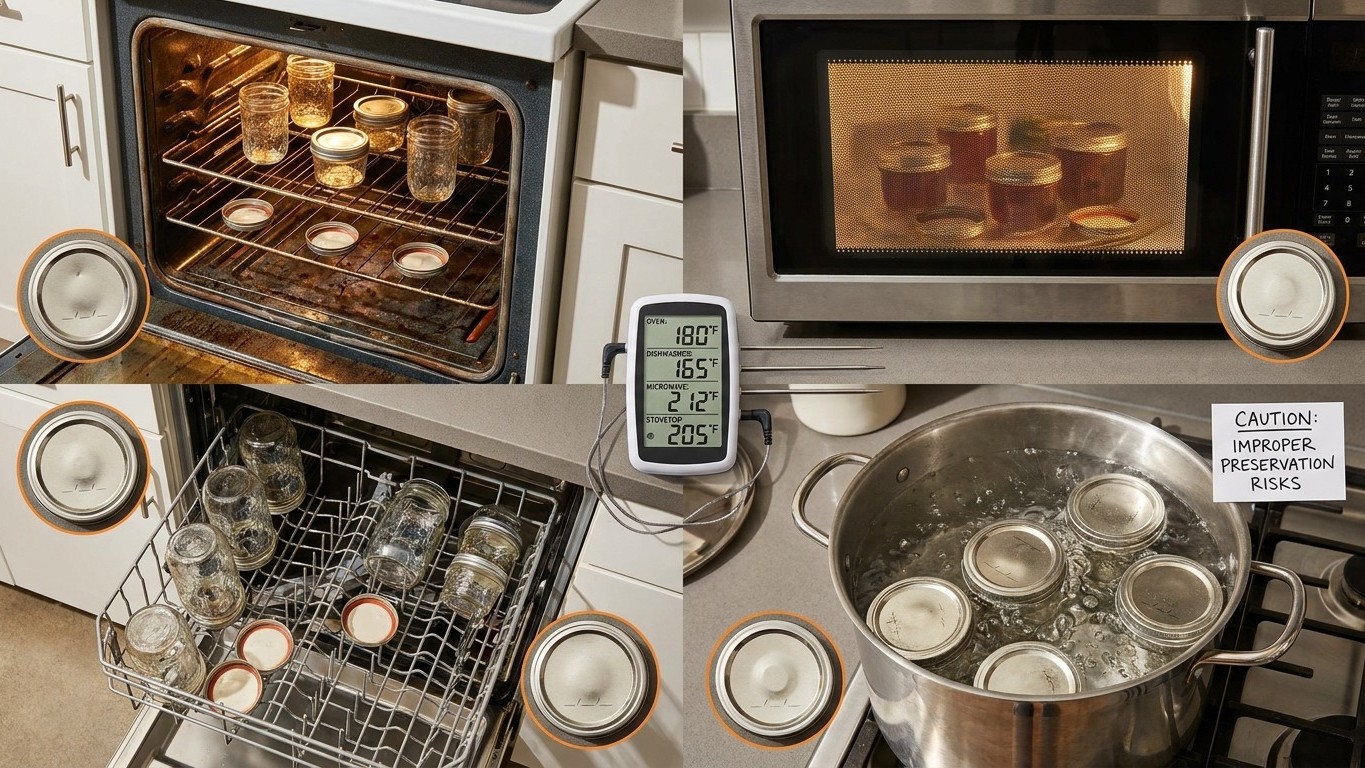

Four canning methods show up in old cookbooks and social media posts every year: oven canning, dishwasher canning, open-kettle canning, and microwave canning. None of them are recommended. The National Center for Home Food Preservation lists all four as methods that fall outside tested processing methods, because none of them can be verified to reach and hold a high enough temperature, for long enough, to make low-acid food safe. The jars might look sealed. That’s the problem.
The short answer

The reason these four methods fail isn’t tradition or squeamishness. It’s temperature verification. The National Center for Home Food Preservation, the research and extension unit housed at the University of Georgia, maintains a page that names exactly which equipment and methods sit outside tested canning science: oven canning, dishwasher canning, open-kettle canning, and microwave canning. Each one fails a different way, but they all fail the same test, which is whether anyone can prove the food inside the jar reached a temperature hot enough to destroy the organisms that matter.
Oven canning heats jars with dry air instead of water or steam, and dry air transfers heat unevenly and slowly compared to the boiling water or pressurized steam a tested canner uses. Jars can also build pressure with nowhere for it to go, which has caused jars to shatter inside the oven. Dishwasher canning runs at wash-and-rinse temperatures designed to clean plates, nowhere close to what a low-acid vegetable needs, and a dishwasher has no way to build the pressure that low-acid food requires. Open-kettle canning cooks food in an open pot, then pours it into jars and seals them using only the residual heat of the food itself, with no processing step afterward, no verified kill step, and no way to drive trapped air out of the jar. Microwave canning heats unevenly by nature. A jar at the back of the turntable and a jar at the front don’t receive the same dose of heat, and there’s no tested way to standardize that.
The pH line that decides which foods even need this level of scrutiny sits at 4.6. Foods above that number are classified low-acid and require a pressure canner. Foods at or below it are classified acid and can go through a boiling-water canner. None of the four rejected methods can reliably deliver either standard, which is why the National Center for Home Food Preservation flags them regardless of what food a person is trying to preserve. A home cook working from a jam recipe and a home cook working from a green bean recipe both run into the same wall if they try to use one of these methods, because the equipment itself, not the food, is what’s disqualified.
What actually decides it
Every canning decision traces back to one number: pH 4.6. Foods measuring above 4.6 are low-acid and need a pressure canner, which reaches 240 to 250 F. Foods at or below 4.6 are acid and can be processed in a boiling-water canner, which tops out at 212 F at sea level. Red meats, seafood, poultry, milk, and nearly all fresh vegetables fall into the low-acid category. Fruits, pickles, sauerkraut, jams, jellies, marmalades, and fruit butters fall into the acid category. A few foods sit right on the border: some tomatoes and figs now measure slightly above 4.6, which is why both require acidification before they can be safely processed as acid foods.
That number matters because of one organism: Clostridium botulinum. It needs three conditions present at the same time to produce its toxin, and a sealed jar of unprocessed low-acid vegetables happens to supply all three without anyone intending it to.
- A moist, low-acid food. This is removed by keeping the food’s pH at or below 4.6, either naturally or through acidification, which starves the organism of the environment it needs.
- A temperature between 40 and 120 F. This is removed by processing the sealed jar at a temperature above that range (240 to 250 F in a pressure canner for low-acid food) long enough to destroy spores, then storing sealed jars at room temperature rather than in that danger zone.
- Less than 2 percent oxygen. This condition is actually created by the canning process itself, since a properly sealed jar is airless inside. It’s removed as a danger only when the first two conditions have already been eliminated by acidity or heat.
None of the four rejected methods can reliably remove the second condition for low-acid food, because none of them can be verified to hold 240 to 250 F throughout the jar for the necessary time. That’s the entire argument against them in one sentence: they can create the sealed, oxygen-free environment just fine, they just can’t prove they killed what’s living inside it.
How to do it
A tested canning process always follows the same order, regardless of whether the food is acid or low-acid. Skipping a step, or reordering one, is usually where trouble starts.
- Identify whether the food is acid or low-acid, using its pH, and choose a boiling-water canner for acid food or a pressure canner for low-acid food.
- Find a tested recipe for that specific food from the National Center for Home Food Preservation rather than adapting one from memory or an untested source.
- Wash, peel, cut, or otherwise prepare the food exactly as the tested recipe specifies.
- Pack the food into clean jars, leaving the headspace called for in that recipe.
- Remove air bubbles from the jar and adjust the headspace if the recipe requires it.
- Wipe the jar rim clean before applying the lid, so nothing interferes with the seal.
- Apply the lid and band according to the manufacturer’s directions for that lid type.
- Load the jars into the canner type the recipe specifies and process for the time and, if applicable, pressure that recipe states.
- Turn off the heat and allow the canner to depressurize or cool as the recipe directs before removing jars.
- Let jars cool undisturbed, then check that each lid has sealed before storing.
- Label each jar with the food and date, then store sealed jars in a cool, dark place.
Every specific number in that sequence, the headspace, the process time, the pressure, comes from the tested recipe itself, not from this list. A recipe was tested as a whole, and changing one number without retesting the rest defeats the purpose of testing at all.
What goes wrong
- A jar already went through oven, dishwasher, microwave, or open-kettle canning. Discard the food. Don’t taste it first to check. Botulinum toxin has no taste and no smell, so tasting tells you nothing except whether you’ve now been exposed.
- The lid didn’t seal after processing. Refrigerate the jar and use the food within a few days, or reprocess it with a fresh lid within the timeframe the original recipe allows, or freeze it instead.
- Liquid siphoned out during processing, leaving the jar low. If the lid sealed properly, the jar is still safe to store; low liquid alone isn’t a safety failure, just a texture one for the top layer of food.
- The liquid inside looks cloudy or has floating particles. This can be starch release from the food itself, but if the jar didn’t seal, smells off, or the food looks slimy, discard it rather than trying to judge it by sight or smell alone.
- A jar broke inside the canner during processing. This usually points to thermal shock from uneven heating, which is exactly the failure mode that makes oven and microwave canning unreliable in the first place. Discard the contents and inspect remaining jars for cracks before reloading.
Where the exact times come from
A tested processing time belongs to a tested recipe, tested as a complete set of variables together: the specific food, its density, its jar size, its acidity, and the canner type. Pulling one number out of that set and applying it somewhere else is not a shortcut, it’s an untested combination.
For an exact time and pressure, go to the National Center for Home Food Preservation’s page for the specific food being canned. That page will list the process built for that food, not an approximation.
The reason this matters more here than almost anywhere else in cooking is simple: botulinum toxin has no taste and no smell. A jar that received too short a process time, or the wrong canner, can look, smell, and taste completely normal right up until it isn’t. There’s no sensory check that substitutes for a tested time.
Common questions
Can I use a boiling-water canner for low-acid vegetables if I process them longer?
No. Boiling-water canners top out at 212 F at sea level, well below the 240 to 250 F a pressure canner reaches. Extending the time in a boiling-water canner doesn’t raise its ceiling temperature, so it can’t compensate the way added pressure can.
Is open-kettle canning safe for jams and jellies since they’re acidic?
Acid foods are more forgiving, but open-kettle canning still skips a verified processing step after sealing, which is why the National Center for Home Food Preservation lists it among methods not recommended regardless of the food’s acidity.
Does living at a higher elevation change any of this?
Yes. Water boils at a lower temperature as elevation rises, and a lower boiling temperature kills less. The USDA Complete Guide to Home Canning addresses this by increasing either the process time or the canner pressure to compensate, depending on the method used.
What should I do with equipment marketed as an electric or countertop canner?
Check whether the National Center for Home Food Preservation’s list of not-recommended methods and equipment includes it before using it for low-acid or acid foods, since that list is the reference point for what’s been tested and what hasn’t.