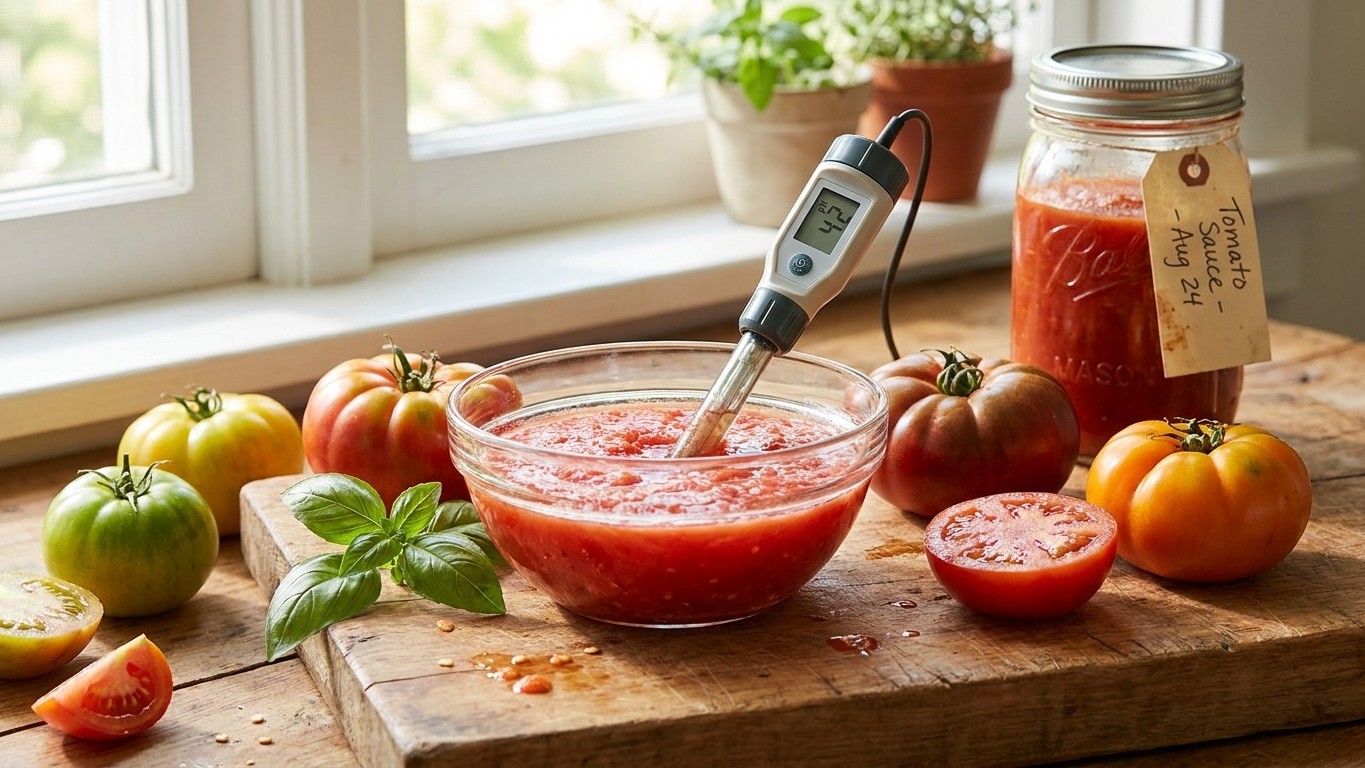

Tomatoes sit right on the line that divides safe canning methods. The National Center for Home Food Preservation puts that line at pH 4.6: foods above it need pressure canning, foods at or below it can go in a boiling-water bath. Most tomatoes test acid enough on their own, but some modern varieties measure slightly above 4.6, which means an unacidified jar can end up in low-acid territory without anyone noticing until it’s too late.
The short answer

Tomatoes must be acidified before canning because some of them no longer reliably fall below pH 4.6, and a boiling-water canner only kills what a truly acid food requires it to kill. The National Center for Home Food Preservation, based at the University of Georgia, has documented that tomato pH varies by variety, growing conditions, and ripeness, enough that a batch grown one summer can test differently than the same variety grown the next. That variability is the entire reason home canning instructions call for added acid in every jar of tomatoes, no exceptions made for taste or tradition.
The confusion makes sense. Tomatoes taste sharp, they’re classified as fruit in the produce aisle, and generations of home canners processed them in a water bath without a second thought. But taste is not a measurement. A tomato can taste tart and still sit at a pH the National Center for Home Food Preservation would classify as too close to the danger line to process safely without added acid. There’s no way to taste your way to a safe answer here, and that’s not a small caveat.
Why this isn’t true of other fruit
Apples, peaches, and berries don’t carry this warning because their pH sits comfortably below 4.6 across virtually every variety and growing condition. Tomatoes and figs are the exceptions the National Center for Home Food Preservation flags specifically, which is why both are treated differently from the rest of the produce aisle. Adding a measured amount of acid, typically bottled lemon juice or citric acid in a tested recipe, pushes every jar of tomatoes safely below that threshold regardless of what the raw fruit measured before it went in the pot.
What actually decides it
The number that governs all of this is pH 4.6. Foods that measure above it are classified as low-acid and require a pressure canner, which reaches temperatures of 240 to 250 F, hot enough to destroy bacterial spores that survive boiling. Foods at or below 4.6 are classified as acid and can be safely processed in a boiling-water canner, which tops out at 212 F at sea level. That 212 F ceiling is the reason the classification matters so much: it’s simply not hot enough to kill what a low-acid food might harbor.
What a low-acid, sealed jar might harbor is Clostridium botulinum, a bacterium that produces one of the most potent toxins known. It needs three conditions together to grow and produce toxin, and a jar of unprocessed vegetables sealed on a shelf supplies all three without anyone intending it to.
- A moist, low-acid food. Acidifying the tomatoes below pH 4.6 removes this condition entirely, because the bacterium can’t grow in an environment that acidic.
- A temperature between 40 and 120 F. Refrigeration or freezing removes this condition, but a shelf-stored jar of canned goods sits inside this range indefinitely.
- Less than 2 percent oxygen. A properly sealed canning jar creates exactly this kind of oxygen-free environment, which is otherwise the entire goal of canning, so this condition can’t be removed by good technique alone.
Notice that two of the three conditions, temperature and low oxygen, are unavoidable in a sealed jar sitting on a pantry shelf. That leaves acidity as the only lever a home canner actually controls. Once you see it that way, the whole practice of acidifying tomatoes stops looking like an old-fashioned ritual and starts looking like the one variable standing between a shelf-stable jar and a genuine hazard. A reader who understands these three conditions can classify almost any food they’ve never canned before: ask whether it’s moist, whether it’ll sit at room temperature, and whether the jar will seal, and then ask what its pH is. If the answer is above 4.6, it needs a pressure canner or it needs acid added to bring it under that line.
How to do it
Acidifying tomatoes follows a specific order, and skipping or reordering steps is where home canners get into trouble. Each step matters on its own; none of them substitutes for another.
- Select a tested tomato canning recipe from the National Center for Home Food Preservation or the USDA Complete Guide to Home Canning, since the acid amount is calculated for that specific product, whether it’s whole tomatoes, crushed tomatoes, or a sauce.
- Wash, core, and prepare the tomatoes according to that recipe, removing any bruised or damaged flesh.
- Add the specified acid, bottled lemon juice or citric acid, directly to each jar before adding the tomatoes. Bottled juice is used rather than fresh because its acidity is standardized; fresh lemon juice varies too much from fruit to fruit to trust for this purpose.
- Pack the tomatoes into the jar on top of the acid, following the pack style (raw or hot pack) called for in the recipe.
- Add any additional ingredients, such as salt for flavor, that the recipe permits, keeping in mind that these do not affect the acidity calculation.
- Wipe the jar rim, apply the lid and band, and place the jar in the canner.
- Process the jars for the time given in the recipe, adjusted for your elevation. That time belongs to the specific tested recipe you selected in step one.
- Remove, cool, and check the seals before storing, since an unsealed jar needs refrigeration and prompt use rather than pantry storage.
Water boils at a lower temperature as elevation rises, and that lower boiling temperature kills less. The USDA Complete Guide to Home Canning addresses this directly: increasing the process time, or the pressure in a pressure canner, compensates for the altitude. That adjustment is built into every tested recipe’s elevation chart, which is one more reason step one, choosing a tested recipe rather than improvising, carries so much weight.
What goes wrong
Most tomato canning problems trace back to one of a handful of predictable mistakes. Here’s what to look for, and what to do about each one.
- Acid was skipped or estimated by eye. If you’ve already processed and sealed jars without adding the measured acid called for in a tested recipe, don’t taste-test them or store them on the shelf. Reprocessing isn’t a safe fix for an already-sealed jar; treat the batch as unsafe for shelf storage and consult the National Center for Home Food Preservation’s guidance on reprocessing or refrigerating instead.
- Fresh lemon juice was used instead of bottled. Fresh juice varies in acidity fruit to fruit, so a jar made this way can’t be trusted even if it tasted fine going in. Treat it the same as a missing-acid batch: don’t rely on shelf storage.
- A boiling-water canner was used for a low-acid add-in. Recipes that mix tomatoes with low-acid ingredients like peppers, onions in large quantity, or meat often require a pressure canner instead, because those additions can shift the overall product’s pH or density enough to change the required method. Always match the canner to what the specific tested recipe specifies, not to what tomatoes alone would need.
- A jar didn’t seal. This isn’t an acidity problem, but it does nullify the low-oxygen condition that would let bacteria grow, so a jar that failed to seal should go in the refrigerator and be used within a few days, or be reprocessed with a new lid within 24 hours per tested guidance.
- Elevation wasn’t accounted for. If jars were processed at the sea-level time despite being canned well above sea level, the lower boiling temperature at altitude may not have delivered enough heat. These jars should not be considered shelf-stable; refrigerate and use promptly, or discard if there’s any doubt about how long they’ve sat on the shelf.
Where the exact times come from
A tested time belongs to a tested recipe, matched to a specific product, jar size, and pack style, all evaluated together by food scientists. Pulling a number from a different recipe, an old family notebook, or a general rule of thumb breaks that match, and there’s no visible sign when it fails. Clostridium botulinum toxin has no taste and no smell, so a jar that wasn’t processed correctly can look, smell, and taste completely normal right up until it isn’t safe to eat.
For the tomato product you’re actually making, whether that’s whole tomatoes, juice, sauce, or salsa, go to the National Center for Home Food Preservation’s tomato canning pages at nchfp.uga.edu and use the time, pressure, and acid amount listed there. It’s the same standard this whole silo is built around, and it’s the one source with tested numbers for every tomato format home canners actually use.
Common questions
Can I skip acidifying if I only grow “acid” heirloom tomato varieties?
No. The National Center for Home Food Preservation’s guidance applies to all tomatoes precisely because pH varies by growing conditions and ripeness, not just variety name. A variety that tested acid one season isn’t guaranteed to test the same the next, so every tomato canning recipe calls for added acid regardless of what’s growing in your garden.
Does cooking the tomatoes first lower their pH enough to skip added acid?
Cooking doesn’t reliably change a tomato’s pH. Heat kills organisms and inactivates enzymes, but it doesn’t make a food more acidic, so a cooked sauce still needs the same measured acid a raw pack would need.
What’s the difference between citric acid and bottled lemon juice for this purpose?
Both are acceptable acidifying agents in a tested recipe; the recipe will specify the amount for whichever one you choose. What matters is using the standardized, bottled or measured form rather than fresh lemon juice, since fresh juice’s acidity isn’t consistent enough to guarantee the jar drops below pH 4.6.
If a jar of home-canned tomatoes looks and smells fine, is it safe to eat?
Appearance and smell tell you nothing about botulinum toxin, which has neither. Safety depends on whether the jar was acidified and processed according to a tested recipe and time, not on how the finished jar looks when you open it.