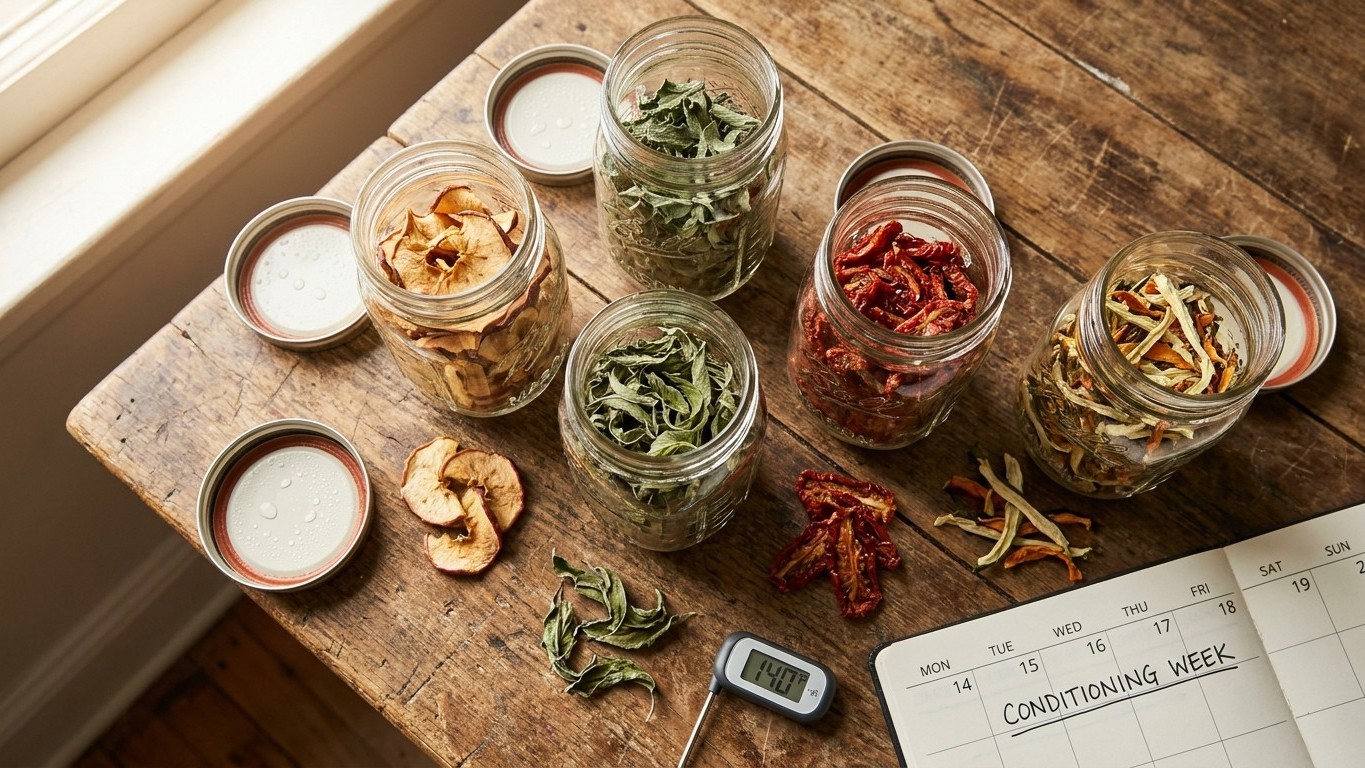

Conditioning means letting fully dried food rest in loosely closed jars for about a week before it goes into long-term storage, and it’s the step most home dryers skip because the food already looks and feels done. The National Center for Home Food Preservation includes conditioning as a standard part of the drying process because a food dehydrator runs at 140 F, a temperature that removes water unevenly across a batch, not because the food needs more time to dry further.
The short answer

Conditioning exists because a batch of dried food is never uniformly dry, even when every piece has spent the same stretch of time in the same dehydrator at 140 F. Thinner slices near the edge of a tray lose water faster than thicker chunks stacked near the center. Pieces closer to the fan or heating element see different airflow than pieces tucked behind them. The result is a jar of food that reads “done” by touch but actually contains a range of moisture levels, some low enough to be shelf-stable and some just high enough to feed mold or bacteria over the following weeks.
The National Center for Home Food Preservation, based at the University of Georgia, addresses this by recommending that dried food be packed loosely into jars right after drying and cooling, then left to sit for roughly a week, with the jars shaken or the food redistributed daily. That week does something a dehydrator can’t: it lets moisture migrate. Wetter pieces slowly give up water to drier ones sitting next to them in the same jar, and the whole batch drifts toward a more even moisture level. If any piece was actually too wet to begin with, that week is also when it shows itself, usually as beads of condensation on the inside of the glass.
Skip that week and you lose the warning system. A dehydrator can’t sterilize food. Its 140 F setting pulls water out of the food’s tissue, and it’s the absence of water, not the heat itself, that stops microorganisms from growing. Dried food is not sterile food. That distinction matters here because it means the only real defense against a stray damp piece is catching it before it’s sealed away in a jar for months, and conditioning is the mechanism built for exactly that catch. A dehydrator setting alone doesn’t guarantee even results, which is why the resting week functions as a diagnostic step, not a formality.
What actually decides it
Three separate mechanisms determine whether a batch of dried food actually needs, and benefits from, conditioning, and understanding them lets you reason about any dried food, not just the one in front of you.
Moisture is never uniform to begin with
Every piece of food loses water at its own rate depending on its size, its density, and its sugar or fat content, which all change how tightly the food’s tissue holds onto its remaining moisture. A dehydrator running at a steady 140 F applies the same air temperature to every tray, but it can’t equalize a thick piece against a thin one, or a piece near the airflow path against one shielded by trays above it. That built-in unevenness is the entire reason conditioning has a purpose.
Airflow design changes how uneven a batch gets
Horizontal-flow dehydrators push air sideways across each tray, which keeps every tray exposed to roughly the same heat and keeps different foods’ flavors from drifting into each other, and it also keeps dripping juices away from the heating element. Vertical-flow dehydrators, where air moves up through a stack of trays, do none of those three things. Heat and moisture get carried from the bottom trays toward the top ones, so a batch dried in a vertical-flow unit is more likely to come out with real differences in moisture from top tray to bottom tray. That’s not a flaw you can dry your way around. It’s a structural feature of the appliance, and it’s exactly why the conditioning week matters more, not less, for anyone using that kind of unit.
Drying removes water, it does not sterilize
This is the mechanism underneath everything else. A dehydrator’s job is to strip water out of food’s tissue until microorganisms can’t function without it. It’s a physical drying process, not a heat-kill process the way canning is. That means a piece of food that didn’t quite finish drying isn’t just “a little softer.” It’s a piece that still has enough available moisture for mold or bacteria to use, sitting inside a sealed jar with plenty of company. Any food you dry, whatever it is, carries that same underlying rule: dry enough and it’s stable, not dry enough and it isn’t, and no amount of storage time turns the second case into the first.
How to do it
- Let the dried food cool completely before handling it, since warm food releases condensation inside a sealed container.
- Pack the cooled food loosely into wide-mouth glass jars, filling them only about two-thirds to three-quarters full so the pieces can move.
- Close the jars and set them somewhere out of direct sunlight for the conditioning period.
- Shake or turn each jar once a day so pieces near the glass trade places with pieces in the middle.
- Check the inside of the jar each day for condensation or beads of moisture on the glass.
- If any jar shows moisture, return that batch to the dehydrator for further drying rather than risking it.
- Once a jar shows no condensation through the full conditioning period, move that food into its final storage containers.
What goes wrong
- Packing jars completely full during conditioning. A tightly packed jar doesn’t let pieces move against each other, so moisture can’t migrate and wet spots stay wet. Fill jars loosely enough that the food can shift when you shake them.
- Sealing dried food straight into long-term storage without conditioning at all. This is the skipped week the title refers to, and it removes the only chance to catch uneven drying before the food is out of sight for months. Always give a fresh batch its resting period first.
- Ignoring condensation because “it’s just a little.” Any visible moisture on the inside of the glass means a piece in that jar is wetter than the rest, and there is no safe amount of extra moisture in a sealed container of dried food. Return the whole batch to the dehydrator rather than picking out one piece.
- Assuming a vertical-flow dehydrator dries every tray the same way. Because vertical-flow units carry heat and moisture upward through the stack, top and bottom trays can finish at different moisture levels even with identical food and identical run times. Rotate trays during drying and treat the conditioning week as non-negotiable with this type of appliance.
- Storing jars somewhere warm or humid during conditioning. Heat and ambient humidity work against the moisture migration conditioning depends on, and can mask condensation that would otherwise be visible on cooler glass. Keep jars somewhere at normal room conditions, out of direct sun.
- Treating “dry to the touch” as proof the food is finished. Since a dehydrator removes water rather than sterilizing food, the surface can feel dry while the interior still holds enough moisture to spoil. Conditioning, with its daily check for condensation, is the step that catches what touch alone misses.
Where the exact figures come from
The exact drying time, final moisture target, and storage duration depend on the food. Those figures differ by food, by how it’s cut, and by the dehydrator itself, and an untested figure borrowed from a different food or a different source can leave a batch under-dried without any visible sign of it, since dried food carries no smell or taste warning when it’s unsafe. For the exact drying time, temperature guidance, and storage recommendation for the specific food you’re drying, use the National Center for Home Food Preservation’s published guidance at the University of Georgia. Don’t substitute a figure remembered from another food or another recipe.
Common questions
Does every dried food need conditioning, or just some?
Conditioning addresses uneven moisture, which is a byproduct of how drying works in any dehydrator, so it applies broadly rather than to a narrow list of foods. The mechanism, uneven moisture loss across pieces and across trays, exists whenever food is dried in batches.
What if I only dried a small batch in one jar?
Even a single jar can hold pieces that finished drying at different rates depending on their size or their position on the tray, so a small batch still benefits from the daily shake-and-check routine before it’s stored long term.
Can I speed up conditioning by leaving jars in a warm spot?
Warmth works against the process here rather than for it. Moisture migration and the ability to see condensation both depend on jars sitting at normal room conditions, and warm storage can also mask the very moisture beads you’re checking for each day.
Is a horizontal-flow or vertical-flow dehydrator better for avoiding this problem?
Horizontal-flow units expose every tray to similar airflow and heat, which produces a more even batch to begin with. Vertical-flow units carry heat and moisture upward through the stack, so trays finish unevenly, which makes the conditioning week and daily tray rotation during drying more important with that design, not less.