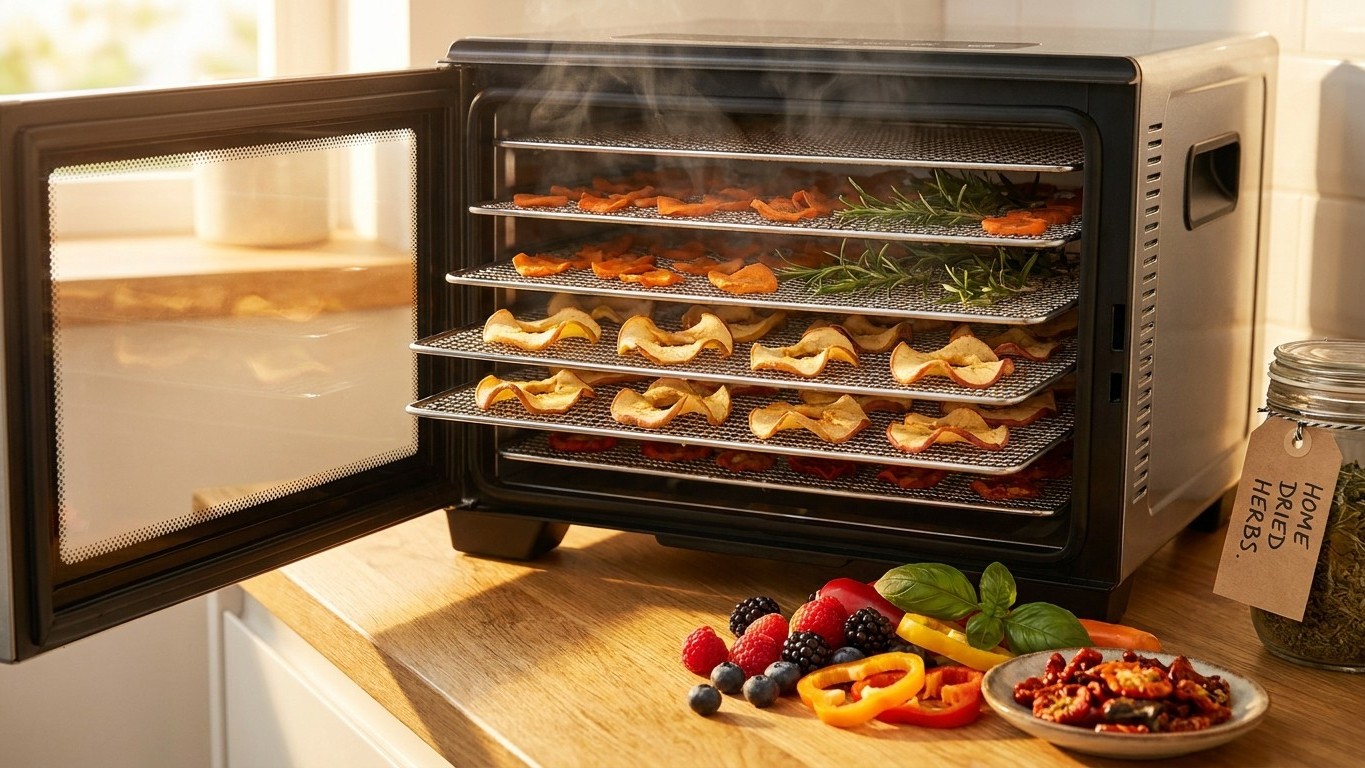

Drying preserves food by pulling out the water that bacteria, yeast, and mold need to grow. That is the entire mechanism: no water, no growth. What it does not do is heat food hot enough to kill the organisms already present, which is why the National Center for Home Food Preservation (University of Georgia) treats dried food as a preserved food, not a sterile one, and why a dehydrator’s own operating point, 140°F, is a drying temperature, not a canning temperature.
The short answer

A food dehydrator runs at 140°F, according to the National Center for Home Food Preservation. That figure tells you almost everything about what drying can and cannot claim to do. At 140°F, water evaporates steadily from thin, exposed surfaces of food. Given enough time and enough airflow, that steady evaporation drops the moisture level low enough that bacteria, yeast, and mold can no longer multiply. The food becomes shelf-stable in the sense that spoilage organisms stop reproducing. That is the whole preservation mechanism, and it works.
But 140°F is nowhere near a temperature that reliably destroys spores or toxins already present in the food before drying started. Canning relies on sustained high heat, often well above boiling in a pressure canner, specifically to knock down organisms like Clostridium botulinum. Drying was never built to do that job, and the National Center for Home Food Preservation does not present it as doing that job. Dried food carries a lower microbial load in the sense that growth has stopped, but it is not the same as food that has been heat-processed to destruction of pathogens.
What “preserved” actually means here
Preservation by drying is really preservation by starvation. Microorganisms need liquid water to move nutrients across their cell membranes and to multiply. Pull that water out of reach, whether it is bound in the tissue of a sliced apple or free-floating in ground meat, and those organisms go dormant or die off slowly over time. They do not get cooked to death in an instant the way a pressure canner is designed to achieve. That distinction is the reason dried food still needs correct handling before drying, sensible packaging after drying, and storage that keeps moisture from creeping back in. The dryness is doing the preserving. The heat is just the tool that removes the water.
What actually decides it
Two separate mechanisms are at work whenever you dry food, and confusing them is where most kitchen mistakes start.
Water removal, not heat kill
The first mechanism is evaporation. Warm, moving air passes over a thin piece of food and carries away moisture from its surface. As the surface dries, water migrates up from the interior to replace it, and the cycle repeats until the whole piece reaches a low enough moisture level that microbes can no longer function. This is a physical process, governed by surface area, airflow, and humidity, not by reaching some magic kill temperature. A sliced root vegetable follows the same logic: more exposed surface and steadier airflow removes water faster, regardless of what the food actually is.
Airflow pattern inside the machine
The second mechanism is how air actually moves through the dehydrator, and this is where equipment design changes outcomes even at the same 140°F setting. Horizontal-flow dehydrators push air sideways across each tray, which keeps flavors from mixing between trays, heats every tray at roughly the same rate, and keeps dripping juices away from the heating element at the bottom. Vertical-flow designs, where air moves straight up through stacked trays, do none of those three things. Juices from an upper tray can drip onto lower trays or onto the heating element itself, flavors bleed together, and trays closer to the heat source dry faster than trays farther away. None of that changes the water-removal mechanism itself, but it changes how evenly and how safely that mechanism plays out in a real kitchen.
Put those two mechanisms together and you have the reasoning tool: any food dries by losing water to moving warm air, and any dehydrator’s airflow design decides how evenly and cleanly that water loss happens across every tray.
How to do it
- Wash the food and trim away any damaged or bruised sections before cutting.
- Cut the food into uniform pieces or slices so that every piece loses water at roughly the same rate.
- Follow the pretreatment step specified for that particular food, since some foods call for a step before drying and others do not.
- Arrange the pieces on the dehydrator trays in a single layer without overlapping, so warm air can reach every surface.
- Load the trays into a horizontal-flow dehydrator where possible, since that design keeps every tray heated evenly and keeps juices off the heating element.
- Set the dehydrator to run at 140°F, the operating temperature identified by the National Center for Home Food Preservation.
- Check the food’s texture against the doneness description given for that specific food, rather than relying on a fixed clock.
- Cool the dried food completely before packaging it, since warm food sealed into a container traps moisture that undoes the drying.
- Store the cooled, dried food in a container that keeps humidity and light out.
What goes wrong
- Using a vertical-flow dehydrator and expecting even results: juices from upper trays can drip onto the heating element and lower trays, and heat reaches trays unevenly. Switch to a horizontal-flow design when one is available, or rotate and monitor trays closely if it is not.
- Overlapping or crowding pieces on the tray: stacked or touching pieces block airflow to the surfaces underneath, so those spots stay damp while the exposed edges look done. Spread pieces in a single layer with space between them.
- Treating “dried” as the same thing as “sterile”: removing water stops microorganisms from multiplying, but it does not destroy spores or toxins that were already present. Follow the pretreatment and handling steps specified for that food rather than assuming drying alone covers every risk.
- Guessing at a drying temperature or time instead of checking the food’s own instructions: the mechanism (water loss) is the same for every food, but the specific temperature and duration a recipe calls for depend on that food’s thickness, density, and composition. Look up the figure for that exact food rather than borrowing one from a different food.
- Packaging food while it is still warm: warmth inside a sealed container creates condensation, which reintroduces the moisture drying just removed. Let dried food cool fully on the tray before it goes into storage.
Where the exact figures come from
The mechanism behind drying rests on one verified operating figure for a food dehydrator, 140°F. It does not publish drying times, temperatures for specific foods, or storage durations, because those figures change with the food’s thickness, moisture content, and composition. Guessing at a time or temperature for a food you are drying is not a safe shortcut: an undercooked assumption about dryness can leave enough moisture behind for spoilage organisms to restart, and with some foods, that risk extends to toxins that have no taste or smell to warn you. For the exact drying instructions for a specific food, consult the National Center for Home Food Preservation (University of Georgia) recipe for that food before you start.
Common questions
Does drying kill bacteria already in the food?
No. Drying removes the water those organisms need to multiply, but it does not heat the food to a temperature that destroys bacteria or spores already present. That is a separate job handled by processes like pressure canning, not by dehydration.
Why does a horizontal-flow dehydrator matter if the temperature is the same?
Temperature is only one part of the equation. A horizontal-flow design moves air sideways across each tray so every tray heats evenly, keeps flavors from different foods from mixing, and keeps dripping juices away from the heating element. A vertical-flow design does none of those three things, even set to the identical temperature.
Is dried food safe to store indefinitely once it is dry?
Dried food is shelf-stable in the sense that growth of spoilage organisms stops once moisture drops low enough, but it is not sterile and it is not immune to reabsorbing moisture from the air. Proper cooling before packaging and a container that keeps out humidity and light both matter for how long that dryness holds up.
Can I use the same drying time for a different food than the one a recipe describes?
No. Drying time depends on that food’s thickness, density, and moisture content, so a time that works for one food will not reliably apply to another. Check the specific instructions for the food you are drying rather than reusing a figure from an unrelated recipe.