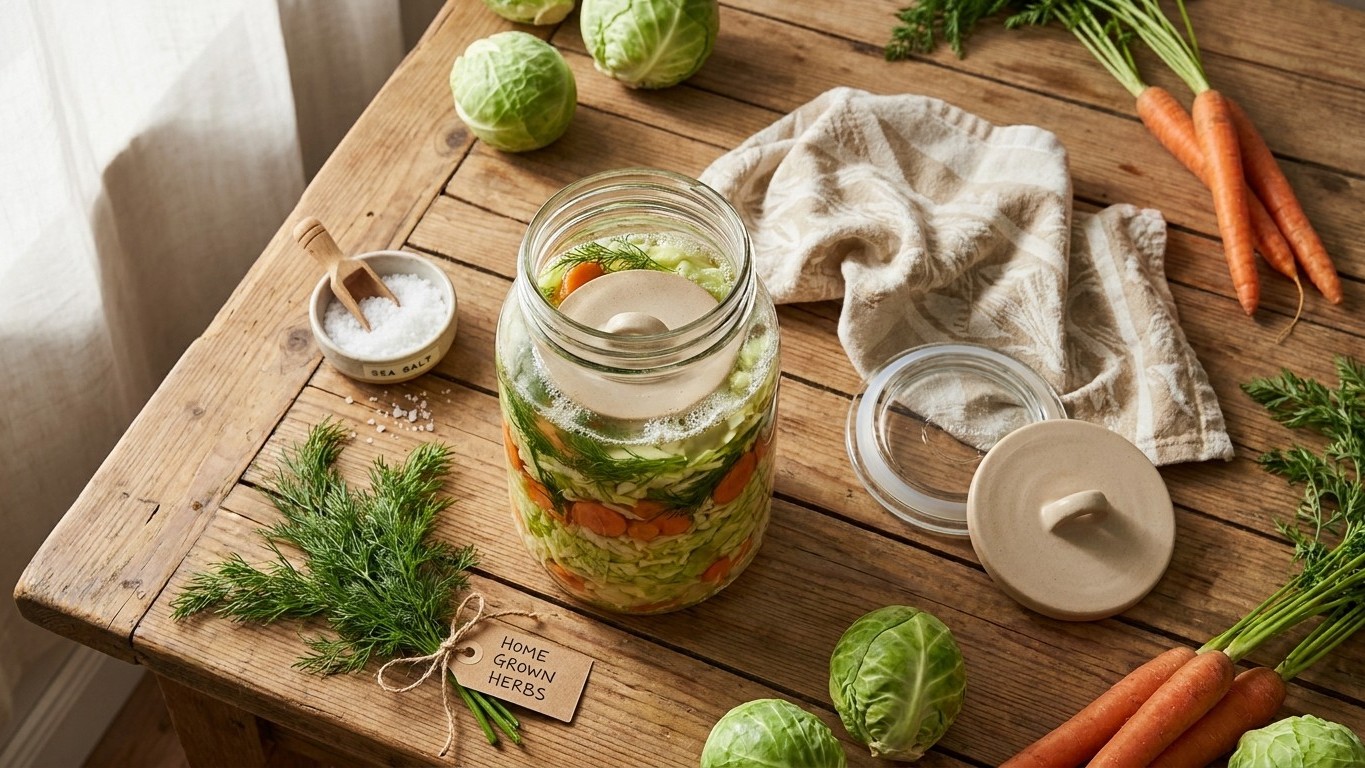

A working fermentation setup comes down to three things: a food-grade, non-reactive container large enough to hold the vegetables under liquid, a cover that keeps out insects and dust while letting gas escape, and a weight that holds everything below the brine surface. The National Center for Home Food Preservation treats submersion, not any particular jar or crock brand, as the detail that makes or breaks the batch.
The short answer

Ask the National Center for Home Food Preservation what container works, and the answer is less about the object and more about what the object has to do. Salt in the brine “favors the growth of desirable bacteria while inhibiting the growth of others,” and that selection only works if the vegetables stay bathed in that salted liquid, away from air, for the length of time fermentation needs. Regular dill pickles and sauerkraut are fermented and cured for about 3 weeks; refrigerator dills, held cold instead of at room temperature, are ready in about 1 week. Neither timeline changes because of what container you used, only because of how consistently that container kept the food submerged and the temperature steady.
So the container itself just needs to be food-grade and non-reactive, with enough volume to leave room for brine above the packed vegetables and still fit a weight on top. The cover has one job: block dust, fruit flies and airborne debris while still letting the carbon dioxide produced by fermentation escape, since a completely sealed jar can build pressure. The weight has a different, non-negotiable job: keep every piece of cabbage, cucumber or other vegetable under the brine line for the entire fermentation, because anything poking above the liquid is exposed to oxygen and is where mold and spoilage organisms take hold first.
None of that changes if the vegetable changes. What stays fixed, whatever you are fermenting, is the requirement that salt do its selective work while oxygen is kept away from the food. The National Center for Home Food Preservation is explicit that this is not a place to improvise: “Do not attempt to make sauerkraut or fermented pickles by cutting back on the salt required.” The container, cover and weight are simply the hardware that lets that salt-driven, low-oxygen environment hold steady for as long as the ferment needs, whether that is roughly a week in the refrigerator or roughly three weeks on the counter.
What actually decides it
The choice of container, cover and weight is not really about brand or material aesthetics. It is about three mechanisms working together, and understanding them lets you judge a setup for any food.
Salt selects the population, not the recipe
Salt concentration in the brine is doing biological work: it favors the desirable fermenting bacteria and inhibits others. That is a population-level effect, not a flavor choice, which is exactly why the National Center for Home Food Preservation warns against cutting back on the salt required. A weaker brine does not just taste different, it changes which organisms get to multiply. This is the single reason any container, cover or weight setup exists in the first place, to protect that salt-driven selection long enough for it to finish.
Submersion creates the low-oxygen zone
Fermentation is the one preservation method where the food makes its own acid. That only happens reliably when the vegetable stays under brine, in an environment poor in oxygen, long enough for fermentation to push the food past pH 4.6, which is why sauerkraut sits on the acid side of that line while the raw cabbage it came from does not. A weight is the physical enforcement of that submersion. Any piece of food riding above the brine surface sits in an oxygen-rich pocket where the desired fermentation bacteria lose their advantage and molds or undesirable organisms move in instead.
Container material and cover design manage the gas and the contaminants
A reactive container can interact with the acid the ferment is producing, which is a separate hazard from anything related to salt or oxygen. A cover has to strike a balance: airtight enough to keep out insects, dust and airborne yeasts, loose enough to let the carbon dioxide of active fermentation vent instead of pressurizing the vessel. Get either mechanism wrong, contaminated inflow or trapped gas, and the setup fails regardless of how correct the salt level was.
How to do it
- Select a food-grade, non-reactive container sized to hold the prepared vegetables with room left above them for brine and a weight.
- Prepare the vegetables according to the specific method required for that food, since preparation steps and any brine strength are food-specific and are not restated here.
- Pack the vegetables into the container and add the brine so the food is fully covered by liquid.
- Place a weight on top of the vegetables so that every piece stays below the brine surface throughout fermentation.
- Fit a cover over the container that keeps out dust and insects while still allowing fermentation gas to escape.
- Hold the container at the condition called for by the method, room temperature for regular fermented pickles and sauerkraut, or refrigerated for refrigerator dills.
- Check the container periodically to confirm the food remains submerged and to watch for signs of spoilage on the surface.
- Let fermentation and curing continue for the timeframe the food requires, about 3 weeks for regular dill pickles and sauerkraut, about 1 week for refrigerator dills.
- Once fermentation is complete, move on to the storage or further processing step specified for that particular food.
What goes wrong
- Vegetables float above the brine. Anything above the liquid sits in oxygen and becomes the starting point for surface mold. Add or reposition the weight so every piece stays submerged for the full fermentation period.
- The salt is cut back to make a milder ferment. Lowering the salt changes which bacteria get to grow, and the National Center for Home Food Preservation specifically warns against cutting back on the salt required for sauerkraut or fermented pickles. Use the salt level specified for that food, not a reduced version.
- A reactive metal container is used. Metals that react with the acid the ferment produces can contaminate the food or corrode. Switch to a food-grade, non-reactive container instead.
- The cover is sealed completely airtight. Fermentation produces gas, and a container with no way to vent it can build pressure. Use a cover designed to let gas escape while still keeping out insects and airborne contaminants.
- The cover is left loose or absent. An open or poorly covered container invites fruit flies, dust and airborne yeasts that compete with the fermentation. Fit a proper cover rather than leaving the container open.
- Vinegar, food or water proportions get adjusted mid-recipe, or an unknown-acidity vinegar is substituted. The National Center for Home Food Preservation is direct on this: do not alter those proportions or use a vinegar of unknown acidity. Follow the proportions given for that specific food.
- The ferment is judged “done” by taste or appearance alone rather than by the timeframe the method calls for. Pull sauerkraut or regular dills too early and they have not had the roughly 3 weeks needed to finish fermenting and curing; treat refrigerator dills the same way regarding their roughly 1 week timeframe.
Where the exact figures come from
Botulinum toxin has no taste and no smell, so a container, salt level or timeframe that has not been tested for that specific food can look and smell completely normal while still being unsafe. For the exact salt concentration, container guidance and timing for the food you are fermenting, go to the National Center for Home Food Preservation at the University of Georgia (nchfp.uga.edu), and where canning follows the ferment, the USDA Complete Guide to Home Canning is the other tested authority. Neither figure should be estimated, scaled or borrowed from a different food.
Common questions
Can I use a plastic bucket instead of a crock? The requirement is food-grade and non-reactive with enough capacity for the food, the brine and a weight, not a specific material; check the food-specific instructions from the National Center for Home Food Preservation for that food’s container guidance.
Why does my ferment need a weight at all if I stir it? Stirring does not keep vegetables permanently below the brine line, and any piece that surfaces even briefly sits in oxygen where mold and spoilage organisms get a foothold. A weight holds the food down continuously, which stirring cannot replace.
Is it safe to seal the container completely so no air gets in? A completely airtight seal traps the gas fermentation produces, which can pressurize the container. The cover needs to keep out contaminants while still letting that gas vent.
Does refrigerating a ferment change the salt or the container needed? Refrigeration changes the timeframe, refrigerator dills take about 1 week versus about 3 weeks for regular fermented dills and sauerkraut, but it does not remove the need for submersion, a weight, or the salt level specified for that food.