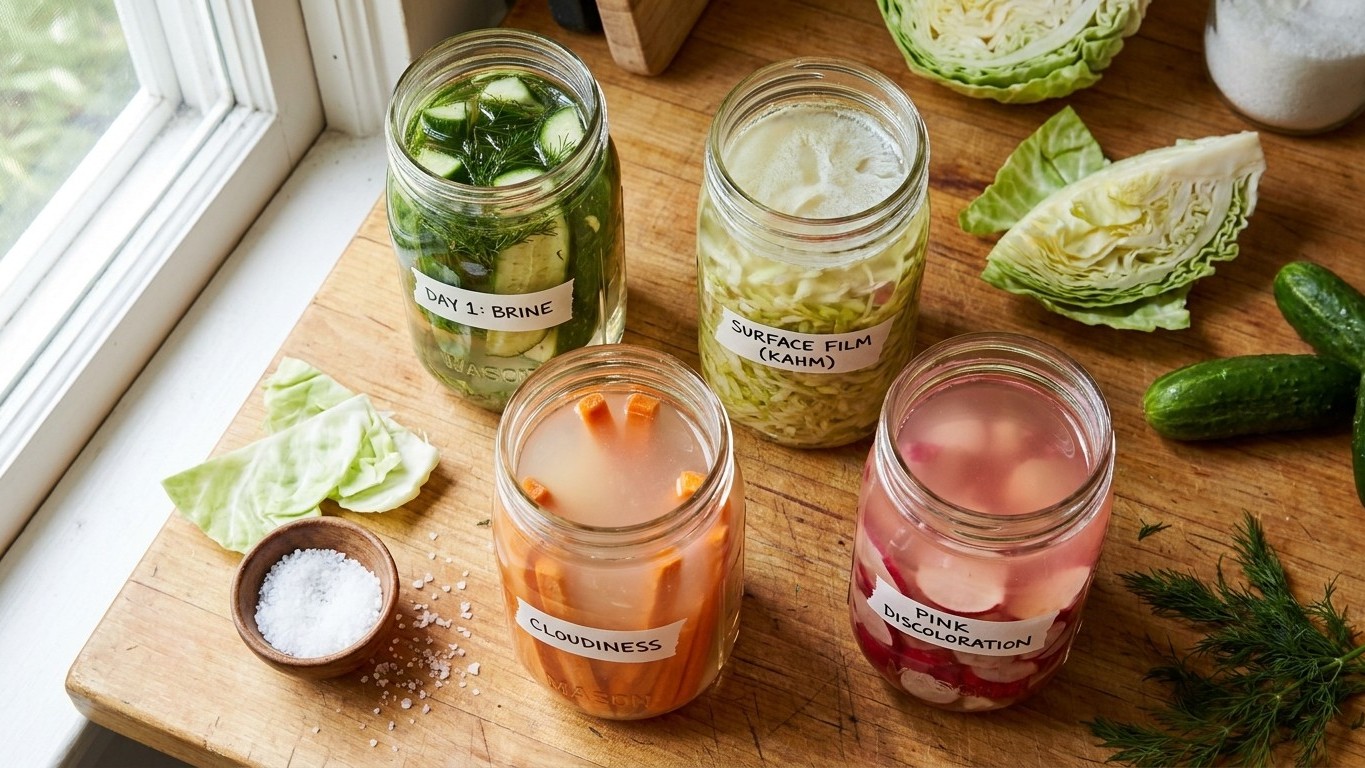

Sliminess, film on top, a sudden pink tinge, a smell that’s off instead of sharp and sour: each of these signs points to a different cause, and the fix depends on which one you’re seeing. Most trace back to salt, oxygen, or time not doing their job. The National Center for Home Food Preservation ties nearly every fermentation problem back to one of those three factors, and knowing which one is misbehaving tells you whether to fix the batch or toss it.
The short answer

Start with what salt actually does, because almost every fermentation sign traces back to it. The National Center for Home Food Preservation states plainly that in fermented foods, salt favors the growth of desirable bacteria while inhibiting the growth of others. That’s not a flavor note, it’s the entire safety mechanism. Salt creates an environment where lactic acid bacteria thrive and outcompete the organisms that cause spoilage or illness. Cut the salt and you don’t just get a blander batch, you shift which microbes win the race. That’s why the Center is explicit: do not attempt to make sauerkraut or fermented pickles by cutting back on the salt required. There’s no safe workaround, no substitute ratio, no “close enough.”
Time matters just as much, and it isn’t flexible either. Regular dill pickles and sauerkraut are fermented and cured for about three weeks. Refrigerator dills, which are a different process, take about one week. Pull a jar early because it smells sour enough or looks done, and you may be looking at a product that hasn’t finished developing the acid level a fully fermented food needs. The visual and aroma cues people rely on aren’t a substitute for that timeline.
The other half of the safety picture is what fermentation actually does chemically. Fermentation is the one preservation method where the food makes its own acid, rather than having acid added to it the way pickles get vinegar. That’s why sauerkraut sits on the acid side of pH 4.6 while the raw cabbage it came from does not. The cabbage starts out barely acidic at all. Only the fermentation process, powered by the salt-selected bacteria, pushes it into a genuinely safe acid range. That transformation takes the full fermentation period. Interrupt it, dilute it, or short-circuit it with less salt than called for, and the cabbage may never actually get there, no matter how it looks or smells to you.
What actually decides it
Three separate mechanisms determine whether a ferment turns out safe or turns into a problem, and they interact rather than working in isolation.
Salt concentration
Salt works through simple physics: it draws water out of plant cells through osmosis, and that same osmotic pressure is inhospitable to many spoilage organisms while lactic acid bacteria tolerate it just fine. This is a selection process, not a seasoning choice. When a recipe specifies a certain salt level, that number was tested to confirm it suppresses the right organisms while letting fermentation proceed. Guessing at a lower amount because you’re cutting sodium, or because a batch “tastes fine” without full salt, removes the barrier that was doing the actual protective work, even though the flavor might seem unaffected at first.
Oxygen and submersion
Lactic acid bacteria that drive fermentation work without oxygen. Anything exposed to air on the surface of a ferment behaves completely differently: molds and film-forming yeasts need oxygen, and they’ll happily colonize any cabbage shred or cucumber that pokes above the brine line. This is a mechanical problem as much as a microbial one. Keep the food submerged and you keep the anaerobic environment that favors the bacteria you want. Let air reach it and you’ve opened the door to the organisms that produce the surface film, discoloration, and off odors people encounter partway through a ferment.
Time and acid development
Acid doesn’t appear the moment you add salt and walk away. It builds as the bacteria consume available sugars and produce lactic acid as a byproduct, gradually pushing the food’s pH down. That process has a pace, and the timelines noted above (about three weeks for regular sauerkraut and dill pickles, about one week for refrigerator dills) reflect how long that acid-building process actually needs to run its course for each method. A ferment that looks or smells “ready” ahead of schedule hasn’t necessarily finished the chemical work, since appearance and true acid level don’t move in perfect lockstep, especially early on.
How to do it
- Select a tested recipe for the specific food you’re fermenting, and use the salt amount it specifies exactly as written.
- Prepare the vegetable according to that recipe, since cut size and preparation affect how evenly salt and brine reach the food.
- Combine the food with the specified salt, either dry-salted or as a brine, following the recipe’s method precisely.
- Pack the salted food into a clean fermentation container, pressing to remove air pockets as you go.
- Submerge the food fully under its own liquid or a prepared brine, using a weight or follower to keep everything below the surface.
- Cover the container in a way that keeps out contaminants while still allowing fermentation gases to escape.
- Check the ferment regularly, keeping the food submerged and removing any surface film or debris as it appears.
- Let the ferment run for its full recommended period, about three weeks for regular sauerkraut and dill pickles or about one week for refrigerator dills, without shortening it.
- Move the finished ferment to cold storage once it has completed its full fermentation period.
What goes wrong
- A white film or yeasty layer forms on top of the brine. This is typically an oxygen-loving yeast growing where the food has risen above the brine line. Keep everything weighted and fully submerged from the start, and remove the film promptly if it appears, checking that the food beneath is still firm and normal-smelling.
- Fuzzy or colored mold appears on the surface. Mold needs air, so this again points back to a submersion failure, whether from an inadequate weight, brine that evaporated, or food that floated free. Because mold can extend contamination below what’s visible, this is a sign to reassess the whole batch rather than simply scraping off the top.
- The finished product turns slimy or overly soft. This usually reflects the wrong balance of salt, temperature exposure, or fermentation conditions allowing the wrong organisms to dominate instead of the lactic acid bacteria that should be doing the work. It’s not something to fix mid-batch; it’s a sign the selection process described above didn’t go as intended.
- The cabbage or vegetable develops an unexpected pink or reddish tint. Certain yeasts that can grow under low-oxygen conditions produce pigments as a byproduct. It’s a visual clue that the microbial balance shifted, and it’s worth treating as a signal to review your salt measurement and submersion method rather than something to ignore because the smell still seems fine.
- The batch smells off rather than pleasantly sour. A properly fermenting food should smell increasingly acidic and tangy as lactic acid builds. A smell that’s rotten, yeasty in a bread-like way, or simply wrong instead of sour suggests the bacteria you want aren’t the ones dominating the jar, often traceable back to insufficient salt or an early break in submersion.
Where the exact figures come from
Fermentation and food safety failures don’t announce themselves reliably through taste or smell in every case, and guessing at a proportion can produce a product that looks and smells acceptable while still posing a risk.
For the tested salt concentrations, container guidance, and timing specific to the food you’re fermenting, consult the National Center for Home Food Preservation (University of Georgia, nchfp.uga.edu). For any ferment that will later be canned or processed for shelf storage, cross-check against the USDA Complete Guide to Home Canning as well, since those two resources carry the tested figures.
Common questions
Can I use less salt than the recipe calls for if I’m watching sodium intake?
No. The National Center for Home Food Preservation states directly that reducing salt below what’s required is not a safe substitution for sauerkraut or fermented pickles, because the salt level is what selects for safe bacteria over harmful ones.
Is a small amount of surface mold something I can just scrape off?
Mold on a ferment signals that oxygen reached the food, and it’s a reason to examine the whole batch rather than assume the problem is confined to the visible surface layer.
Why did my ferment turn pink partway through?
Pink discoloration is usually linked to certain yeasts producing pigment under fermentation conditions, and it’s a sign worth investigating alongside your salt measurement and how well the food stayed submerged.
How do I know when a ferment is actually finished?
Regular sauerkraut and fermented dill pickles are fermented and cured for about three weeks, while refrigerator dills take about one week; those timeframes reflect how long the food needs to fully develop its own acid rather than a flavor preference.