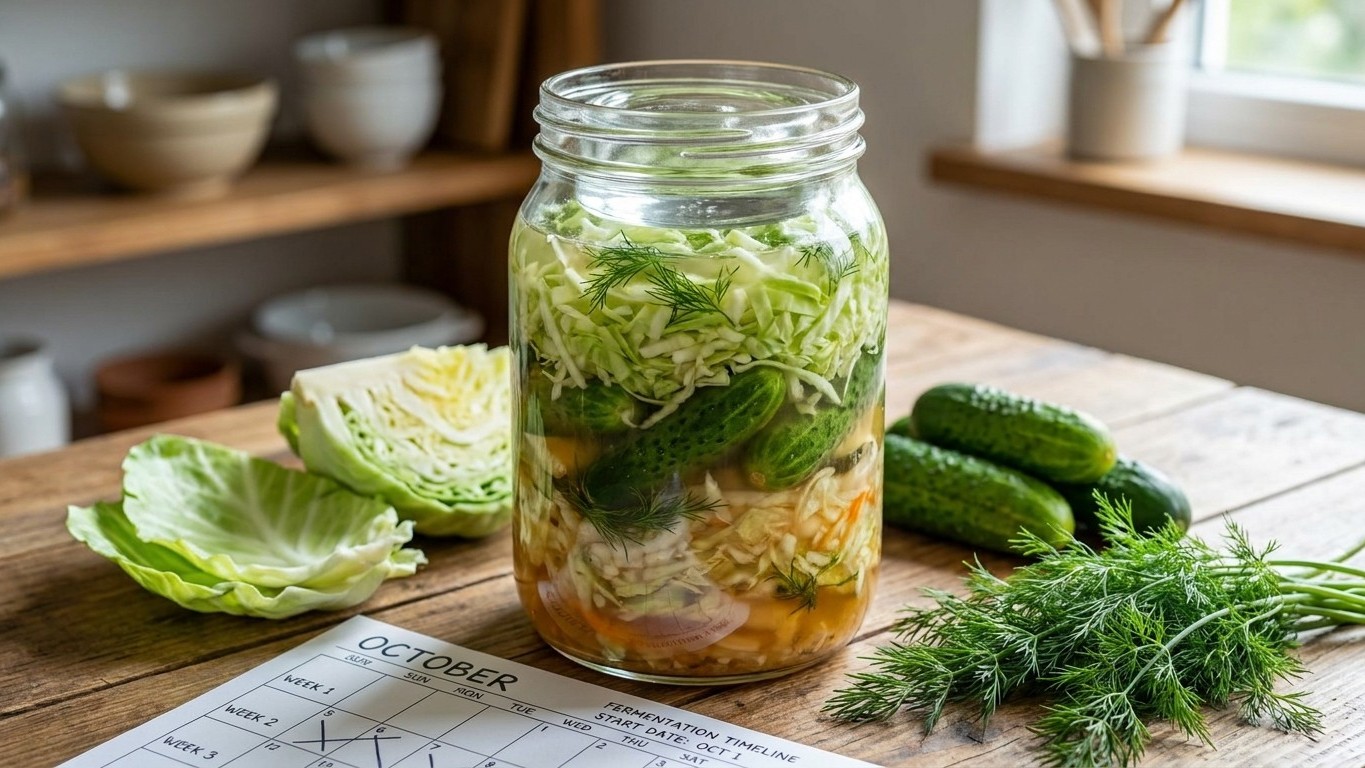

A regular fermented sauerkraut or dill pickle needs about three weeks of fermenting and curing before it is ready. A refrigerator dill, made with a lighter salt approach and stored cold from the start, needs about one week. Those figures come from the National Center for Home Food Preservation, and they are not guesses: they mark the point where the food’s own acid has done its job.
The short answer

Regular dill pickles and sauerkraut are fermented and cured for about three weeks. Refrigerator dills, which follow a different path from day one, need about one week. That’s the figure the National Center for Home Food Preservation publishes, and it’s the number to work from if you’re making either at home.
What “done” means here isn’t a matter of taste, though taste changes too. It’s a matter of chemistry. Fermentation is the one preservation method where the food generates its own acid rather than having acid added to it. That’s why sauerkraut ends up sitting on the acid side of pH 4.6 while the raw cabbage it started as does not. The bacteria doing the work convert sugars in the vegetable into lactic acid, and over the course of that fermenting period, the acid level climbs until the environment is too hostile for the organisms you don’t want.
Three weeks isn’t a magic number picked for convenience. It’s roughly how long it takes, at usual fermenting conditions, for that acid climb to run its full course in a standard batch of cabbage or cucumbers. Pull a kraut at week one and you’ll have started the process without finishing it: some fermentation has happened, but the acid hasn’t reached the level that makes the food stable and safely sour. Refrigerator dills work on a shorter clock because they’re held cold, which slows the whole reaction, but also because the recipe itself is built around that shorter, cooler timeline rather than a room-temperature ferment left to run three weeks.
Why the number holds across batches
The reason this timeframe is dependable, batch to batch, is that the food supplies its own raw material. As long as the vegetable, the salt, and the temperature stay within what the tested recipe calls for, the bacteria present will reliably push the acid level down to a safe range in roughly that window. Change the salt, change the temperature, or change the vegetable’s water content, and you’ve changed the conditions the timeframe was built around. That’s the thread the next section picks up.
What actually decides it
Three factors govern how a ferment moves from raw vegetable to finished, safe food: salt, temperature, and time. Each one plays a distinct role, and none of them can compensate for a shortfall in the other two.
Salt does more than season
In fermented foods, salt favors the growth of desirable bacteria while inhibiting the growth of others. It isn’t there for flavor. The salt concentration in a properly made brine creates conditions where the lactic-acid-producing bacteria you want can thrive while less desirable organisms are held back. Cut the salt and you don’t just get a blander pickle. You shift the balance of which microbes get to multiply, and that shift can favor the wrong ones. This is why the National Center for Home Food Preservation states plainly: do not attempt to make sauerkraut or fermented pickles by cutting back on the salt required. There’s no safe substitution math here. The salt level in a tested recipe is part of what makes the timeframe reliable.
Temperature sets the pace
Warmer conditions speed up bacterial activity; cooler conditions slow it down. That’s the whole reason a refrigerator dill, held cold, needs about a week while a room-temperature sauerkraut needs about three weeks. The vegetable, the salt, and the process are similar in spirit, but the temperature changes how fast the acid builds. This is also why moving a ferment to a different temperature partway through, or fermenting in a spot that swings hot and cold, throws off the timeline you’d otherwise expect.
Time is the acid catching up
Time is what lets the first two factors finish their work. The bacteria need enough days to consume available sugars and generate enough lactic acid to drop the food’s pH below 4.6. Stopping early means an under-acidified food that looks finished but isn’t. There’s no shortcut that substitutes for letting that acid climb run its course under the salt and temperature conditions the recipe specifies.
How to do it
- Follow a tested recipe for the specific vegetable, using the exact salt amount it specifies rather than adjusting to taste.
- Submerge the vegetable fully in its brine so all of it ferments under the same conditions, since exposed pieces won’t develop the same protective acid environment.
- Hold the container at the temperature the recipe calls for, and keep that temperature as steady as you can across the fermenting period.
- Check the ferment periodically for the signs the recipe describes as fermentation progresses, without disturbing the brine level or salt concentration.
- Let the food run through its full fermenting and curing period, for regular dill pickles and sauerkraut about three weeks, or for refrigerator dills about one week, before considering it finished.
- Move the finished ferment to the storage the recipe specifies once that period is complete.
What goes wrong
- Cutting the salt to make it less salty. This changes which bacteria dominate the ferment, not just how it tastes. The National Center for Home Food Preservation is explicit that you should not attempt sauerkraut or fermented pickles by cutting back on the salt a recipe requires. If a batch tastes too salty, the fix is choosing a different tested recipe next time, not reducing the amount in the one you’re using.
- Pulling the ferment early because it “looks ready.” Appearance and smell can suggest progress before the acid level has actually reached a safe point. The fix is trusting the timeframe the recipe specifies, about three weeks for regular sauerkraut and pickles or about one week for refrigerator dills, rather than a visual guess.
- Letting part of the vegetable sit above the brine line. Exposed pieces don’t ferment the same way as submerged ones and can develop problems the rest of the batch avoids. Keep everything weighted down and under the brine for the full fermenting period.
- Swapping in a different vinegar, or changing water and food proportions, in a recipe that calls for vinegar alongside fermentation. Do not alter vinegar, food, or water proportions in a recipe, or use a vinegar with unknown acidity. Stick to the exact proportions the recipe lists.
- Assuming a longer or shorter time will simply make the food “more” or “less” fermented in a way you can compensate for later. The acid curve doesn’t work on a sliding scale that can be corrected after the fact. If a batch was rushed or the conditions were off, the safest move is to not eat it and to start over with a tested recipe followed exactly.
Where the exact figures come from
Every time and salt figure in this article traces back to the National Center for Home Food Preservation at the University of Georgia (nchfp.uga.edu). That’s the source to check for the specific food you’re fermenting, because different vegetables, cut sizes, and brine strengths call for different tested figures.
An untested figure, pulled from memory or guessed at because it sounds close to right, is dangerous precisely because a ferment that looks and smells fine can still be under-acidified. There’s no way to taste or smell your way to certainty. The margin between a properly fermented food and one that hasn’t reached a safe pH isn’t something you can sense directly, which is exactly why the tested figures exist and why substituting your own numbers isn’t worth the risk.
Common questions
Can I taste a ferment along the way to check on it?
Tasting to track flavor development is common practice, but flavor alone doesn’t confirm the acid level is where it needs to be. Follow the timeframe the recipe specifies rather than stopping once it tastes sour enough to you.
Does a longer ferment always mean a safer one?
Not necessarily. The recipe’s specified timeframe, for regular sauerkraut and pickles about three weeks, is built around the salt and temperature conditions it also specifies. Extending time without those matching conditions doesn’t automatically improve the result.
Why does refrigerator dill take so much less time than regular sauerkraut?
Cold temperatures slow bacterial activity, and refrigerator dill recipes are built around that slower, cooler process from the start rather than a room-temperature fermentation run over about three weeks.
Is it safe to reuse brine from a finished batch to start a new one faster?
Stick to what a tested recipe specifies for salt, food, and liquid proportions. Altering those proportions, including by reusing brine in place of a fresh batch made to the recipe’s amounts, falls outside what’s been tested for safety.