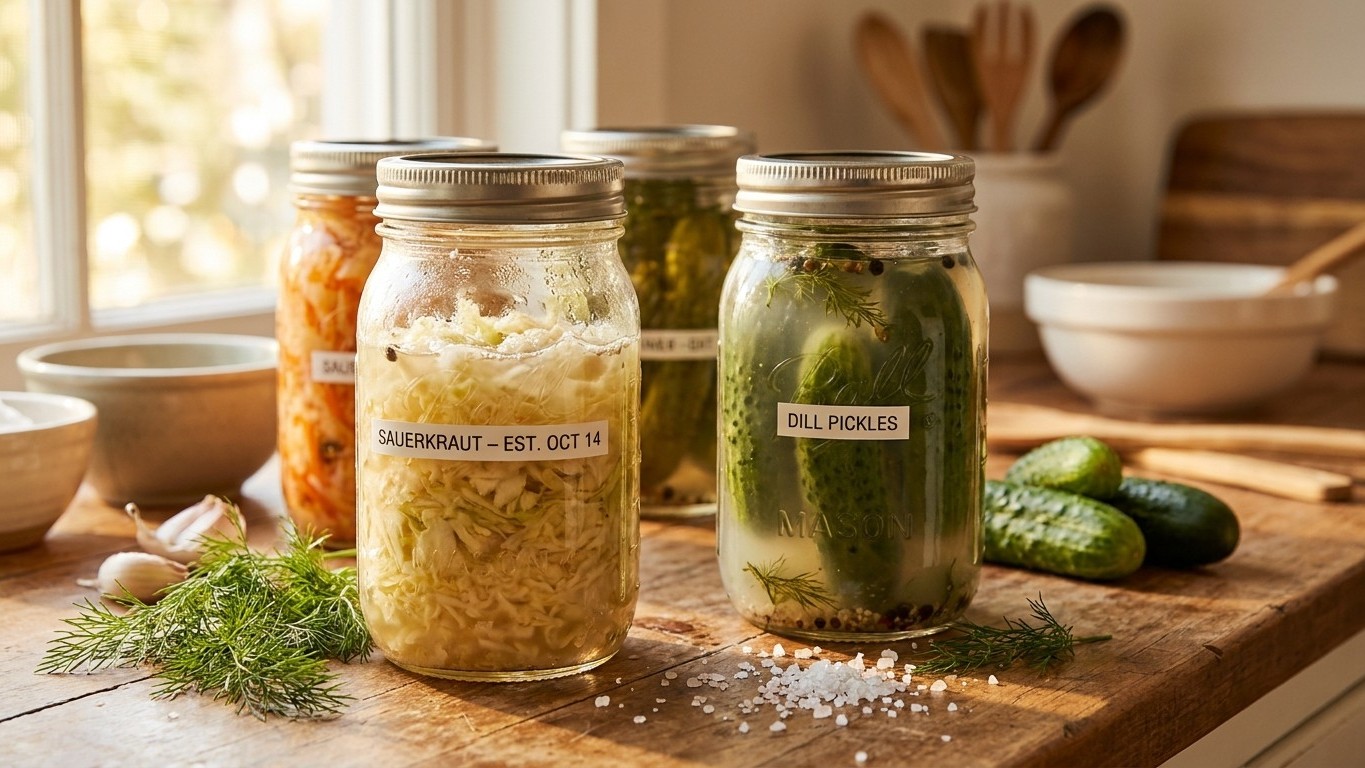

You cannot change the proportions in a ferment because salt is not a seasoning here, it is the control switch. The National Center for Home Food Preservation states plainly that in fermented foods, salt favors the growth of desirable bacteria while inhibiting the growth of others, and the agency is direct about the consequence: do not attempt to make sauerkraut or fermented pickles by cutting back on the salt required.
The short answer

A ferment is a race between two populations of microorganisms living on the same food at the same time. One group, the lactic acid bacteria, is the one you want. The other group includes spoilage organisms and, in some conditions, organisms that can make a person sick. Salt at the ratio a tested recipe specifies gives the lactic acid bacteria the advantage and holds the others back long enough for the food to acidify. Lower that ratio, even by what feels like a small amount, and the advantage shifts. The undesirable organisms are no longer held in check, and they can outcompete the bacteria you’re relying on before the food ever reaches a safe level of acidity.
This is why the National Center for Home Food Preservation’s guidance on this point isn’t phrased as a suggestion. It’s a flat instruction: do not cut back on the salt a recipe requires. The same logic runs through the timing side of the process. Regular sauerkraut and fermented dill pickles are fermented and cured for about 3 weeks. Refrigerator dills, made under cooler, slower conditions, need about 1 week. Those durations aren’t arbitrary either. They reflect how long it actually takes, at the salt concentration specified, for the lactic acid bacteria to finish converting the food’s own sugars into enough acid to make it safe and shelf-stable in the way the recipe intends.
Put the salt ratio and the fermentation time together, and you have a system where each part depends on the other. Change one number, even without touching the other, and you’ve changed the environment the bacteria are working in. A shorter time paired with the correct salt might mean the acid hasn’t finished forming. Less salt paired with the correct time might mean the wrong organisms got there first. Neither error announces itself with a bad smell or an obvious sign. That’s the core of why a tested ratio isn’t a starting point for improvisation, it’s the whole recipe.
What actually decides it
Salt as a selector, not a flavor
Salt works on fermentation through simple physical pressure. It draws water out of plant cells and out of the cells of many bacteria through osmosis. Lactic acid bacteria tolerate this stress well at the concentrations home fermentation recipes call for. Many of the bacteria responsible for spoilage and off-odors tolerate it poorly. That difference in tolerance is the entire mechanism behind the National Center for Home Food Preservation’s statement that salt favors the growth of desirable bacteria while inhibiting the growth of others. Reduce the salt and you narrow that gap. The organisms you didn’t want gain ground they wouldn’t otherwise have.
The food makes its own acid
Fermentation is unusual among home food preservation methods because the food itself produces the acid that makes it safe. Sauerkraut isn’t acidic because vinegar was added to it. It’s acidic because lactic acid bacteria consumed sugars in the cabbage and excreted lactic acid as a byproduct, over the course of about 3 weeks, until the cabbage moved from a food that is not acidic on its own to one that sits on the acid side of pH 4.6. That threshold matters because it’s the line below which the organisms of greatest concern in low-acid, oxygen-poor environments cannot grow. The salt ratio and the fermentation time are what get the food to that line reliably.
Why this differs from measuring vinegar
Some pickled foods take the opposite route: acid is added rather than grown. For those, the National Center for Home Food Preservation warns against altering vinegar, food, or water proportions in a recipe, or using a vinegar of unknown acidity. The mechanism there is different (the acid is already present in the vinegar and simply needs to reach the food at the right strength) but the underlying principle is the same one that governs fermentation. A tested recipe’s ratio isn’t a rough guideline for taste. It’s the specific combination that has been shown to reach a safe level of acidity, whether that acid is added directly or grown by bacteria over time.
How to do it
- Choose a tested recipe for the specific food you’re fermenting and read through the salt-to-food ratio it specifies before you start.
- Measure the food and the salt exactly as the recipe states, rather than adjusting either amount to taste.
- Pack the food so it stays fully submerged under its own brine, which keeps the environment low in oxygen and favors the lactic acid bacteria the process depends on.
- Let the ferment proceed undisturbed for the length of time the recipe specifies, about 3 weeks for regular sauerkraut and fermented dill pickles or about 1 week for refrigerator dills.
- Follow the same recipe’s guidance for confirming the ferment has finished before moving it to storage or to any further processing step.
What goes wrong
- Cutting the salt to make the food less salty or “healthier.” This is the exact error the National Center for Home Food Preservation warns against by name. Lowering the salt removes the selective pressure that keeps spoilage organisms in check, and the fix is simple: use the salt amount the tested recipe specifies, in full, every time.
- Adding extra water to top off the jar. Extra water dilutes the salt concentration the same way cutting the salt directly does, weakening its ability to favor the right bacteria. Measure the water called for in the recipe rather than adding more by eye.
- Letting food float above the brine. Any part of the food exposed to air sits outside the low-oxygen environment fermentation depends on, which invites mold and spoilage organisms at the surface. Keep the food weighted or packed so it stays under the brine for the full fermentation period.
- Treating a fermented recipe and a vinegar-based recipe as interchangeable. One relies on bacteria producing acid over time, the other on added vinegar at a fixed strength. Follow the proportions for the specific method the recipe uses rather than swapping in ratios from a different kind of pickle.
- Cutting fermentation time short to speed things along. Stopping before the recipe’s stated duration, about 3 weeks for regular sauerkraut and fermented dill pickles or about 1 week for refrigerator dills, risks ending the process before the food has acidified enough. Give the ferment the full time the recipe specifies rather than judging by appearance alone.
Where the exact figures come from
Fermentation figures are food-specific: a ratio and timeline tested for cabbage don’t automatically transfer to a different vegetable. For the exact salt-to-food ratio and fermentation time for the food you’re making, use the recipe published by the National Center for Home Food Preservation for that item. An untested figure is dangerous because a ferment that has the wrong balance of organisms can look, smell, and taste unremarkable right up until it isn’t.
Common questions
Can I use less salt if I’m watching my sodium intake?
No. The National Center for Home Food Preservation specifically instructs against cutting back on the salt required for sauerkraut or fermented pickles, because the salt level is what favors the desirable bacteria over the ones that cause spoilage.
Can I shorten the fermentation time if the food already tastes done?
The recipe’s stated duration, about 3 weeks for regular sauerkraut and fermented dill pickles or about 1 week for refrigerator dills, reflects how long the process takes to reach a safe level of acidity, not just a preferred flavor. Taste alone doesn’t confirm the food has reached that point.
Is changing proportions in a vinegar pickle the same risk as in a fermented one?
The mechanism differs, since fermentation depends on bacteria producing acid while vinegar pickles rely on added acid, but the National Center for Home Food Preservation applies the same rule to both: do not alter the proportions a tested recipe specifies.
Does adding more salt than the recipe calls for make the ferment safer?
This page doesn’t have a published figure for what happens above the tested ratio, so the safest approach is to use the exact amount the tested recipe specifies rather than assuming more is automatically better.