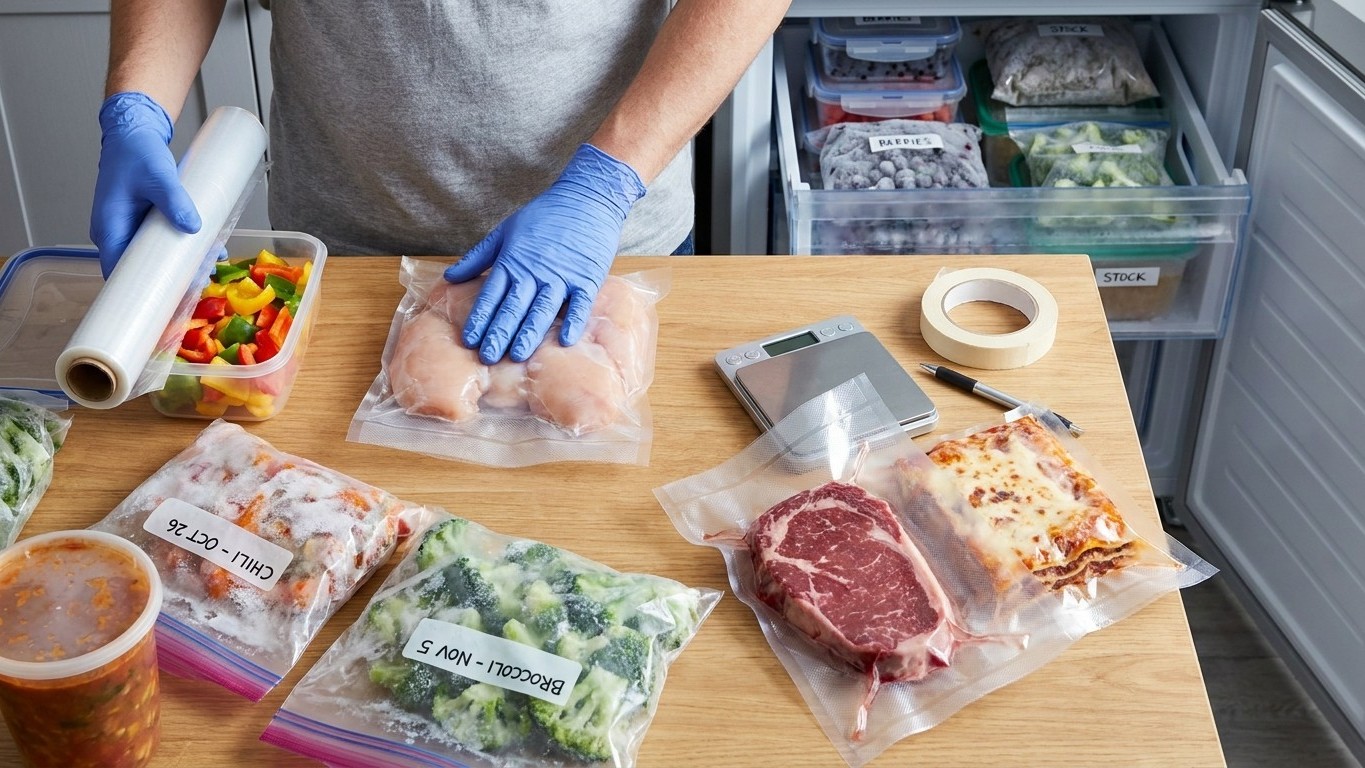

Air ruins frozen food two ways: it lets oxygen reach the surface of whatever you’ve packed, and it lets moisture escape and refreeze as ice crystals inside the bag. Both processes keep working slowly for as long as the food sits in the freezer. The National Center for Home Food Preservation is blunt about the underlying truth here: freezing does not sterilize anything. It only slows down what’s already happening, so whatever quality problem you seal into the package will still be there, just moving at a crawl.
The short answer

Freezer burn isn’t spoilage in the food-safety sense. It’s dehydration. Ice crystals inside the food sublimate, meaning they turn straight from solid to vapor without melting, and that vapor migrates toward the coldest, driest spot it can find, usually the inside surface of a loosely sealed bag or the headspace of a container with too much air in it. What’s left behind on the food is a grayish, leathery patch that’s lost its moisture and, along with it, texture and flavor. That patch is also now exposed to oxygen trapped in the package, and oxygen degrades fats and pigments over time. Neither process makes the food unsafe to eat. Both make it taste and feel like something you’d rather not eat.
This is where the National Center for Home Food Preservation’s point about freezing matters most: freezing does not sterilize. It stops what is already there. That single sentence explains why packaging technique carries so much weight. A jar of home-canned green beans gets heat-processed to destroy organisms and enzymes. A bag of frozen green beans doesn’t. Whatever enzyme activity, whatever bacterial load, whatever moisture content existed at the moment you sealed the package is essentially frozen in place, not eliminated. Good packaging doesn’t add safety the food didn’t have going into the freezer. It preserves the quality that was there, by keeping air, and the oxidation and moisture loss it causes, out of the equation.
Why this trips people up
Most home cooks assume the freezer itself does the protective work, the way heat does in canning. It doesn’t. The cold stops microbial growth and slows enzyme activity, but it doesn’t stop either one completely, and it does nothing to stop oxidation. Packaging is the only variable left in your control once the food goes in. That’s the entire reason air management deserves its own conversation separate from blanching times or storage length.
What actually decides it
Two separate mechanisms determine how a frozen food holds up, and they operate independently of each other. Confusing them is how people end up with soggy, discolored vegetables even after they thought they’d packaged everything correctly.
Oxidation and moisture migration
Air trapped inside a package carries oxygen, and oxygen reacts with fats, pigments and vitamins in food even at freezer temperatures. That reaction is slow, but a freezer holds food for a long time, giving it plenty of opportunity to run its course. At the same time, any air pocket inside a bag or container gives water vapor somewhere to go. The food’s surface moisture sublimates into that space and refreezes as frost on the packaging or as visible ice crystals, pulling moisture away from the food itself. The less air surrounding the food, the less room that vapor has to travel, and the slower both processes move. This is a physical mechanism, not a biological one, and it applies to meat, bread, soup, and vegetables alike, regardless of whether the food was ever heated before freezing.
Enzyme activity, and why underblanching backfires
Vegetables carry natural enzymes that keep working after harvest, breaking down flavor compounds, color and texture whether the vegetable is raw or frozen. Blanching, a brief hot-water or steam treatment before freezing, stops those enzyme actions, and the National Center for Home Food Preservation notes it also removes dirt and microorganisms from the surface and slows vitamin loss. Here’s the part that surprises people: underblanching stimulates the activity of enzymes and is worse than no blanching at all. A too-short blanch can activate enzymes rather than deactivate them, so the vegetable degrades faster in the freezer than if it had never been blanched. Overblanching has its own cost. It causes loss of flavor, color, vitamins and minerals, cooking the vegetable partway before it ever reaches the freezer. Both errors point to the same lesson: blanching is a precise step, not a rough approximation, and getting it right matters just as much as getting the air out of the bag.
How to do it
- If the food is a vegetable that requires blanching, bring water or steam to the point needed for that specific vegetable, using the tested time from the National Center for Home Food Preservation’s blanching table rather than guessing.
- Cool the vegetables immediately in a large quantity of cold water at 60 F or below, letting the cooling run for as long as the blanching itself took.
- Drain the vegetables thoroughly so excess water doesn’t add extra ice inside the package.
- Portion the food into freezer-safe bags or rigid containers sized close to the amount you’ll actually use at one time.
- Press or draw out as much air as possible before sealing, whether that means pressing a bag flat by hand, using a straw to draw out air, or using a vacuum-sealing method.
- Seal the package fully, checking the seam or closure for gaps.
- Label the package with the contents and the date it was packed, so nothing sits forgotten past the point of good quality.
- Place the package in the coldest part of the freezer, spread out rather than stacked, so it freezes through as quickly as possible.
What goes wrong
- Grayish, dry patches on the food’s surface. That’s freezer burn from air trapped against the food. Trim it away before cooking; the rest of the food is still fine to eat, just diminished in that spot. Prevent it next time by pressing out more air or switching to a container that seals tighter.
- Mushy, off-flavored vegetables despite blanching. This usually points to underblanching, which stimulates enzyme activity rather than stopping it. There’s no fixing this after the fact; the vegetable needs to be reblanched properly and refrozen next time, following the tested time for that specific vegetable.
- Vegetables that taste flat or have lost their color even though they were blanched carefully. That’s overblanching, which causes loss of flavor, color, vitamins and minerals before the food ever reaches the freezer. Time the blanch to the tested figure rather than erring long “to be safe.”
- Frost building up heavily inside the bag over weeks in the freezer. That’s moisture that sublimated off the food and had nowhere to go because air was still present at packing. Repackage with tighter air removal, and use the food sooner rather than later once this starts.
- Vegetables that seem partly cooked rather than raw when you pull them out. Water that wasn’t cooled to 60 F or below, or cooling that didn’t run as long as the blanch itself, lets residual heat keep cooking the vegetable after it’s supposedly done. Extend the cooling step and confirm water temperature next time.
Where the exact figures come from
Blanching times differ for every vegetable and are tested, not estimated. Guessing at a blanching time, or borrowing one vegetable’s time for another, risks the underblanching problem described above, where enzymes get stimulated rather than stopped. The National Center for Home Food Preservation, based at the University of Georgia, maintains the tested table for each vegetable, along with guidance on cooling and packaging methods. For anything involving heat processing, brine strength or safety thresholds beyond what’s covered here, the USDA Complete Guide to Home Canning is the other authority worth checking. Neither shortcut nor memory is a substitute for the tested figure specific to the food in front of you.
Common questions
Does vacuum sealing eliminate freezer burn completely?
It reduces the air dramatically, which slows both oxidation and moisture migration, but it doesn’t create a perfect vacuum against every surface of an irregularly shaped food. Long enough storage can still produce some drying at contact points, just far more slowly than with a loosely closed bag.
Can I skip blanching if I’m just going to cook the vegetable thoroughly later anyway?
Blanching stops enzyme actions before freezing even starts, and skipping it lets those enzymes keep working the entire time the vegetable sits frozen. Cooking later doesn’t undo flavor, color or texture already lost in storage, so the tested blanching step still applies for the length of the vegetable’s actual freezer life.
Why does the cooling step matter as much as the blanching step?
Cooling stops the cooking process that blanching started. If the vegetable isn’t cooled fast enough, or long enough, in water at 60 F or below, residual heat keeps softening it, which shows up later as mushiness once it’s frozen and thawed.
Is freezer-burned food unsafe to eat?
No. Freezer burn is a quality change from air exposure and moisture loss, not a safety hazard, since freezing already stopped microbial growth at the point the food went in. Trimming the affected area and using the rest is standard practice.