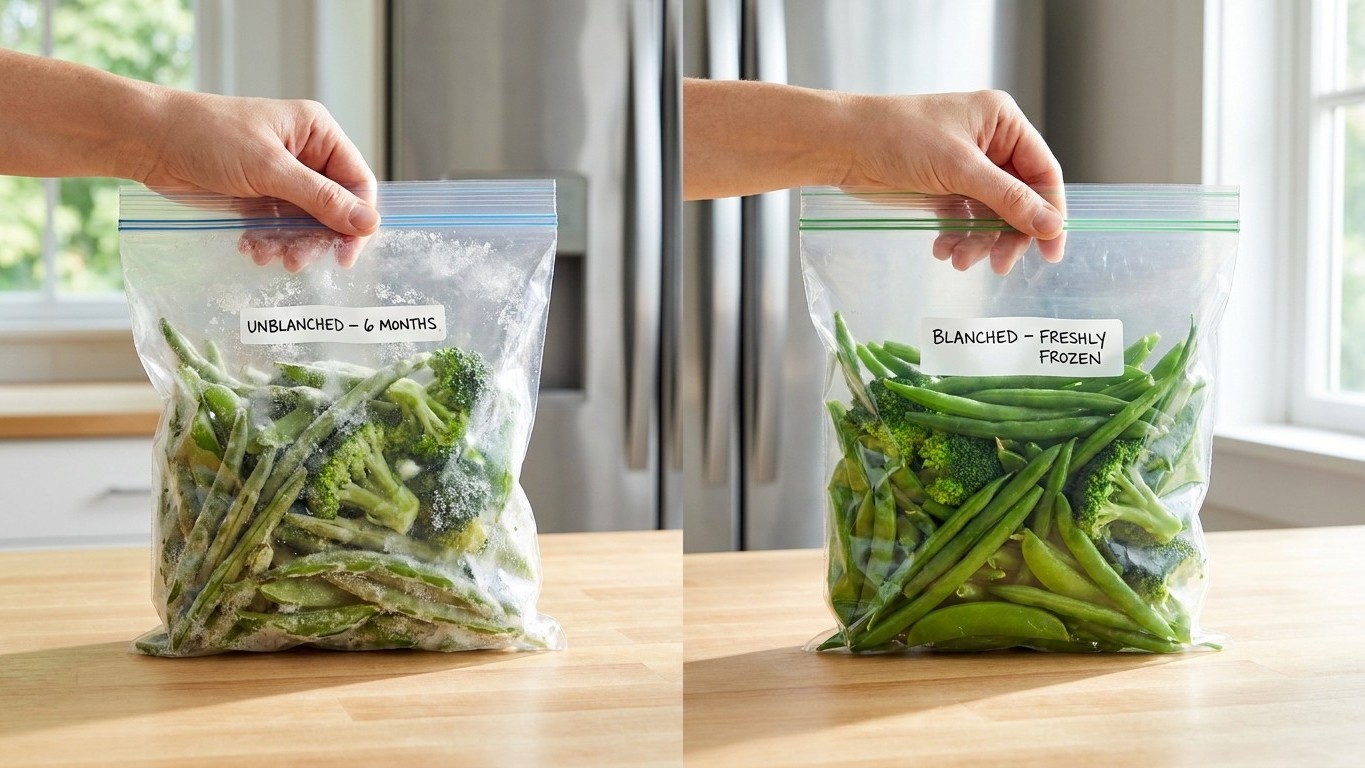

Freezing stops time inside the package. It does not sterilize the food, it does not kill the organisms already present, and it will not correct a food that belongs to a different preservation method entirely. The National Center for Home Food Preservation, the standing authority on these questions, is clear on that distinction. Knowing what freezing actually does, and what it leaves untouched, decides whether the rest of your harvest needs a freezer or a canner.
Freezing

Cold does one job well: it slows biological activity to a crawl. Bacteria stop multiplying, mold stops spreading, and the clock on spoilage nearly stops ticking. That is the entire mechanism. Freezing does not sterilize a food the way heat does in canning. Whatever organisms, spores, or enzymes were present before the food went into the freezer are still there when it comes out, simply dormant or slowed rather than destroyed.
Enzymes are the part people forget. These are the compounds already inside the plant tissue, responsible for ripening, softening, and eventually breaking a vegetable down. Cold slows them, but a home freezer running at typical temperatures does not stop enzyme activity outright. Over weeks and months in the freezer, that low-level activity keeps working on color, flavor, and texture. It’s why a bag of unblanched green beans looks and tastes noticeably worse after a few months than one that was blanched first — a pattern that repeats across many other foods, as explained in What Does Not Freeze Well — and the Reason Behind Each One.
Why blanching exists in the first place
Blanching, a brief plunge into boiling water or steam followed by rapid cooling, exists specifically to interrupt those enzymes before freezing locks the food away. Blanching times are specific to each vegetable. Those times vary by food, by size, and by whether you’re using boiling water or steam, and they come from the National Center for Home Food Preservation’s tested tables, not from a general rule of thumb. A time that’s too short leaves enzyme activity intact; a time that’s too long starts cooking the vegetable before it ever reaches the freezer, and the step right after blanching matters just as much, as covered in Cooling After Blanching.
None of this makes freezing a lesser method. It’s simply a different tool with a different job. Freezing preserves texture and nutrients better than most other methods for many fruits and vegetables, and it asks far less of the cook than pressure canning does. But it operates on the honor system of your freezer’s temperature and your packaging, not on a kill step — a subject covered in depth in Packaging Food for the Freezer, and one that carries through to the other end of the process, as explored in Thawing Frozen Food Without Losing What You Saved, and one that becomes urgent the moment the power fails, as explained in Power Cut: What Can Be Refrozen and What Must Go. That distinction becomes important the moment you decide a food is going into a jar instead of a freezer bag, because jars answer to a different, much stricter set of rules.
Which foods this method suits
The moment you move away from freezing and toward canning, one number governs everything: pH 4.6. It is the dividing line the National Center for Home Food Preservation uses to split every food you might put in a jar into two very different categories, each requiring its own equipment and its own logic.
Foods above pH 4.6 are classified as low-acid. This group needs a pressure canner, a sealed vessel that reaches 240 to 250°F, because boiling water alone (212°F at sea level) never gets hot enough to destroy the heat-resistant spores that survive in low-acid, low-oxygen, sealed environments.
- Red meats
- Seafood
- Poultry
- Milk
- Nearly all fresh vegetables, with the exception of most tomatoes
Foods at or below pH 4.6 are classified as acid. This group can be safely processed in a boiling-water canner, since 212°F at sea level is hot enough to handle the organisms that can survive in an acidic environment.
- Fruits
- Pickles
- Sauerkraut
- Jams, jellies, marmalades and fruit butters
Two foods complicate this tidy split. Some tomato varieties, and figs as well, have been measured with pH values sitting slightly above 4.6, close enough to the low-acid side that they cannot be trusted to fall reliably into the acid group on their own. That’s why tested recipes call for acidifying both before they go into a boiling-water canner, rather than treating them as automatically safe acid foods. The lesson carries over from the freezing conversation: a food’s chemistry, not its taste or its category on a supermarket shelf, decides which preservation path it needs.
What goes wrong
Most preservation failures trace back to a handful of repeatable mistakes. Each one below carries its fix built in.
- Freezer burn from poor packaging. Air left inside the bag or container lets moisture escape and oxidize the food’s surface, leaving grayish, dried-out patches. Press out excess air before sealing and use packaging rated for freezer storage rather than lightweight kitchen wrap.
- Mushy texture from skipped blanching. Vegetables frozen raw keep working on themselves in the freezer because their enzymes were never interrupted. Blanching first, using the food-specific tested time, halts that activity before the freeze locks it in.
- Treating a sealed jar as proof of safety. A jar that seals with a satisfying pop after boiling-water processing means nothing if the food inside was low-acid. The seal reflects pressure and vacuum, not the internal temperature reached during processing, and it has no bearing on whether heat-resistant organisms survived.
- Judging a jar by taste or smell. Clostridium botulinum needs three things together to grow: a moist low-acid food, a temperature between 40 and 120°F, and less than 2 percent oxygen. A sealed jar of unprocessed low-acid vegetables supplies all three, and the toxin it can produce has no taste and no smell. There is no sensory test that catches it.
- Ignoring elevation. Water boils at a lower temperature as elevation rises, which means a boiling-water canner running at altitude reaches less heat than it does at sea level. The fix isn’t guesswork; it’s using the elevation-adjusted process time or pressure specified in tested guidance, since a lower boiling temperature simply kills less unless the time or pressure compensates.
Where the exact times come from
Every one of those numbers depends on the specific food, its density, its jar size, and your elevation, and they’ve been established through lab testing, not tradition. The National Center for Home Food Preservation publishes tested times and pressures for individual foods at nchfp.uga.edu, and that’s the source to check before you process anything.
The reason for that caution isn’t bureaucratic. Botulinum toxin, the danger at the center of low-acid food preservation, has no taste and no smell. A jar that looks, smells, and tastes completely normal can still be unsafe if it was processed with an untested or borrowed time. There’s no shortcut around the tested numbers, because there’s no way to detect the failure afterward.
Common questions
Does freezing kill the bacteria already on the food?
No. Freezing slows or stops the activity of bacteria, mold, and enzymes, but it does not destroy them. Once the food thaws, whatever organisms were present before freezing can become active again.
Can I just freeze low-acid vegetables instead of dealing with pressure canning rules?
Freezing is a legitimate, separate preservation method for low-acid vegetables, and it avoids the pressure canner question entirely because there’s no sealed, oxygen-free jar involved. The pH 4.6 divide only governs which canning method a food requires; it has no bearing on whether that food can be frozen instead.
Why do vegetables usually need blanching before freezing, but many fruits don’t?
Vegetables tend to carry more active enzymes tied to their natural ripening and toughening processes, which keep working slowly even in the freezer and degrade texture and color. Blanching interrupts that activity. This page doesn’t set specific blanching times; those come from the National Center for Home Food Preservation’s tested tables for each food.
Does elevation matter for freezing the way it does for canning?
Elevation affects the temperature at which water boils, which is why it changes canning process times and pressures. Freezing doesn’t rely on boiling water, so elevation isn’t a factor there the way it is in the canning methods discussed above.