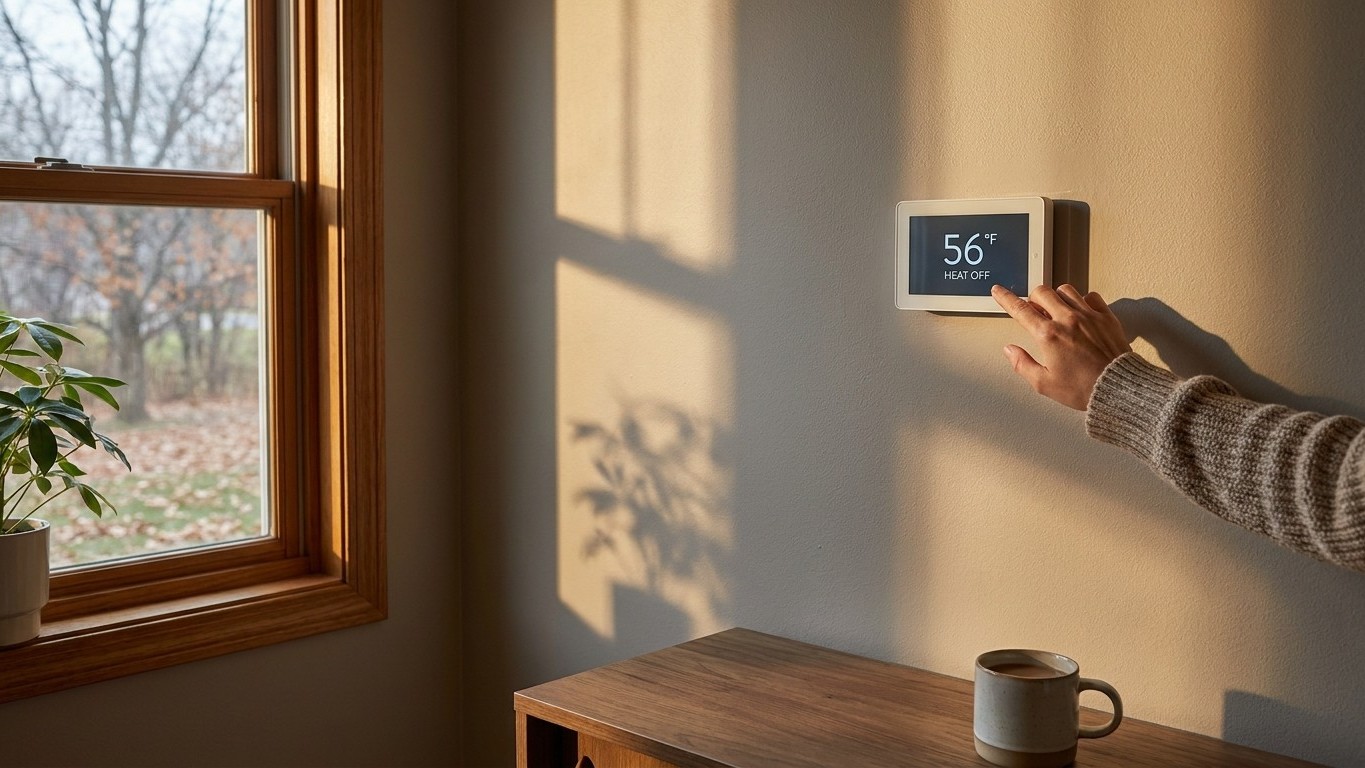

In Connecticut, heating season typically opens in October, when the average temperature normal at the state’s reference station drops below the 65°F threshold used to calculate heating degree days. Demand peaks in January and the season runs about eight months, tapering off by June. The exact week you flip the switch depends on your house, your neighborhood, and how much cold you’re willing to tough out.
When the heating season starts in Connecticut

That 65°F line isn’t arbitrary. It’s the base the National Oceanic and Atmospheric Administration uses nationwide to count heating degree days, a running tally of how far below 65°F the daily mean temperature falls. At Bridgeport Sikorsky Memorial Airport, the station NOAA uses to represent the state’s climate normals, October’s average mean temperature is 56.4°F, low enough to start racking up heating degree days in a meaningful way. That’s the mechanism behind the answer: not a date on a calendar, but a 30-year average crossing a fixed line.
January carries the heaviest load, with 1,042 heating degree days, the coldest month of the normal period on record for this station. The season then eases through spring, and the mean climbs back above 65°F by June, effectively closing the books on furnace demand until fall. That’s roughly eight months of the year, October through May, where the heating system is doing at least some work.
None of this means your thermostat waits for October 1. A normal is an average of three decades of Octobers; some years bring a cold snap in September, others stay mild into November. The number tells you the shape of a typical year, not what any single week will do.
Here’s the month-by-month breakdown, in heating degree days, for the same reference station:
| Month | Heating Degree Days |
|---|---|
| January | 1,042 |
| February | 893 |
| March | 780 |
| April | 452 |
| May | 182 |
| June | 25 |
| August | 1 |
| September | 45 |
| October | 282 |
| November | 570 |
| December | 868 |
July doesn’t appear on this table. The station records no measurable heating degree days for that month, the one stretch of the year when Connecticut’s furnaces and boilers get a genuine break.
How hard the winter works here
Add up all twelve months and Bridgeport’s reference station lands at roughly 5,140 heating degree days a year, against about 955 cooling degree days. That lopsided ratio, five to one in favor of heating, tells you this is a heating-dominated climate, not a place where air conditioning carries the annual energy bill.
Degree days work as a rough stand-in for fuel use. A house that sees twice the degree days of another, all else equal, burns roughly twice the fuel to stay comfortable. That relationship is why the annual number matters for budgeting, even without attaching a dollar figure to it, since prices swing year to year and county to county.
What the annual total can’t tell you is whether a winter is long and gentle or short and severe. Two places can post the same yearly figure while feeling completely different to live through, one stretching mild cold across many months, another cramming it into a brutal stretch. The monthly table above settles that question for Connecticut: the load builds gradually from October, peaks hard in January, and tapers back down through spring, rather than spiking and vanishing.
What most homes in Connecticut actually heat with
Federal survey data on home heating equipment and fuel shows a state where combustion, not electricity, still runs the show:
| System / Fuel | Share of Homes |
|---|---|
| Furnace | 61% |
| Steam or hot-water boiler | 23% |
| Fuel oil or kerosene | 39% |
| Natural gas | 36% |
| Electricity | 19% |
| Propane | 4% |
Central heat pump data wasn’t published for the state, the survey found too few households running one to report a reliable figure. That’s a suppressed estimate, not evidence that nobody in Connecticut uses one.
That 61% furnace share doesn’t mean a furnace is the right call for your house. It mainly reflects what fuel was cheap and what technology was standard when Connecticut’s housing stock went up, especially the oil-fired systems still common in older New England homes. A furnace pushes heated air through ducts, which means it can double as a summer air conditioning delivery system and it responds fast when you crank the thermostat. What it struggles with is even heat distribution in a rambling older layout, and it punishes owners who skip filter changes, since a clogged filter chokes airflow, strains the blower motor, and can shorten the unit’s life. The nearly one in four homes running a boiler face a different rhythm: steam and hot-water systems heat more evenly and quietly, but they’re slower to respond and unforgiving about neglected maintenance like bleeding radiators or checking the pressure relief valve.
Run it once before you need it
Heating systems have a habit of failing on the first genuinely cold night, exactly when every technician within fifty miles is already booked solid. The fix is running the test in October, weeks before you actually need the heat, while there’s still slack in the schedule if something’s wrong.
- Turn the thermostat up a few degrees above the current room temperature and listen for a normal start-up: a click, a whoosh of air or a knock from the pipes, then steady operation. Anything grinding, screeching, or repeatedly cycling on and off deserves attention.
- Expect a faint burnt-dust smell in the first few minutes. That’s ordinary, it’s just summer’s accumulated dust burning off the heat exchanger or baseboard elements, and it should clear on its own within half an hour.
- Replace or clean the filter if you haven’t already. A dirty filter is the single most common cause of an underperforming furnace, and it’s the cheapest fix on this list.
- Walk the house and clear anything blocking vents, radiators, or baseboards, and check that the outdoor unit, if you have a heat pump or a combined system, has clear space around it.
- Press the test button on every carbon monoxide alarm in the house. A furnace or boiler that’s leaking combustion gases is a real hazard, and a working alarm is the cheapest insurance against it. Replace any unit past its stated service life.
- If the system won’t start, trips a breaker, or throws an error code on the thermostat, stop testing and call a licensed technician rather than troubleshooting further yourself.
Even a system that passes every one of these checks can still be losing heat before it reaches a room. The U.S. Department of Energy notes that “in a typical house, about 20%-30% of the air that moves through the duct system is lost due to leaks, holes, and poorly connected ducts.” That’s a national average, not a verdict on your specific ductwork, but it’s worth having a technician check duct connections in the attic or crawlspace if certain rooms never seem to warm up the way others do.
What turning it down is actually worth
The Department of Energy puts a specific number on thermostat setbacks: “You can save as much as 10% a year on heating and cooling by simply turning your thermostat back 7-10°F for 8 hours a day from its normal setting.” That’s a yearly figure tied to that exact setback and that exact daily window, not a per-degree rule you can scale up or down.
In a state where the heating season runs roughly eight months, from October through May, that 8-hour setback has a lot of hours to work with. A programmable or smart thermostat set back overnight, or during the workday when the house sits empty, accumulates savings across a long stretch of the year rather than a brief cold snap. The longer the season, the more days that 7-10°F dip gets to do its job.