
Saskatchewan sits far enough north that day length, not frost dates, decides when onions go in the ground. At Saskatoon’s latitude of 52.17 degrees north, the longest day of the year delivers 16 hours and 31 minutes of daylight. That number is the whole calendar: it tells you which onions can grow here at all, and it forces planting into a narrow window in late winter and early spring rather than the fall planting common further south.
The short answer for Saskatchewan

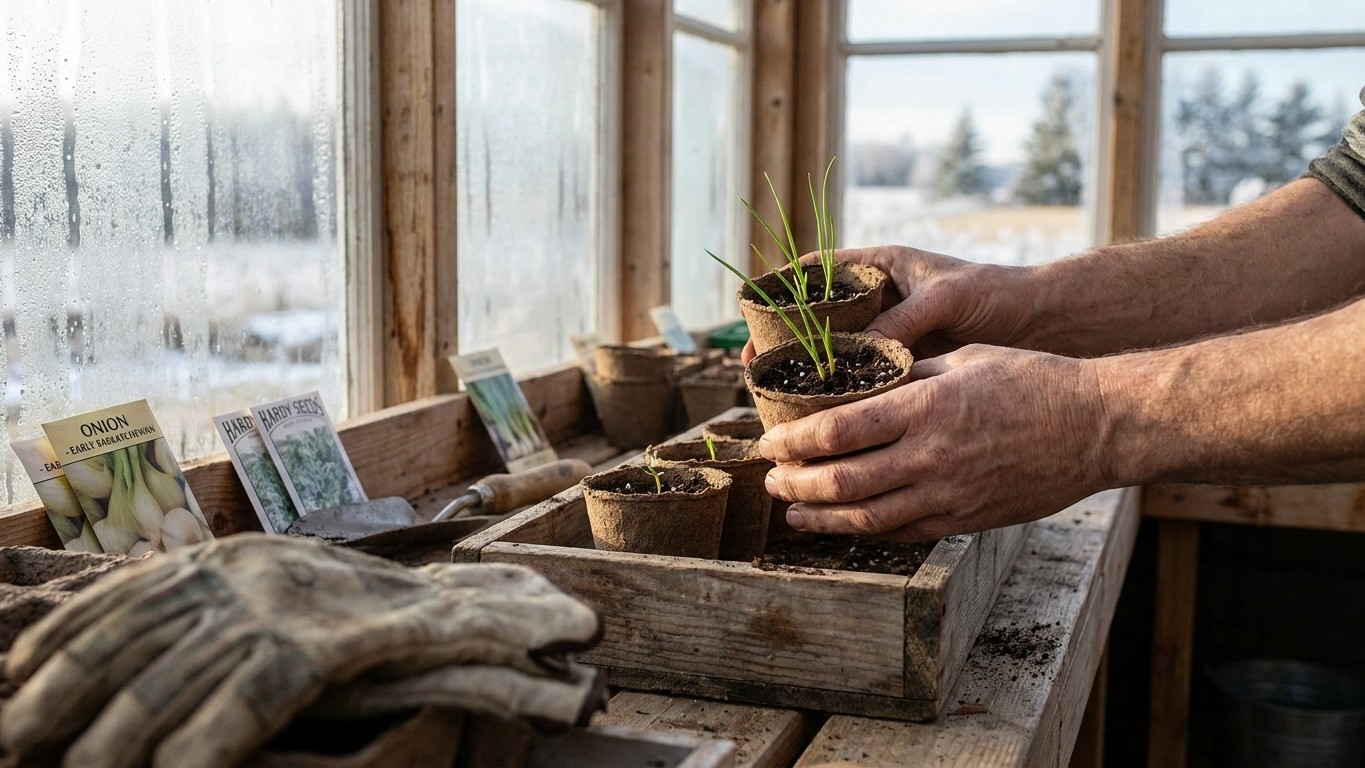
Onions in Saskatchewan get started indoors from seed in late February to early March, then move outside as transplants once the soil can be worked, typically through April and into early May depending on the spring. Sets can go straight into the garden a little later, once the ground has thawed and dried enough to dig. Either way, the goal is the same: build as much leaf growth as possible before the summer solstice arrives and flips the plant from making leaves to making a bulb.
That solstice trigger is the reason the calendar looks so different here compared to warmer states. In Georgia or Texas, growers direct-seed onions in October or November and let them overwinter in the ground, because the short-day and intermediate-day varieties suited to those latitudes bulb early regardless of how big the plant has gotten. Saskatchewan skips that option entirely. Winters here are too hard for a young onion to survive outdoors, and the varieties that suit this far north are long-day types that need every available week of spring growth before the 16-hour-31-minute mark hits.
Only varieties bred for long-day bulbing make sense at Saskatoon’s latitude. Among the ones documented on this site, six have published ranges that cover 52.17 degrees north: Ailsa Craig, Barolo, Blush, Patterson, Redwing, and Walla Walla Sweet. All six are long-day types, and all six are rated to bulb at day lengths in the 14-to-16-hour range, which Saskatoon reaches by early summer. Planting a long-day onion early, and giving it a full spring of leaf growth, is what makes the calendar work here. Planting it late does not.
What will not work here
Late planting does not push the harvest back a few weeks the way it would with tomatoes or beans. It shrinks the harvest. An onion bulbs when day length crosses its genetic trigger point, not when the calendar says it’s ready, and whatever size the plant happens to be on that date is the size the bulb will be. A long-day onion transplanted in June instead of April will still start bulbing right around the solstice, just with far less leaf mass behind it, and the result is a small onion, not a late one.
The bigger mistake, though, isn’t timing. It’s variety. Short-day and intermediate-day onions are built to bulb at 12 to 14 hours of daylight, a threshold Saskatoon crosses well before the solstice, often in April or May. Plant one of those varieties here, on any schedule, and it starts forming a bulb while the plant is still small, then stops growing leaves it needed to size that bulb up. The result is a marble-sized onion, not a stunted one, and no amount of fertilizer or extra water changes that outcome.
Twenty-five varieties documented on this site have published latitude ranges that stop short of 52.17 degrees north, which means none of them are matched to Saskatoon’s day length:
- Bridger (long-day, 35-50N): range tops out two degrees south of Saskatoon, bred for a slightly shorter long-day trigger.
- Cabernet (intermediate-day, 35-45N): bulbs at a much lower day-length threshold, far too early here.
- Calibra (intermediate-day, 35-45N): same intermediate-day trigger, too far south for this latitude.
- Candy (intermediate-day, 33-40N): bulbing threshold reached in Saskatoon well before the plant sizes up.
- Elsye (intermediate-day, 32-45N): intermediate-day trigger, small bulbs guaranteed this far north.
- Expression (intermediate-day, 32-45N): same issue, range ends short of Saskatoon.
- Frontier (long-day, 40-50N): long-day type, but its ceiling still falls south of 52.17N.
- Gabriella (short-day, 20-35N): short-day trigger, bulbs almost as soon as it’s planted.
- Madalyn (short-day, 20-35N): same short-day problem, far too far south a range.
- Monastrell (intermediate-day, 35-46N): intermediate trigger, too early for a Saskatchewan spring.
- New York Early (long-day, 38-50N): long-day, but rated for shorter summer days than Saskatoon gets.
- Powell (long-day, 43-47N): range ends five degrees south of the reference latitude.
- Red Carpet (long-day, 40-45N): same story, ceiling well short of 52.17N.
- Red Long of Florence (intermediate-day, 38-50N): intermediate-day trigger, bulbs early here.
- Red Long of Tropea (intermediate-day, 35-48N): same intermediate-day issue.
- Red Rock (short-day, 30-36N): short-day, wrong trigger for this far north.
- Red Sensation (short-day, 25-35N): short-day range nowhere near Saskatoon’s latitude.
- Rossa di Milano (long-day, 38-50N): long-day but bred for a lower day-length ceiling.
- Safrane (long-day, 42-50N): long-day, still two degrees short of Saskatoon.
- Scout (intermediate-day, 32-46N): intermediate-day trigger, too early a bulb-set here.
- Sierra Blanca (intermediate-day, 32-45N): same intermediate-day mismatch.
- Talon (long-day, 42-50N): long-day, ceiling ends before reaching 52.17N.
- Texas Grano 1015Y (short-day, 25-35N): short-day, bulbs while still a seedling by comparison.
- Vidora (short-day, 25-35N): same short-day trigger, wrong latitude entirely.
- White Castle (short-day, 30-38N): short-day, range far south of Saskatoon.
What changes across Saskatchewan
Saskatchewan is not one point on the map. The province stretches from roughly 49 degrees north at the U.S. border to nearly 60 degrees north near the boundary with the Northwest Territories, a spread of more than a decade of latitude. Saskatoon, where the 52.17-degree figure comes from, sits toward the southern half of that range, so a gardener near the northern edge of the province is dealing with meaningfully longer summer days than the numbers above describe.
| Location | Approximate latitude | What changes |
|---|---|---|
| Southern Saskatchewan (near the U.S. border) | ~49°N | Solstice daylight is somewhat shorter than Saskatoon’s 16h31; long-day onions still bulb reliably, timing is close to the provincial average. |
| Saskatoon (reference city) | 52.17°N | 16h31 on the longest day; the figures used throughout this page. |
| Northern Saskatchewan (toward the NWT border) | ~60°N | Solstice daylight runs noticeably longer than 16h31; frost-free season shrinks even as day length grows, which tightens the transplant window. |
That extra daylight in the north matters for variety choice, too. Of the six long-day onions matched to Saskatoon, only Redwing has a published range that reaches all the way to 65 degrees north, covering the entire province including its far northern reaches. Ailsa Craig, Barolo, Blush, Patterson, and Walla Walla Sweet all cap out at 55 degrees north, which comfortably covers most of the settled, farmed parts of Saskatchewan but leaves a gap for gardens sitting north of that line. A grower that far north is working outside the data these five varieties were rated for, even though they’re solid choices around Saskatoon itself.
Checking this against your own garden
None of the figures above are a substitute for what’s happening in your own yard. They’re a starting point calculated from one weather station in Saskatoon, and a province this large has real variation in both latitude and local microclimate. Before finalizing a planting date, it’s worth confirming a few things specific to where you actually garden:
- Look up your own latitude if you’re farther than an hour or two from Saskatoon; a few degrees north or south shifts your solstice day length noticeably.
- Check your local average last-frost and first-frost dates, since those set the real boundaries of your transplant window regardless of what day length is doing.
- Contact your nearest Saskatchewan Agriculture regional office or provincial extension agent for cultivar trial results specific to your area, especially if you’re gardening well north or south of Saskatoon.
- Watch your onion tops in a normal year: if bulbing starts noticeably earlier or later than expected, that’s a sign your local day length or microclimate differs from the reference figures here.
- Ask neighboring gardeners or a local horticultural society which long-day varieties have actually sized up well in your specific soil and season, since catalogue ranges describe a latitude window, not a guarantee.