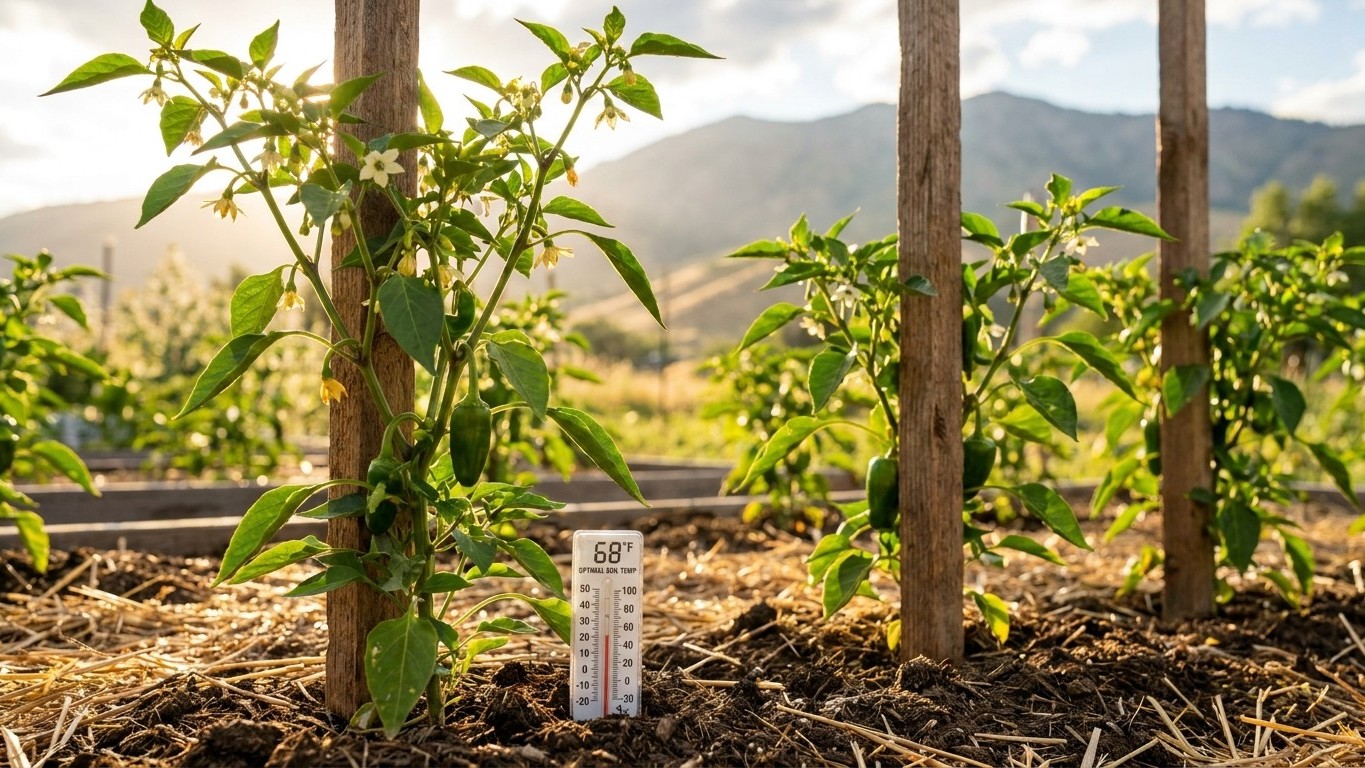

Pepper varieties in Idaho ripen on a narrow calendar: start seed 8 to 10 weeks before you transplant, move plants out only after frost and once soil hits 60 F, and expect 35 to 45 days from flower to fruit if nights stay above 55 F and days stay below 90 F. In Boise’s valley that window opens in late April to early May. Higher ground across Idaho opens later, sometimes much later.
The short answer

Boise averages 47.5 days a year at or above 90 F, based on the 1991-2020 NOAA NCEI Climate Normals for that reference station. That’s not a curiosity number. It’s the figure that decides whether a pepper plant sets fruit at all during the hottest stretch of summer. Pepper flowers stop converting to fruit once daytime highs push past 90 F, and with almost seven full weeks of that heat in a typical Boise year, a plant that blooms only during the peak of summer can stall out entirely, dropping flowers instead of setting pods. That’s the hot end of the failure window, and it’s the one growers usually notice first because it’s visible: flowers form, then fall, then nothing.
The other end of the window matters just as much, and it’s easier to miss because it doesn’t look dramatic. Pepper fruit set also fails when nighttime temperatures drop below 55 F, according to Utah State University Extension. A plant can look healthy, keep flowering, and still fail to set fruit if the overnight low sits under that mark for several nights running. This is where Idaho growers need to be careful about what they actually know versus what they assume. This site carries days above 90 F for Boise because that figure is published in the NOAA Climate Normals. It does not carry summer night minima for Boise or anywhere else in Idaho, and neither should you assume one.
Don’t guess at your overnight lows based on where you sit on the map. Idaho’s elevation swings hard from one valley to the next, and two towns at similar latitude can have very different nighttime temperature patterns depending on elevation, air drainage, and how close they sit to mountains or open desert. A grower in a low valley might run warm nights all summer. A grower thirty miles away at higher elevation might see 55 F nights well into July. Neither the coldest month of the year nor a spot on the map tells you what your July and August nights actually do. Track it yourself with an outdoor min-max thermometer through the growing season, and treat the 55 F floor as a working rule you check against your own readings, not something you calculate from a map.
Put those two thresholds together and Idaho pepper timing becomes a matching exercise: get plants through their flowering window during the stretch when nights sit above 55 F and days sit below 90 F. In most of the state, that stretch is real but not huge, which is exactly why the next section, on when to start seed, matters as much as it does.
When to start seed here
Working backward from frost and soil temperature gives every Idaho gardener a personal seed-starting date, and the math is the same whether you garden in a warm valley or a cold mountain bench. Here’s how to run it.
- Find your last spring frost window. For Boise, the NOAA NCEI 1991-2020 Climate Normals put the 30-70% probability band for a 32 F freeze between April 23 and May 7, based on station USW00024131. That’s a range, not a single date, and it reflects freeze risk easing gradually rather than switching off overnight. Boise sits in a low valley. Most of Idaho sits higher and colder, so if you garden outside the Treasure Valley, your last-frost window almost certainly runs later, sometimes considerably later at elevation.
- Add the soil-temperature check. Frost date alone isn’t enough. Peppers need soil at 60 F before transplant, and cold spring soil can lag well behind the calendar even after the frost risk has passed, especially in shaded beds or heavy clay that holds winter cold. Check soil temperature with a simple probe thermometer at a 4-inch depth rather than trusting the date on its own.
- Pick whichever comes later. Your transplant date is the later of “after your local frost window closes” and “once soil reads 60 F.” In a cool, wet spring those two markers can land weeks apart, and the soil reading should win.
- Count back 8 to 10 weeks for indoor seed starting. Utah State University Extension recommends starting pepper seed indoors 8 to 10 weeks before transplant. If your transplant date lands in early May, that puts seed-starting somewhere in late February to early March. If you garden at higher elevation with a later transplant date, push seed-starting back to match.
- Reserve the 35 to 45 day figure for flowering, not sowing. Once plants are in the ground and flowering, expect 35 to 45 days from flower to ripe fruit. That clock starts at bloom, not at the seed tray and not at transplant, so don’t fold it into your spring planning math. Use it later in the season to estimate when your first peppers will actually be ready to pick.
Run this arithmetic with your own county’s frost data and your own soil readings rather than borrowing Boise’s numbers wholesale. A grower in a mountain valley with a frost-free window that opens in June needs a very different seed-starting date than a Boise gardener working with late April.
What goes wrong here
Idaho’s swing between hot valley days and cool mountain-influenced nights sets up a specific set of pepper problems, and most of them trace straight back to the fruit-set thresholds covered above.
- Blossom drop during a hot spell. When daytime highs push into the 90s during flowering, plants form blossoms and then shed them without setting fruit. With 47.5 days a year at or above 90 F on average in the Boise area, this isn’t a rare event, it’s a predictable stretch of the season. The fix isn’t chemical: give plants afternoon shade during the worst heat waves, keep soil moisture consistent so the plant isn’t fighting heat and drought stress at once, and expect a lull in fruit set during the hottest weeks even on healthy plants.
- Blossom drop during a cool night stretch. The opposite failure shows up when overnight lows fall below 55 F, which can happen in Idaho even in summer at higher elevations or in valleys with strong nighttime cooling. Because summer night minima aren’t published for most Idaho locations here or elsewhere, the only reliable fix is to monitor your own nights with a thermometer and expect a pause in fruit set if a cool snap settles in, rather than assuming disease or poor pollination.
- Sunscald on exposed fruit. Idaho’s high-elevation sun and long clear summer days can scald pepper fruit that loses its leaf cover, especially on plants pruned hard or thinned of foliage. Sun-facing fruit develops pale, papery patches that soften and rot. Keep foliage full rather than pruning it back hard, and avoid removing leaves just to “let the sun in,” since that’s usually the direct cause.
- Blossom-end rot. Irregular watering, common in a climate with hot dry days punctuated by uneven rainfall, disrupts calcium uptake to developing fruit and produces the sunken, leathery brown-black patch at the fruit’s blossom end. Even, consistent soil moisture, delivered through mulch and a regular watering schedule rather than occasional heavy soaks, prevents most cases.
Common questions
Do pepper varieties differ enough to matter for Idaho’s short window?
Utah State University Extension names six pepper varieties suited to home gardens, but its guide does not attach a heat rating, a days-to-maturity figure, or a size specification to any of them. Rather than picking a variety off a number this source doesn’t provide, focus on the transplant math and heat/night thresholds above, which apply regardless of which variety you grow.
What if I garden above Boise’s elevation, where frost lingers later?
Push your whole calendar back. Boise’s April 23 to May 7 frost window applies to a low valley station; most of Idaho sits higher and colder, with shorter, later-starting seasons. Use your own local frost history rather than Boise’s dates, and count backward 8 to 10 weeks from whenever your soil actually reaches 60 F.
Can I speed up fruit set by feeding plants more during a heat wave?
No. Blossom drop from heat above 90 F is a temperature response, not a nutrient deficiency, and extra fertilizer won’t reverse it. Consistent watering and afternoon shade during the worst stretches do more than any feeding schedule.
How do I know if my nights are actually staying above 55 F?
Track it directly with an outdoor min-max thermometer placed in your garden through the growing season. This figure isn’t published for specific Idaho locations, and it can’t be estimated from latitude, elevation guesses, or the coldest month of the year, so a direct reading is the only reliable source.